Sean Spicer (‘89) Shares Thoughts on Life and Leadership

(The essay was first published in the Portsmouth Abbey School Bulletin, Summer, 2014.)

Sean Spicer believes in family, God, trust, hard work, determination, gratitude, service, and seizing opportunities. It is also clear that the Abbey’s hallmark values of reverence, respect, and responsibility infuse the personal and professional life of this Class of ’89 Abbey graduate who has risen to the high ranks of the Republican National Committee.

On April 14 in a Mother Seton Lecture to the Abbey school community, Sean offered his “Rules for Life Beyond Cory’s Lane.” Afterward I had the opportunity to explore his thoughts on leadership and other aspects of his life.

Since February, 2011, Sean has been the Communications Director for the Republican National Committee (RNC), supervising the party’s strategic communications, research, television studio, war room, minority engagement, and media affairs operations. With a staff of thirty, he indicated that the position is clearly his most challenging to date. There was once a “news cycle” which allowed some daily breathing room; however, now the communications environment is much more fast-paced. A person in the political communications business is really on duty “24/7”. Sean stated that nowadays a situation can change dramatically with a few words said in a Tweet. True to his upbeat and positive personality, he followed by saying that he has enjoyed all his jobs to date and implied that they have all given him valuable experience in the complex world of American politics.
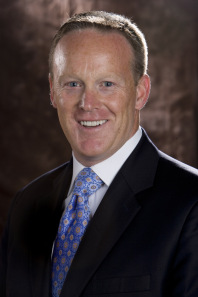
profile-sean_m-_spicer

Sean Spicer

His current position is a culmination of many lesser positions, ones which others may have rejected. During his lecture in which he offered students “Seventeen Rules for Life,” he spoke to this subject with his very first rule. Rule #1: “There are no jobs for ‘anything’.” He related a story about an early interview he had in which he eagerly told the interviewer that he was “prepared to do anything.” The interviewer indicated: “I do not have a job for anything.”  Looking to their future, he encouraged Abbey students to formulate clear ideas on positions they desire before they enter an interview.

Sean began his discussion of leadership with me by referring to his military career. Since 1999, he has been a member of the Navy Reserves, and now holds the rank of commander. He attended the Naval War College in Newport in 2012, and earned a Master of Science degree in National Security and Strategic Studies. Mission accomplishment is a phrase which the military can drum into you; however, I found that Sean never focused on this. He holds as fundamental the principle: If you take care of your people, they will take care of you. He added that leadership always begins at the top, implying that a leader’s behavior affects the entire culture of an organization. Second, Sean also believes that a leader must treat all people—no matter what rank or station in life—with respect. Third, in a situation that demands leadership but where an absence exists, a good leader steps in and takes charge. Such a leader can perceive the void and also can muster the fortitude to take action.

In his current job, he leads and manages the Communications section of the RNC, composed mainly of young college graduates. He describes his leadership challenge as twofold: to keep them energized and focused, and also to strive to find and recruit the highest quality individuals available.

In his lecture to the students, he covered a number of principles which clearly relate to leadership. Rule #4: Take responsibility when you screw up, and you will be rewarded. Many people just make excuses. Rule #7: Have a plan, but be flexible. Here he related a story about taking a position with a candidate running for Congressional office in Pennsylvania. Even though this meant leaving the capital and even though the individual lost the election, Sean gained valuable experience, something which helped him gain future positions. Rule #12: Remember to say thank you, orally and in writing. Rule #16: Follow your mom’s advice: It’s not what you say, but how you say it. The tone and tenor of your words count.

Sean’s religious-spiritual side was also evident in his lecture. Tucked into his essentially secular set of 17 rules was: “Rule #14: Have a relationship with God.” In his case, both he and his wife value their religions and their personal relationships with God.

Both in his formal comments as well as in our discussion, the values which Sean cherishes as foundational and fundamental became evident. Prominent were family, God, trust, and voluntary service, but there were others. Hard work was shown in his Rule #3: Showing up is half the battle. Showing up early and often is the other half.      The value of gratitude was also evident. His Rule #12: Say thank you/write thank you. Responsibility, a hallmark of the Abbey Mission, also ranked high. His Rule #4: Take responsibility when you screw up and you will be rewarded. Determination surfaced in Rule #5: Never give up. The value of friendship shined in Rule #11: Make good friends. Find a mentor. Asked about his mentors, Sean indicated that his father was his key mentor in life, the man who infused him with his “moral compass.” For a career mentor, he mentioned Ed Gillespie, who has served as the party chair and a senior White House counselor, and who is now a candidate for the U.S. Senate.

A native of Barrington, Rhode Island, he developed early an interest in Portsmouth Abbey, and as he investigated it, his interest grew. “There was something about the Abbey that was special, and I wanted to be here.” St. Aelred’s and St. Leonard’s were his homes, and he played soccer, sailed, and wrestled. Not surprisingly, Cliff Hobbins’ Political Science course was one of his favorite classes. He also appreciated Father Damian’s English class, and he admired Father Pashal’s genuine interest and active engagement with students. During his visit to the Abbey, Sean marveled at the physical changes to the campus, especially the more magnificent views of the Bay that have been created.

Sean’s initial interest in politics which germinated at the Abbey was nurtured at Connecticut College where he majored in Government. With degree in hand, he decided to venture to the locus of political power—Washington, D.C. From the start, Sean’s “Seventeen Rules” were surfacing and shaping his life. He realized early the importance of knowing before an interview the types of jobs for which he searched (Rule #1). In his lecture Sean related an experience in which a colleague had recommended a particular internship. After winning the position, Sean realized it was a mistake. The position may have been well suited for his friend, but not for Sean.

In order to gain positions of higher responsibility in the political world, Sean first had to serve in many intern and other low-level positions. In his lecture, he related this in his Rule # 3: Showing up is half the battle. Showing up early and often is the other half. He illustrated this point with a story from his younger days when he filled a position in one of Senator Robert Dole’s campaigns. The position called for a daily, 5:00 am, visit to Union Station, Washington, D.C., to receive the New York papers. He then prepared a summary of important news with clippings.  Showing his lighter and more humble side, Sean twice served as an Easter Bunny during the White House Easter Egg Roll.

In February 2011, Sean was accepted into his current position of the Communications Director of the Republican National Committee. At the time the Republican Party, staggering with a $23 million debt, was badly in need of good leadership and management. He led the party organization out of these doldrums, rejuvenating the Committee both inside and outside the capital. In the 2012 election cycle, Sean oversaw a substantial growth in the Committee’s social media strategy, quintupling the party’s Facebook fans and multiplying its Twitter followers by over 700 percent. Sean has also increased the YouTube videos of the Party and their viewership. Sean’s team was recognized for its outstanding efforts during the 2012 election cycle with 18 Pollie Awards by the American Association of Political Consultants.

I directed our discussion to the highly abrasive partisanship in national politics today.  Sean noted that Congressmen today spend less time in Washington and therefore less time with each other. This clearly helps to explain the harsh tone, adding his hope it would decline. I noted that he, with his Democratic counterpart, had raised over $16,000 for St. Baldrick’s, a foundation dedicated to children’s cancer research, by shaving their heads on ABC’s “This Week”. Sean is clearly able to separate his professional work from his volunteer work and to reach across the political aisle.

I asked him about maintaining his integrity in the rough and tumble world of Washington politics. Sean emphasized that “you can be a strong partisan and still be a good person.” There are always short cuts that a person may take, but with regard to integrity, Sean has not seen an individual take these short cuts, compromise his or her integrity, and win “the marathon.” In his lecture he also spoke to this with two of his rules. Rule #8: Trust your gut. If it does not feel right, use caution, he told the students. Also Rule #13: Your mail can always be addressed to “occupant.” Here Sean stressed the importance of being the person you truly want to be. Do not be arrogant and pretentious in an enviable position you have attained. With these comments he clearly reflected the Benedictine value of humility.

Sean also encouraged Abbey students to seize life and the opportunities beyond Portsmouth Abbey. Get to know the international students and understand their different perspectives (Rule # 10). Life is short. Live it fully so you can look back with no regrets (Rule #17).

Sean currently resides in Alexandria, Virginia, with his wife Rebecca and their two children.
 

Posted in Uncategorized | Tagged , , , , , , , , | 11 Comments

Fall of Atlanta Boosts Lincoln’s Re-Election Hopes

(This essay was originally published as “Tide of war turns at last,” in the Newport Daily News on August 16, 2014.)

After the stunning Northern victories at Gettysburg and Vicksburg in July 1863, Northern hopes were high that the war would soon be concluded. The invincibility of the South’s pre-eminent general, Robert E. Lee, had been shattered and his redoubtable Army of Northern Virginia had sustained heavy casualties. With General Ulysses S. Grant’s seizure of Vicksburg on the Mississippi River, the Confederacy had been torn in two. Historian James McPherson calls these two events the war’s “crucial turning point.”

But in the following year victory proved elusive. The South rebounded and won battles. The North also won some victories; however, none were decisive. And then there were battles with heavy casualties on both sides and no clear victors. In September 1863, Confederate General Braxton Bragg tactically defeated Union forces led by Gen. William S. Rosecrans at Chickamauga, Georgia; however, losses were heavy on both sides, the second highest in the war after the Battle of Gettysburg. In October-November, Gen. Grant had a stunning victory over Gen. Bragg at Chattanooga, Tennessee.  In the spring of 1864, Gen. Grant faced Gen. Lee in numerous, horrific battles, including the Battle of the Wilderness, the Battle of Spotsylvania Court House, and the Battle of Cold Harbor. This was relentless war with heavy casualties on both sides. During the summer, Gen. Grant was unable to make any significant progress in his siege of Petersburg, Virginia.

Southern hopes were raised in July when Confederate Gen. Jubal Early threatened Washington, DC. Rebel forces came within five miles of the White House. President Lincoln visited the front lines, stovepipe hat and all, and could not resist peering over the parapet as bullets whizzed by him. A Captain Oliver Wendell Holmes, Jr., not knowing his identity, shouted: “get down, you damn fool, before you get shot!”

Gloom descended over the North during the summer of 1864, reflected in the popular songs of the day. The more robust, hopeful songs of the earlier years gave way to more melancholy refrains. The most popular was “When This Cruel War is Over.”

Dearest Love, do you remember, when we last did meet,

How you told me that you loved me, kneeling at my feet?

Oh! How proud you stood before me, in your suit of blue,

When you vow’d to me and country, ever to be true.

 CHORUS: Weeping, sad and lonely, hopes and fears how vain!

When this cruel war is over, praying that we meet again.

There were also: “I Would the War Were Over,” “Brother, Will You Come Back?” and “Tell Me, Is My Father Coming Back.”

At this point Southern grand strategy was clear. The South had to stifle Union armies enough so that the Northern will to fight would weaken. This would increase the political power of the Northern “peace Democrats” and increase the chances of Lincoln losing the November election to a man who would be prepared to end the war on terms favorable to the South. For Confederate President Jefferson Davis the essentials were independence for the Confederacy and the retention of slavery.

Northern grand strategy was also clear. Lincoln was adamant that the Union must be maintained. Secondly, despite tremendous political pressure to reverse Emancipation, Lincoln’s commitment to it did not falter. Happily Lincoln had found generals who understood how the war had to be fought: Generals Grant, William T. Sherman, and Philip H. Sheridan. Once Jefferson Davis’ views were clarified, Lincoln said in a message to Congress: “[Davis cannot voluntarily reaccept the Union; we cannot voluntarily yield it. Between him and us the issue is distinct, simple, and inflexible. It is an issue which can only be tried by war and decided by victory.”

In that summer, with decisive victories elusive and with Southern will manifesting remarkable endurance, Lincoln was clear-eyed about his chances at being re-elected in November. He told an Army officer: “I am going to be beaten and, unless some great change takes place, badly beaten.”

A great change did come: the fall of Atlanta on September 2. Next to Richmond, Atlanta was politically the most important city in the South. Gen. Sherman finally succeeded in dislodging Confederate Gen. John B. Hood, who withdrew his forces from the city. Sherman raised the American flag over city hall and sent a wire to Washington: “Atlanta is ours, and fairly won.”

An attentive follower of events, New York lawyer George Templeton Strong was elated. He wrote in his diary: “Glorious news this morning—Atlanta taken at last!!! . . . It is (coming at this political crisis) the greatest event of the war.”

GeorgeTempletonStrong

George Templeton Strong

 Mary Boykin Chesnut

Mary Boykin Chesnut

          In South Carolina Mary Boykin Chesnut was shaken and wrote in her diary: “Since Atlanta I have felt as if all were dead within me, forever.” “We are going to be wiped off the earth.”


Posted in Uncategorized | Tagged , , , , , , , , | Leave a comment

“The Great War” Begins: July 28 is the 100th Anniversary of World War I

(This essay was originally published by the Newport Daily News on July 26, 2014.)

For many Europeans, the early 1900s must have been exciting and hopeful times. The Industrial Revolution, beginning 150 years earlier, had given them a higher standard of living and had transformed their lives to be more comfortable, healthy, and entertaining. The world economy had become truly interconnected, cities were booming, transportation systems were much faster and more efficient, health and sanitation had improved. Historian Arnold Toynbee captured the spirit of the age when he said that his generation expected that “life throughout the World would become more rational, more humane, and more democratic…that the progress of science and technology would make mankind richer…that all this would happen peacefully.”

We should forgive this generation, then, for failing to foresee the coming catastrophe of World War I, fought by all the major and many lesser powers throughout the world, lasting over four years, and resulting in 17 million deaths of military personnel and civilians. (Statistics vary widely.)

By the early 20th century, after four centuries of expansion and development, the most powerful states of Europe and the United States had come to dominate the world. These states included Austria-Hungary, France, Germany, Great Britain, Russia, and to a lesser extent, Belgium, Italy, the Netherlands, Portugal and Spain. These states controlled directly or economically just about the entire continent of Africa and the better part of South and Southeast Asia. Beyond Europe the Ottoman (Turkish) Empire was unraveling, China was in turmoil, and Japan was modernizing and seeking an empire.

In 1914 the United States was on the road to becoming the most powerful country in the world. By 1890 it had surpassed other Western states to become economically the most powerful by most indicators. Fed by a surge of immigrants searching for economic opportunity, education, and a better way of life, American cities in the decades before the War grew at a tremendous rate. The Statue of Liberty, completed in 1886, bore Emma Lazarus’ words relating to this process: “Give me your tired, your poor, your huddled masses yearning to breathe free.”

With the battle for the American West essentially over by 1890, the United States cast its eyes beyond its shores to spread its influence and secure its interests. In 1898 it had won the Spanish-American War and gained the overseas territories of Guam, Puerto Rico, and the Philippines. My grandfather had helped to build the Panama Canal which opened in 1914.

At home Americans had become focused on “Progressive” issues in their search for a better society: poverty, prostitution, women’s rights, temperance, corporate greed, and environmental conservation. In 1912 they elected Woodrow Wilson to the presidency, and he readily used his powers for progressive ends. In 1913 and 1914 the Federal Reserve system was established to regulate the money supply, credit, and the banking system; the Federal Trade Commission was established to regulate commerce; the Clayton Antitrust Act was passed, prohibiting some of the worst corporate practices. What historians call the era of the “modern, activist state” had clearly begun.

Volumes have been written about the causes of World War I, which historian Jackson Spielvogel has called “the defining event of the twentieth-century.” Historians cite the following major factors. The international competition between the major powers had reached a very high pitch. Austria-Hungary competed with Russia and other minor powers for influence and control in the Balkan Peninsula. Great Britain, the dominant naval power for 150 years was now challenged by a united and assertive Germany, determined to play a more prominent role on the world stage.

Second, the small Kingdom of Serbia sought to free all Southern Slavs from Austria-Hungary and form a new pan-Slavic state. This agitation was a nagging thorn in the side of Austria-Hungary.

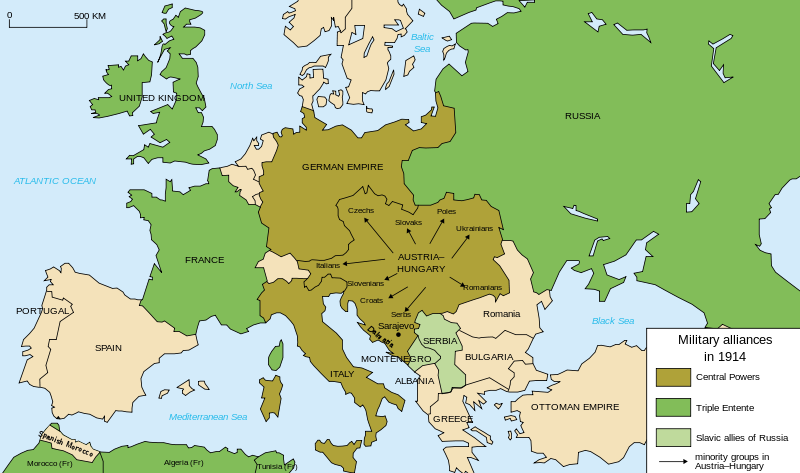
Third, since the end of the Napoleonic Wars in 1815, the European powers had shown a certain flexibility in political-military alliances to match the interests they sought to protect. By 1914 this flexibility had given way to a more rigid bipolar system: the Triple Alliance (Austria-Hungary, Germany, and Italy) versus the Triple Entente (France, Great Britain, and Russia).

Alliances, WWI.jpeg

Military Alliances, 1914

(Wikipedia.com)

          Fourth, while the size of European armies had grown dramatically during the Napoleonic Wars, they now continued to grow not only in size but also in weaponry and technological and logistical sophistication, a consequence of the Industrial Revolution. Also, in preparation for a possible conflict, several states had developed elaborate and fairly rigid war plans. The German “Schlieffen Plan,” for example, assumed a simultaneous war against both France and Russia, not one or the other. The Russian plan assumed a war against both Germany and Austria-Hungary.

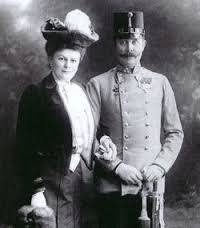
The spark that ignited the war was the assassination on June 28, 1914, of Archduke Franz Ferdinand, the heir to the throne of Austria-Hungary, by Serbian nationalist Gavrilo Princip. On July 28 Austria declared war on Serbia. Within two weeks the major powers of Europe were at war; the U.S. would join the war in 1917.

Ferdinand

Archduke Franz Ferdinand and wife Sophie

(findagrave.com)

          The British statesman Sir Edward Grey reportedly said: “The lamps are going out all over Europe; we shall not see them lit again in our life-time.”

Posted in Uncategorized | Tagged , , , , , , , | 1 Comment

Returning Home to Hasbrouck Heights

(This essay was originally published as a letter to the editor–abridged– by The Record (North Jersey) on July 24, 2014.)

There is something both comforting and disquieting about returning to one’s home town after many years. With voices both pushing me and restraining me, I—with my nine-year-old grandson in tow—returned to Hasbrouck Heights where I grew up in the 50s and 60s and graduated the High School in 1966.

Beginning on the Boulevard, I was very happy to see some of the old anchors of the avenue still remaining: Corpus Christi Church—our family parish, Spindler’s Bakery, Henry’s Deli, and Lovey’s Pizzeria. With many of the older trees gone, the Boulevard overall looked brighter and still exuded a certain community feeling. The trees in the Passaic Street Circle stood very healthy.

I noted a number of new eating establishments such as Sofia’s Mediterranean Grill—with outdoor seating no less. As an Italian-German-American, I was very happy that The Risotto House has replaced Chicken Delight. Gus’s Sweet Shop is now an Italian restaurant.

Other changes were evident. Franklin School, where I attended junior high, has been converted to senior apartments, and the high school now incorporates the middle school.

I was sad to see a Chinese restaurant in place of the Boulevard Pork Store. At twelve I began to work there when Helmut Wildermann owned the store. Once I began studying German with Ms. Rechnic at the High School, I could practice the language with customers and also with the new owners, Hans Gartner and Alois Lipp. Little did I know that 25 years later I would use the language to study the unification of Germany in 1990.

The most striking change I realized was that the town now has people of color. As a teenager I remember playing sports against African-Americans from other towns; however, they were not to be found on our streets and in the high school, something which puzzled me. In the summer of 1963, Martin Luther King led the March on Washington and gave his “I Have a Dream Speech.” In the summer of 1964, we white teenagers danced to black groups like Martha and the Vandellas singing “Dancing in the Street,” and the following summer to the Four Tops singing “I Can’t Help Myself;” however, we did not have black classmates or teammates. In those years I assumed some type of conspiracy kept the town white. This contrasted with what I saw on my visit. I noticed people of color on the streets and behind the counters at the stores. It seems that my home town has indeed entered the 21st century.

Traveling down Franklin Avenue, I visited the athletic field and little league fields which all looked in very good shape with the athletic field now having artificial turf, suggesting the continued value the town still places on its athletic teams. On Route 17, Fat Mike’s, Jiffy Burger, and Dairy Queen are long gone.

Slowly I drove down Columbus Avenue pointing out to Vincent the houses of Mrs. Bear and Ms. Hoag where I tended the lawns and gardens, friend Jimmy McKenna’s house where we played basketball, and friend “Speedy” Wall’s house whose cousin set the garage on fire.

Most of the old trees whose shade I played under were gone; newer, younger trees lined the street. Midway to Terrace Avenue I pulled over, and I asked Vincent to follow me. I had to show him where we spent many summer hours playing stickball in the street, a game played with a broom stick and a pink rubber “Spalding” ball. I pointed out the location of the bases and especially of the home run line. After my friends and I had painted the line and marked it “Home Run,” a very angry woman left her adjacent home armed with a pail and wash broom. As she leered and cast angry words at us, she tried furiously to remove our home run line—in vain.

Stickball Street, Columbus Ave, 7-2014 003

        Adjacent to my former house on the corner of Columbus and Terrace, I identified the Finks’ house. It was on this property brother Denis and I agitated a hornet’s nest. Mr. Fink left his home to investigate and drifted a bit too close to the nest. The hornets attacked and drove a tumbling Mr. Fink back into his home.

I was comforted to see my former home at 75 Terrace Avenue still standing and in good repair, especially since I found my wife’s former home at 318 Henry Street demolished and replaced with two new homes. Although most of the sidewalk was new, I did find a segment made up of the original pieces of the uneven blue slate which made shoveling snow so challenging. Our lamp post, which once had my father’s name and “Massaging” on it, remains with the number “75.” I was also happy to see evidence of a young family living there—a portable basketball net stood in the driveway and a trampoline stood in the side yard where I played endless hours of catch with brother Denis and climbed the cherry tree. Reflecting the heightened concern for children’s security in our society at large, the most striking change was the fence around the property. The neighborhood in my time had very few of these, allowing much free-for-all through back yards and across property lines.

75 Terrace, Grandson Vincent, 7-2014 002

         The highlight of the return was lunch at Lovey’s Pizzeria in the heart of town. As a teenager this was where I would go with Terry Gascoyne and Bobby Wildermann for a slice of pizza or a hero sandwich, perhaps the occasional eggplant parm sandwich. One of these tasty items with a soda and we were sitting on top of the world.

Lovey's Pizzeria, Boulevard

        Choosing lunch was a tough challenge, but in the end I went with the eggplant sandwich with a side of broccoli rabe. We met the current owners Corinne and Duke Seidel who very patiently listened to my stories of the old days. It was Corinne’s father, Jimmy Longo, who always was to be found behind the counter throwing pizza dough.

Vincent and Corinne Seidel

        My return to Hasbrouck Heights proved to be, on balance, very rewarding and comforting. I embraced my home town as a source of constancy in this world of increasing inconstancy.

Follow me on Twitter: @FredZilian

Posted in Uncategorized | Tagged , , , , , , , , | 23 Comments

Burnside: A “Want of Success”

(This essay was originally published by the Newport Daily News on June 18, 2014.)

Ambrose Everett Burnside, Rhode Island’s most famous Civil War general, had a military career with actions sometimes very competent and praiseworthy but at other times incompetent and ineffective. After his military service he gave distinguished service to our state as a political leader.

Born in Indiana to poor Quakers, Burnside attended West Point, graduated with the class of 1847, and was commissioned as an artillery officer. Early in his career he had a short tour at Fort Adams, Newport, and then spent three years in the New Mexico Territory where he was wounded fighting Apaches. He returned to Newport, met and married Mary Bishop of Providence in 1852.

In 1853 he resigned his commission and moved to Bristol where he developed a breech-loading carbine. Failing to secure a government contract, he left Rhode Island and took a position with the Illinois Central Railroad under his classmate and friend George B. McClellan.

At the outbreak of the Civil War in April, 1861, Governor William Sprague invited Burnside to lead its first infantry unit, the 1st RI Volunteers. He ascended to brigade command and led his unit in the First Battle of Bull Run in July. In August he was promoted to brigadier general.

Over the next four years he obtained many commands and saw action in numerous campaigns. In the first half of 1862, Burnside led a combined army-navy force to North Carolina to seize coastal fortifications and to help enforce the blockade of the Confederacy. Within a few weeks Union troops had secured all of Carolina’s ports in the main sound, a success which brought Burnside a promotion to major general.


640px-Burnside_Park_monument, wikipedia

 Burnside Statue, Kennedy Plaza, Providence

(www.wikipdedia.com)

His next major operation came at the Battle of Antietam (MD) in September, 1862. Burnside commanded the 9th Corps in McClellan’s Army of the Potomac. In the battle Burnside showed a lack of imagination in securing a bridgehead across Antietam Creek but finally succeeded by early afternoon. However, later that day fresh Confederate units forced his three divisions to retreat.

After tolerating General McClellan’s timidity in battle for many months, President Lincoln replaced him in November 1862, with Burnside, who had twice earlier refused to accept the position, indicating he felt unqualified for the command.

With high expectations for an offensive from both Lincoln and the public, Burnside decided to engage General Robert E. Lee and his army at Fredericksburg (MD) on December 13, 1862. His plan of attack was questionable and his execution was flawed as his written orders were confusing. A total of 14 Union brigades eventually charged without success the Confederate forces which occupied the Marye Heights. It was at this battle that Lee remarked to General Longstreet: “It is well that war is so terrible—we should grow too fond of it!” One newspaper reporter wrote: “It can hardly be in human nature for men to show more valor, or generals to manifest less judgment.” With almost 13,000 Union casualties, the battle proved to be one of the worst Union defeats. Burnside quickly accepted responsibility and offered his resignation to Lincoln, which he did not accept.

During the following month Burnside made another attempt at a campaign against Lee. However, as soon as the operation began, heavy rains made movement impossible, giving the operation the name of the “Mud March.”  Within two days Burnside called off the operation. Morale plummeted, Burnside’s generals opposed him, desertions and sick call lists increased. When Burnside again offered his resignation, Lincoln accepted it and assigned him as the commander of the Department of the Ohio. In the fall of 1863, Burnside successfully seized and held the city of Knoxville (TN).

His final major operation was in the summer of 1864 in the siege of Petersburg (VA). Burnside once again commanded the 9th Corps. He approved an unusual plan for digging a tunnel under a Confederate fortified position. Union troops of the 48th PA Regiment succeeded in digging a tunnel 511 feet long and loaded it with four tons of gunpowder. The explosion on July 30 blew a hole 170 feet long, 60 feet wide and 30 feet deep. Changes to the battle plan from higher headquarters at the last minute seemed to confuse Burnside, who with his subordinate leaders did not control their troops well. Instead of skirting the crater, they attacked into it, stopping to look at the carnage and spectacle. When the battle ended, the Union had suffered 4,000 casualties with little to show. General Grant stated: “It was the saddest affair I have witnessed in the war.”

In April, 1865, after a court of inquiry found him “answerable for want of success” at Petersburg, Burnside resigned. He worked as a director of railroads, was elected three times as governor of the Rhode Island, and served as a senator from 1875 until his death in Bristol in 1881. He gave his name to the style of whiskers he wore.

ambrose-burnside, history.com

 Ambrose Everett Burnside

(www.history.com)


Posted in Uncategorized | Tagged , , , , , , , , | 4 Comments

From Slavery to Greatness

(This essay was originally published by the Newport Daily News on May 7, 2014.)

Next to Martin Luther King, Frederick Douglass was probably the greatest African-American in US history. Unlike King, Frederick Douglass—born Frederick Bailey in February 1818—was not killed by an assassin’s bullet, but rather lived until January 9, 1895.

Douglass was born a slave. His mother, Harriet Bailey, was black, while his unknown father was white, perhaps Colonel Edward Lloyd, the plantation owner, or one of Lloyd’s sons. He lived on the eastern shore of Maryland and also in Baltimore until the age of 20 when he and his future wife, Anna Murray—a free black—escaped. With a sailor’s garb and false free black seaman’s papers, Douglass and his wife in 1838 made their way through Philadelphia, New York City, and Newport to their final destination of New Bedford, Massachusetts, a town with a total population of 12,354, including 1051 blacks. Having never been to a free state, Douglass was surprised at the “wealth, refinement, enterprise, and high civilization” of the city, believing that “poverty must be the general condition of the people of the free states.” Before he left Baltimore, he had changed his name to Johnson. On the advice of his friends, he now changed his name to Douglass. Working as a free man and earning decent pay, he was “imbued with a spirit of liberty.” Within a few years, Douglass, Anna, and their three children became respectable members of the black community.

During his years in New Bedford, Douglass came to realize his tremendous gift of oratory which he soon employed in the great cause of the day—abolitionism. William Lloyd Garrison led this movement, and soon Douglass was reading his newspaper, The Liberator. Garrison’s words, ideas, and unwavering conviction helped to crystallize Douglass’ calling. This gift of oratory made its debut at the annual meeting of the Massachusetts Anti-Slavery Society on August 16, 1841, on Nantucket. With his personal story of slavery and his powerful voice, he succeeded in transfixing the audience. He had found his calling, and he would be heard.

Over the course of the next two decades, Douglass made over one hundred speeches each year in the antislavery crusade leading up to the Civil War in 1861. This young man, who learned the power of words early as a slave boy studying Webster’s Spelling Bee and then later The Columbian Orator, was not only a great orator but also a great writer. He wrote for Garrison’s newspaper and other publications, including his own antislavery newspaper, The North Star, and eventually the Douglass’ Monthly. During his lifetime he also wrote three books, all autobiographical. With his violin he enjoyed playing Mozart, Haydn, and Haendel.

Douglass_c1860s, wikipedia

Douglass circa 1860s

 (Wikipedia.com)

         During the Civil War, Douglass worked tirelessly for the emancipation of slaves and for equal rights for African-Americans. In 1848 he first met the zealously antislavery John Brown and learned of his bold scheme to foment a slave insurrection and to establish a black state in the Appalachian Mountains. Douglass resisted participating in Brown’s seizure of Harpers Ferry, Virginia, in 1859; however, he had knowledge of it and was pursued by his enemies. Douglass fled to first Canada and then Great Britain, returning the following year after the death of his daughter.

Striving to maintain as many states as possible in the Union, President Abraham Lincoln emphasized until September 1862, that the paramount goal of the war was to restore the Union and not to abolish slavery. Douglass and other abolitionists attempted to change his mind. “Sound policy … demands the instant liberation of every slave in the rebel slaves,” said Douglass. He also argued for the recruitment of blacks into the Union military forces. In January 1862, he said, “We are striking the guilty rebel with our soft, white hand, when we should be striking with the iron hand of the black man.”

After Emancipation on January 1, 1863, Douglass had his first of three meetings with President Lincoln. During the first in August 1863, Lincoln defended his policies toward blacks and hoped that Douglass saw this not as “vacillation” but as slow but steady progress in securing the rights of blacks. Douglass left the meeting jubilant over Lincoln’s gracious and respectful manner toward him.

After the Civil War he championed the vote for blacks—and women, and served as the president of the Freedman’s Bank in Washington, D.C., as the marshal of that city, and as the American minister to Haiti. These years were filled with frustrations, defeats, as well as triumphs; however, Douglass never relinquished his efforts for full racial equality in America, or—like Martin Luther King—for our country to live up to the promises in its founding documents.

Posted in Uncategorized | Tagged , , , , , , | Leave a comment

The Seeds of Inhumanity: Rwanda’s Genocide

(This essay, abridged, was originally published by the Newport Daily News on April 8, 2014, as “After Rwanda, can world say: ‘Never again?.'”)

Twenty years ago this month, the world watched what was probably the fastest genocide in modern history take place in Rwanda, killing some 800,000 Rwandans in just over three months. The United Nations dithered; the United States balked. While the international system has made some progress during these two decades in preventing such horrors, the genies of genocide still persist.

Within the space of 100 days, April-July, 1994, extremist Hutu Rwandans massacred mostly Tutsi Rwandans and the more moderate Hutu Rwandans. The figure totaled almost 10% of the population of this small, central east African country. A comparable massacre in the U.S. would equate to killing over 30 million. Kingsley Chiedu Moghalu, Special Counsel and Spokesman of the International Criminal Court for Rwanda, has asserted that this genocide was three times faster than the Holocaust: 333 murders per hour; five and one-half lives per minute. While guns and hand grenades were employed, mostly used were thousands upon thousands of machetes, along with hoes and clubs studded with nails. A witness indicated: “there are no more devils left in hell; they are all in Rwanda.”

Numerous factors, underlying and immediate, have been cited to explain this mammoth massacre. Underlying factors included: European colonial rule by the Germans and then Belgians who favored the generally lighter-skinned Tutsis; the historical domination of the Tutsis, about 14% of the population, over the Hutus, about 85% of the population; repeated, mutual killings over the three decades between Rwanda’s independence in 1962 and the genocide; the Hutu formation of the Rwandan Patriotic Front and its Army’s subsequent invasions into Rwanda from neighboring countries; world economic conditions along with drought which caused an economic crisis in Rwanda; the presence of many desperate young Rwandan male refugees which fed the formation of armed militias; competition among rival Hutu political groups; population pressure on limited arable land; and finally venomous racism. The spark that set Rwanda ablaze was the downing on April 6, 1994, of the plane carrying Juvénal Habyarimana, the Hutu president, an event Hutu extremists blamed on the Tutsis.

By illuminating demographic and environmental factors, Jared Diamond, in his book, Collapse, enriches our understanding. With a population growth averaging 3% over many decades, Rwanda, by 1990, had a high average population density of 760 people per square mile. He clarifies the genocide was not simply a matter of an angry, ethnic majority—economically and politically disadvantaged for centuries—finally seizing power and settling scores gruesomely. Not only were Hutus massacred, so were the Twas (pigmies). Also, three rival, mainly-Hutu factions were vying for power. In Northwest Rwanda, most people were Hutu, but there were mass killings there almost on the scale as in other parts. Lastly, as Hutus killed Tutsis, Hutus also started to kill other Hutus. He concludes that population pressures on limited arable land was also a key underlying factor. It was not uncommon to hear Rwandans say that violence is sometimes necessary to bring population in line with available land resources.

The small land-locked country of Rwanda, in an economically anemic continent, did not have the strategic pull to provoke the United Nations, a major power, of any “coalition of the willing” to intervene to stop the fast-paced slaughter. The UN Security Council president’s statement of April 30 avoided the use of the term “genocide,” deleted from an earlier draft by pressure from the US supported by China and Great Britain. The UN Assistance Mission for Rwanda (UNAMIR), the peacekeeping operation there since 1993, was feckless. The United States, still smarting from the loss of 18 Americans in the debacle in Somalia in 1993, could not muster the will to intervene, either alone or with its French or Belgian friends. The US also rejected proposals from the UN to jam the Hutu-dominated radio hate campaign, one which clearly fanned the massacre’s flames. The Department of Defense argued that it would cost $8500 an hour to fly the necessary aircraft over the country and also raised the issue of Rwanda’s sovereignty.

Happily, the world did intervene afterward judicially. On November 8, 1994, the UN created the International Criminal Tribunal for Rwanda, “established for the prosecution of persons responsible for genocide and other serious violations of international humanitarian law…” in that country, since then completing 75 cases. This progress in international law notwithstanding, it would be a mistake to believe our inhumanity toward each other has been vanquished. Was this not believed after the Holocaust, Bangladesh, Cambodia, and the former Yugoslavia? And recently, we have Darfur, Sudan. The genies of genocide still abide: fear, revenge, prejudice, power, desperation, resource limitations, and devotion to the commands of a diety, a state, an identity group, or a demagogue.

Posted in Uncategorized | Tagged , , , , , , , , , , , , , | 5 Comments

Julia Ward Howe, Author of Battle Hymn, Spent Much of Her Life in Portsmouth

(This essay was originally published as “Beyond the ‘Battle Hymn,'” in the Newport Daily News on March 22, 2014.)

Julia Ward Howe, a talented, independent-minded woman of the 19th century—poet, writer, playwright, preacher, lecturer, and reform leader—spent much of her life at her “Oak Glen” country home in Portsmouth, Rhode Island.

She is best remembered for writing “The Battle Hymn of the Republic” in 1861. She traveled to Washington, DC, met President Abraham Lincoln, and visited military camps in the area. During these visits she heard the tune popular at the time, “John Brown’s Body,” celebrating his martyrdom for the anti-slavery cause. As she lay in her hotel bed early one morning, the words came to her.  She explained: “I awoke in the gray of the morning twilight; and as I lay waiting for the dawn, the long lines of the desired poem began to twine themselves in my mind. Having thought out all the stanzas, I said to myself, ‘I must get up and write these verses down, lest I fall asleep again and forget them.'”

        The poem was first published in the Atlantic Monthly magazine in February, 1862, and was quickly put to the tune of “John Brown’s Body,” becoming an unofficial anthem of the Union. For it, she received a mere $5.00 from the magazine editor.

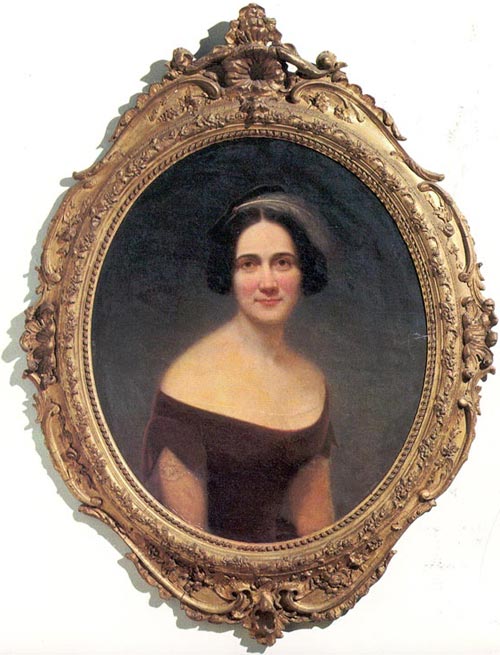
julia-ward-howe, poetryfoundn.org Julia Ward Howe circa 1865

(poetryfoundation.org)

        Howe’s other notable achievements are often forgotten. She was clearly a woman ahead of her time on many fronts. Even as a young woman, she clashed with her father and eventually her husband, Dr. Samuel Gridley Howe, twenty years her senior, both of whom wished her to be the more conventional, deferential, domestically-oriented type of woman. A gifted writer, she achieved great literary success. By the age of 17, she was contributing to literary magazines. In 1852, she published Passion Flowers, dealing with Italian and Hungarian patriots, and in 1853, Words for the Hour. She soon became a regular contributor to the new periodical, The Atlantic Monthly. When she and her husband joined the anti-slavery crusade, she became an editor and writer for her husband’s journal, The Commonwealth. She also co-edited and wrote for The Woman’s Journal. She had many other published works, including: Sex and Education, Modern Society, Is Polite Society Polite?, Reminiscences, and two tragic plays Lenore and Hippolytus.   Fluent in seven languages, she was the first woman elected to the Society of Arts and Letters.

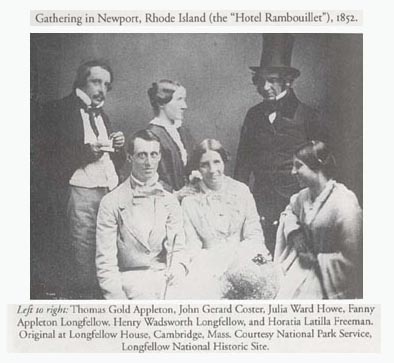
Howe and Friends, juliawardhowe.org (juliawardhowe.org)

        While contributing to such causes as the abolition of slavery, education reform, and prison reform, her greatest energy was devoted to women’s suffrage. She wrote and lectured widely on it for most of her life both in the US and in England and eventually served as the president of the New England Woman’s Suffrage Association.

Howe was deeply distressed by the physical, social, and psychological devastation she had witnessed during the Civil War. With the wars of German Unification erupting in Europe, she called on women everywhere to oppose war in all its manifestations. Howe hoped to join women across nationalities in the cause of universal peace, issuing a “Mother’s Day Proclamation” in 1870.

Arise then …women of this day!

Arise, all women who have hearts!

Our husbands will not come to us, reeking with carnage

Our sons shall not be taken from us …

Her efforts helped to lay the foundation for the establishment of Mother’s Day as a national holiday in 1914.

This distinguished, national celebrity spent much of her life at her beloved country home, “Oak Glen,” now 745 Union Street, in Portsmouth, Rhode Island. The Howes bought the 4.7 acres, overlooking Lawton Valley, in 1852. She and her husband had homes in both Boston and Newport; however, they decided to establish this home “out in the country.” Other wealthy individuals like Cornelius Vanderbilt and H.A.C. Taylor, also had farms in Middletown or Portsmouth to grow crops and flowers and to maintain prize horses and livestock.

oakglen, juliawardhowe.org

Oak Glen in later 19th century

(juliawardhowe.org)

        At Oak Glen the Howes were primarily focused on their six children, outdoor activities, the reception of literary and artistic friends, and certainly their own work and interests. They lived there several months each year, sometimes as long as eight months. Their guests included famous people from the US as well as Europe, including Henry Wadsworth Longfellow, George W. Curtis, Thomas Higginson, and Oscar Wilde, who were treated to picnics, sailing parties, and theatricals. Oak Glen must have come to be one of the centers of New England’s reform and intellectual movements of the later 19th century, with Julia continuing this after the death of her husband in 1876.

frontpiece, juliawardhowe.org

(juliawardhowe.org)

        It was at Oak Glen in 1910 that Howe died. In summing up her life she stated: “I have written one poem which … is now sung South and North by the champions of free government. I have been accounted worthy to listen and to speak at the Boston Radical Club and at the Concord School of Philosophy. Lastly and chiefly I have had the honor of pleading for the slave when he was a slave, of helping to initiate the women’s movement … and of standing with illustrious champions of justice and freedom for woman’s suffrage when to do so was a thankless office involving public ridicule and private avoidance.” Some have referred to her as “The Queen of America.”

Posted in Uncategorized | Tagged , , , , , , , , , , | 3 Comments

Rhode Island’s Industrial Might Boosted the Union’s War Effort

(This essay was originally published by the Newport Daily News on February 19, 2014.)

Many historians consider the Civil War the first “modern war,” by which they are referring to two things. It was the first war to mobilize the entire resources of a country. Second, it was the first war in which such a tremendous scale of resources and weapons were employed, a result of the Industrial Revolution.

        This Revolution began in the mid-18th century in Great Britain, spread to the European continent, and leaped to America when Samuel Slater, an Englishman, built the first successful “factory” in the United States in 1793, a cotton spinning facility which happened to be in Pawtucket. The Revolution eventually enabled the mass production of textiles, tools, nails, screws, sewing machines, and steam engines, improving the quality of life for millions. Nefariously, it also allowed the mass production of instruments of war.

Rhode Island’s economic contribution to the Union war effort is nicely covered in Maury Klein’s chapter, “Rhode Island’s Civil War Economy,” in the book, The Rhode Island Home Front in the Civil War Era, recently published by the state’s Civil War Sesquicentennial Commission.

The war’s increased demand for uniforms and blankets boosted the already substantial textile manufacturing industry in our state. As the war began, Rhode Island had 176 cotton mills and 57 woolen mills. To meet the demand, this sector expanded greatly. For example, the Atlantic Delaine Mills grew in size and the Wanskuck Mill was founded, both north of Providence.

The cotton textile industry was dominated by such groups as Brown and Ives and also the Sprague family. As the war opened, 26-year-old William Sprague, brother Amasa, and cousin Byron headed the Sprague businesses.

William Sprague

William Sprague

(Wikipedia.com)

        The astute and capable William took charge of the newly-formed A. & W. Sprague Company. Headquartered in Cranston, it operated nine mills with some 300,000 spindles. (Young William successfully ran for governor in 1860, the same year Lincoln was elected and the southern states began seceding from the Union.

Overall, the value of the state’s cotton goods rose from $20 million in 1860 to $55 million in 1865; woolen goods from $4 million to $11 million.

Beyond textiles, Rhode Island factories contributed greatly to the Union war effort in a wide variety of metal-related industries.

In 1856 the Corliss Steam Engine Company opened a foundry in the Providence area which produced engines, boilers, shafting, gears, and heavy castings. By 1861 its steam engines were reputed as the best in the country. The company eventually produced the large metal ring that allowed the turret of the ironclad ship Monitor to turn. The company’s advanced steam engine with its patented automatic cut-off valve was the mainstay in the industry for decades after the war.

George Corliss

George Corliss

(findagrave.com)

        In addition to steam engines, the state’s factories produced hinges, nuts, bolts, screws, nails, agricultural tools, sewing machines, valves, winches, rivets, stoves, safes, files, cutlery, and springs.

        The Brown and Sharpe Company in Providence manufactured a precision gear-cutting machine, dividing machine, automatic screw machine, and gyroscopic top, along with other innovations. In 1858 it had invented the new Gibbs sewing machine; by 1863 it had produced 20,000 of them.

The great leap in production quantities was made possible by the development of a system of interchangeable parts on a large scale. “Each part is so made that it can be supplied to any machine and is thoroughly gauged, tested and inspected before it reaches the assembly room to be finally put in its place,” reported the Providence Journal in December 1863.

Perhaps the most significant of Brown’s inventions was the universal milling machine which allowed the machining of rifle barrels. This invention eventually enabled the Providence Tool Company to produce over 70,000 rifles. It also manufactured 10,400 cavalry sabers, and its sewing machines were used to mass produce clothing for soldiers.

Also adding to the war effort was the Builders Iron Foundry in Providence which produced 11-inch smoothbore Dahlgren guns and shells and 13-inch cannons.

The Bristol Firearms Company was founded by Ambrose E. Burnside who rose to become a general and command the Army of the Potomac. This company evolved into the Burnside Rifle Company which eventually produced 100,000 carbines, a weapon that Burnside had patented.

Other notable companies that contributed to the war effort included the Providence Steam Engine Company, the Hope Iron Foundry, the Mansfield and Lamb Company (bayonets), Congdon & Carpenter (horseshoes), the American Ship Windlass Company, Jeremiah Heath and Bowen & Clark (military clothing), L. Chapman (cavalry boots), and M. H. Sullivan of Providence (military saddles).

Klein concludes, “Rhode Island’s contribution was wholly out of proportion to its size and did much in those critical areas not only to define the new face of warfare but also to achieve victory for the Union.”

Posted in Uncategorized | Tagged , , , , , , , , , , , | 1 Comment

What the Robins Tell Me: Climate Change Is Our Problem

(This essay was published originally by the Newport Daily News on February 12, 2014.)  

Even before Rachel Carson’s book Silent Spring in 1962, I was environment-curious. Sixty years ago in northeast New Jersey, I watched the trash men haul away our garbage and wondered where it went. As I lay awake on those warm summer nights, I wondered where the acrid stench originated, drawn into our home by our attic fan. A few years later I stood, eyes skyward, and watched jet upon jet at a quickening pace on their short final approaches to an expanding Newark Airport. As I watched the jet fumes disperse, I wondered about the air I breathed.

            Perhaps twenty years ago, the first time I taught the Industrial Revolution in a European History course, I became environment-concerned. The text books always contained at least one picture of the smokestacks of some British city belching the horrid black fumes from its factories. How could the atmosphere absorb so much pollution these 250 years and not strike back?

            And now there are the robins. As a boy, I remember the robins vanishing silently as the dipping temperatures turned summer greens to autumn golds. It was indeed a true harbinger of spring when the first robins arrived in late February. This year on Aquidneck Island I observed the robins in late December; did they ever actually leave?

            The international community and the United States have made some progress the last few decades addressing climate change. In 1992 the first international treaty on climate change was signed. The Framework Convention on Climate Change sought the “stabilization of greenhouse gas concentrations in the atmosphere at a level that would prevent dangerous anthropogenic [human-induced] interference with the climate system….” This was followed by the Kyoto Protocol in 1997 which gave specific emissions targets for each industrialized country over a five-year period, a protocol ultimately the U.S. did not ratify. In 2009, agreement was nearly reached for a more meaningful “Copenhagen Accord;” however, several nations raised insurmountable objections and success proved elusive. In the U.S., the Obama Administration has succeeded in mandating that the average fuel economy for cars and light trucks must be 35.5 miles per gallon by 2016. In the president’s recent state of the union address, he took a strong stance in asserting: “But the debate is settled. Climate change is a fact.” However, he stopped short of advocating a tax on carbon emissions.

            Nonetheless, over the past ten years, with so many strange weather events here and around the globe, with so many scientific indicators of unprecedented climate change, and with so much of the scientific community waving red flags, I have become environment-troubled. These small steps may be too little, too late. The carbon will kill us. The World Meteorological Organization reported in November that the carbon dioxide level had reached 393 parts per million (ppm) in 2012. More recent measurements have placed it at more than 400 ppm, the highest level some say in hundreds of thousands of years, if not millions. Before the Industrial Revolution in the mid-18th century, the level was 280 ppm.

            There is little genuine disagreement among scientists on the role of humans in this. The Intergovernmental Panel on Climate Change, composed of hundreds of scientists from many countries, concluded in its 2007 report: “Most of the observed increase in global average temperatures since the mid-twentieth century is very likely due to the observed increase in anthropogenic [human-induced] greenhouse gas concentrations.” Carbon dioxide is the most significant of these gases.

            This clearly is not a challenge that our grandchildren will face; rather, it is a challenge which confronts us today.  In its world energy outlook in late 2011, the International Energy Agency said the world has about five years to make dramatic changes to avoid severe impacts from climate change. Other agencies and scientists have made similar exhortations for meaningful steps now.

            Clearly needed is a change in attitudes the world over; however, let’s start with our own.  After all, while China has surpassed us as the world’s largest polluter, we Americans are the greatest polluters per capita. Since the Scientific and Industrial Revolutions, we have tried first to understand how Nature works and then control Nature to serve “progress.” We must move from an attitude of control over to harmony with Nature.

            With a certain irony then, we may have to borrow from the culture of our Native Americans. Susan Jeffers, in her book, Brother Eagle, Sister Sky, tries with words and beautiful artwork, to have us experience the meeting in the 1850s between Chief Seattle, and Isaac Stevens, the Commissioner of Indian Affairs for the Washington Territory. “When the last Red Man and Woman have vanished with their wilderness, and their memory is only the shadow of a cloud moving across the prairie, will the shores and forest still be here? Will there be any of the spirit of my people left? My ancestors said to me, ‘This we know: The earth does not belong to us. We belong to the earth.’”

            Without such a change in attitude, I fear that we may need an “environmental 9/11” to shake us from our complacency.


Posted in Uncategorized | Tagged , , , , , , , , , , , | 5 Comments