With the ending of the French and Indian War in 1763, Great Britain felt fully justified in taxing the American colonies to relieve its debt from the war and in restricting settler movement westward to avoid friction with Native Americans. The war nearly doubled the national debt from a prewar £74 million to a postwar £133 million ($43.6 trillion today).
American colonists resisted, holding that only their colonial assemblies could tax them and that no restrictions should be placed upon their migrations westward. To restrict them was to deny them their inherent rights as loyal British subjects who had done their fair share in the war.
In December 1773, in response to the British tax on tea, scores of colonists in Boston, thinly disguised as Native Americans, forcibly boarded three British East India Company ships and dumped in protest 342 chests of tea into the harbor, some 92,000 pounds. After this, Boston and the colony of Massachusetts became the spearhead of American resistance. Parliament closed the port of Boston, with disastrous effects on the colony’s economy and society. Rather than cave in, colonial leaders like John Hancock and Samuel Adams, organized and resisted, receiving surprising support from the other colonies.
Relations between the Crown and the American colonies continued to deteriorate throughout 1774 and into 1775. In the fall 1774, the First Continental Congress rejected just about every piece of legislation Parliament had passed since 1763. In his speech opening the new Parliament in November 1774, King George III remained steadfast, stating: “You may depend upon my firm and steadfast resolution to withstand every attempt to weaken or impair the supreme authority of this legislature over all the dominions of my crown.”
Undermanned but pressured to take action, General Thomas Gage, commander of the British North American forces, fortified Boston and began to seize munitions in the area. He decided to arrest the two key leaders, Hancock and Adams, in Lexington and to seize munitions in Concord.
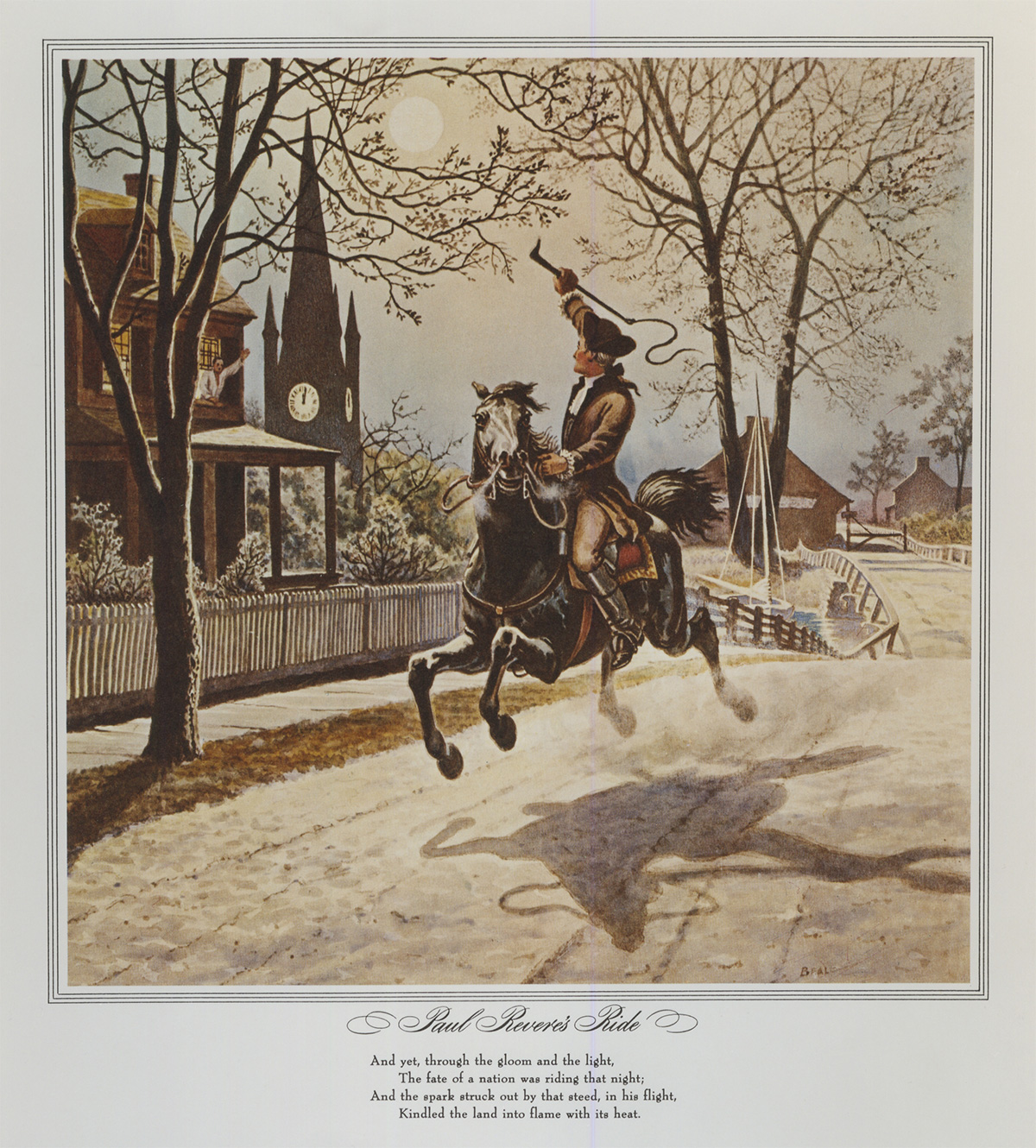
On the night of April 18-19, 1775, resistance leader Dr. Joseph Warren gave instructions to Paul Revere to ride from across the Charles River to those two towns to spread the warning. His friends sent the signal to Charles Town, two lamps in the steeple of Old North Church, and other friends rowed him across the river to begin his fateful journey.
In his poem written 85 years after the event, Longfellow gave several historical inaccuracies. The poem implies that Revere was the only rider. This is not true; there were three initial riders, Revere, William Dawes, and Samuel Prescott, and many others who followed and eventually helped sound the alarm. Second, the poem states that Revere was on the opposite shore waiting for the lantern signal. Revere was still in Boston when the signal was given to alert friends in Charles Town of the British route and of Revere’s imminent arrival. Third, three friends helped to give the signal, not just the one who climbed into the steeple that night, Robert Newman, John Pulling, and Thomas Barnard. Fourth, Revere never reached Concord as the poem states. It was Dr. Samuel Prescott who reached it and spread the alarm there. Finally, Revere’s ride was not smooth and easy. Revere was seized by a British patrol and had some close moments before being released.
In writing the poem in 1860, Longfellow was influenced by the turmoil and division of America at the time. North-South sectional strife by then had reached a fever pitch and in December of that year after the election of Abraham Lincoln, South Carolina became the first state to secede from the Union. Clearly, Longfellow was seeking to offer a unifying story and hero to a country divided.
It is an honor and privilege to address the Abbey Community this morning in this Kearney Lecture. This is a community that my wife and I were members of for over 20 years and to which in our hearts we still belong.
Dedication: I would like to dedicate this talk to Father Paschal. He and I would often ride the recumbent bikes next to each other. Did you see him in there? He had the books going, and he’d be balancing his laptop. Athletic and intellectual at the same time! Quite a sight.
Rather than give you a history lecture, the school has asked me to talk about some of the experiences I have had in my 76 years and perhaps offer you some words of wisdom that might help you in your journey.
Hence, my subject for today: “Challenges & Choices.”
1. Challenge #1:The opportunity challenge. Are you taking full advantage of your academic, athletic, extracurricular, and spiritual opportunities here? Do you give your best or just the minimal?
One thing that immediately struck me when I began to work here 33 years ago: even the wise guys—the hoodlums—took academics seriously.
Speaking of hoodlums, would Andrew Thibeault please stand? Do students here who may not necessarily follow all the rules, still work hard academically? The student culture on academics: Students may smoke in the woods tonight but they will study like hell for tomorrow’s Latin test? Is it still “cool to concentrate”?
When I was a sophomore in high school, I enjoyed learning. I had done well freshman year, and so I decided to double-up on languages. Instead of taking just Latin II, I started studying German. My last name is German, my father’s father was born in Germany, and teachers told me that, given my interest in science, German was a better choice compared to French or Spanish.
I fell in love with German. I always did my German homework first. I took German II the following year. When I entered West Point, I was placed in the top section of Advanced German. I wound up studying it for my Political Science degrees in graduate school.
Fast forward, fifteen years later I found myself, in my last assignment in the Army, embedded in the German Army and also looking for a subject for my dissertation.
Quiz time: We arrived in West Germany in the summer 1989? What happened a few months later in November 1989? Yes, the Berlin Wall fell, followed by the unification of East and West Germany. I had my dissertation subject: How the West Germany Army took over the East German Army after Unification 1990. Students, 90% of my research was done in the German language.
This was all made possible because I was ready to work in high school, and to do a little bit more.
Choice #1: To do the minimal and get by, focusing more on the fun & games, or to work as hard as you possibly can—even in the subjects you do not like—and get the most out of this experience?
2. Challenge #2: The kindness challenge. I asked if it was still cool to concentrate here: Is it still “cool to be kind” here?
I had been here 7-8 years when we had a crisis in the leadership of the school. The details are not important. What counts was that I wrestled with leaving the Abbey. This was not an easy choice for me. Matters of high principle were involved. But on the other hand, I had grown to love working here: my colleagues on the faculty, the pace of the Abbey week, of the Abbey academic year. My wife had just been designated Director of Admissions. So, she’s going to stay and I am going to leave? How is that going to work?
A year or two before this, a new student arrived in my classroom a few weeks after the semester had begun. I believe it was Third Form Ancient Medieval History. So after the first week, in front of the class, I asked her about her first impressions of the school. Jennifer thought a moment and said: “Well, you hold doors for each other.”
One very important reason I stayed was the student culture: your desire to learn, but also your kindness to each other. Is it still cool to be kind here? Are you still kind and respectful to each other? Do you still “hold doors for each other”?
Choice #2: To be kind and respectful of each other, to behave in what I always liked to call, “the Abbey Way” or to be self-centered, selfish, and unkind?
3. Challenge # 3: The reading challenge.To read like hell!
Students, if I had to do it all over again, I would start my reading journey much earlier. When I was your age, I was a pretty good student; I finished pretty high in my high school class in Hasbrouck Heights, NJ. But I can’t say I developed early the habit of reading even though early on I developed a love for words. I read to complete my assignments. After that, I was playing sports, working at our town’s German Deli, and doing what else—chasing girls!
It probably changed when I was in my 20s and read Carl Sagan’s The Dragon’s of Eden: Speculations on the Evolution of Human Intelligence. He was an astrophysicist at Cornell University who received the Pulitzer Prize for this book in 1978. Do you know Neil deGrasse Tyson? May I ask Enyu Zhang to stand? You know of Tyson? Sagan was the Tyson of the late 20th century.
Sagan’s book taught me how to wonder, to be curious. In this book he asks very interesting questions and—what I guess amazed me—he did not have the answers? This was an epiphany to me. Questions like: Do horses have glimmerings of patriotic fervor? Do dogs feel religious ecstasy for humans? Now those are very interesting questions to ponder.
Oh! The places that books have taken me. In the last month, books have taken me to the wonders of nature on land and under the sea at Makatea Island in French Polynesia (Richard Powers: Playground), to a dark and dank bomb shelter during the WW II Nazi Germany bombing of London (Erik Larsen: The Splendid and the Vile), and to life on the international space station (Samantha Harvey: Orbital). Amazing!
Not only does reading take us to other lands, peoples, and times, it helps generate empathy for people unlike us, something all of us need, but especially important to us Americans at this time.
And another key thing: Reading builds our vocabulary and helps us articulate our thoughts orally and in writing. Boys & girls, you cannot think without words. The more words in your vocab toolbox, the better you can think and can express yourself.
One thing that held me back was my mode of reading. I thought no matter what I was reading, I had to read every word. I felt it was my duty, once I began a book or an article on sports, to read every word or else I was a sinner. This was silly. I did not have what is called a flexible reading speed. I read everything at the same speed.
In case you are interested, I have sent to Mr. Zelden a list of books that have been important to me for one reason or another. (See below)
Choice #3: To read just enough or to read more than required. Try to develop early a flexible reading speed. Play sports, study hard, chase girls, and read on the side.
4. Challenge #4: The technology challenge. Do you let our magical technology control you or do you control it?
I try to work out 2-3 times each week at the Fitness Center, generally late morning. I am the guy with the Abbey sweat shirt and the Salve Regina sweatpants. Now I have met a few of you, but I could have met so many more of you.
Too often, the students have their phones in their hands and so there is a techno-wall between us. Now I do not want to preach to you, but let me say there is a real cost to you and me, to Abbey society, and society at large, when we are not present where our feet are. We kill serendipity.
What do I mean by that? We eliminate the possibility of our chance personal engagement and the good things which may flow from this?
May I ask Jimin Shon to stand? I spent one year of my life in your country, long ago before you were born. I was stationed near the DMZ just south of the Imjin Gang. I did not have much time off; however, I did get to Seoul a few times. I want to know what it is like now. Gamsahabnida (Thank you)
Who participates in Model UN? Which ones are you doing now?
Are you on the baseball team? How is the team doing? Can I take a look at your swing?
Who is interested in history? How can I help you?
Who is interested in political science? How can I help you?
Who is interested in the military? A military academy? How can I help you?
So, be careful with the unscrupulous seduction of digital technology & social media. It gives us speed, convenience, optimization, and efficiency. But these are not necessarily the best values all the time. For example, some things in life—like love, like friendship, like growing a garden—take time to nurture and develop.
Choice #4: To control technology or to let technology control you? To be seduced and deluded by the easy, shallow human connections technology enables or to build true interpersonal connections which will last and will stand up in tough times? Will you give serendipity a chance?
5. Challenge #5: The Hero Challenge: Which people do you admire and would like to emulate? And not just people, what things are important to you?
About 25 years ago I attended a conference on Francis Bacon, the English philosopher and scientist of the 17th century. The single most important experience occurred not in the formal sessions around the big table with some thirty learned individuals—mostly professors from various academic fields. It occurred during the coffee break in an informal discussion with a female professor from Canada. She said that she was not married; however, if she were and if she had children, she would move her family to the United States. I asked why. She said because in the United States we still believe in heroes, not so in her country.
In 399 BC the great Greek philosopher Socrates was executed for spreading radical ideas to the youth of Athens and for lack of respect for the ancient Greek gods. Rather than escaping when given the chance, he drank the hemlock poison. With his death, later Greek generations came to look at him as a hero quite different from their traditional heroes of military courage or athletic ability. This was a rather funny looking man with a pug nose and bow legs ….. who had the courage to die for the principles he believed in.
I wonder who your heroes are. What is your definition of a hero? Also, what things are your “heroes,” that is, what do you spend your time on? Thinking about? What do you spend your money on?
I hope and pray that during your time here you develop and clarify who your heroes are and what are the values and principles which guide your ethical code.
The Abbey will help you do this, something exceedingly important for the future. It can be an especially vexing question in our American culture and economy today which wants us—rather than human beings—to be commercial and techno-beings, interested more in our money and our data rather than or hearts and souls.
Choice #5: Look at yourself, look at the people you look up to. Look at the things that are important to you. Are they the right ones? Will they fortify you or fail you in the challenges of adult life?
Challenge #6: The God challenge: How do you think about God and about your relationship to God?
You knew this one was coming, right? I mean, this is Portsmouth Abbey School.
One of the great things I loved about teaching here was the ability to talk about God, carefully and respectfully, without fear of persecution.
You are awfully young and I have not heard about him in the media lately. Do you know the comedian, Charlie Day? He is in: It’s Always Sunny in Philadelphia. Did you know he attended Portsmouth Abbey? Yes, indeed. I taught him history; I believe it was US History.
Perhaps 12 years ago, the Abbey invited him back to speak to an assembly like this. He gave a nice talk and afterward, I approached him in the Dining Hall to say hello. I was pleasantly surprised that he remembered me very well, especially one thing I had said to his class which clearly resonated with him at that time. I told his class it was OK to challenge the religion you grew up with, not to blindly accept a religion forced on you. It’s OK to examine other religions.
Let me repeat that to you. At your age, I was asking questions about the Catholic faith I had grown up in, and the clergy I spoke with were not giving me adequate answers. So, for several years I became agnostic: I did not lose my faith in a Higher Power. I just wasn’t sure which set of beliefs made sense to me.
So just like with Charlie, let me offer you similar advice. We all must face the God question; and we all must decide if a personal relationship with God is possible or if it is all fairy tales.
Here you are immersed in one of the world’s major religions. Explore it. Get to know at least one of the monks. Ask him questions. I can tell you that without my belief in God, my life would have been very different. I know because I tried it.
And one more thing it took me years to realize. This: (SMALL LEAP). You will never completely find your answers using your reason. I tried it many times. You will always need ultimately a LEAP OF FAITH.
Choice #6: Will you be open to God and a personal relationship to God or not? (Father Paschal is watching)
Conclusion:
In conclusion, I have presented you with six challenges:
The Opportunity Challenge
The Kindness Challenge
The Reading Challenge
The Technology Challenge
The Hero Challenge
The God Challenge
In facing these challenges, you will need to make choices. I hope and pray for you to face them with courage and determination to make the right choices to fortify you for the challenges of the future. Thank you.
(Note: This essay was originally published in the Newport Daily News on September 30, 2017. I re-publish it today because of its continued relevance.)
As a human body is only as healthy as its individual cells, so a civilization or modern state is only as healthy as its individual citizens. As a healthy human body is sustained by new, healthy cells, so a modern state needs continuous rejuvenation with new, healthy, good citizens to sustain itself, especially in times of stress.
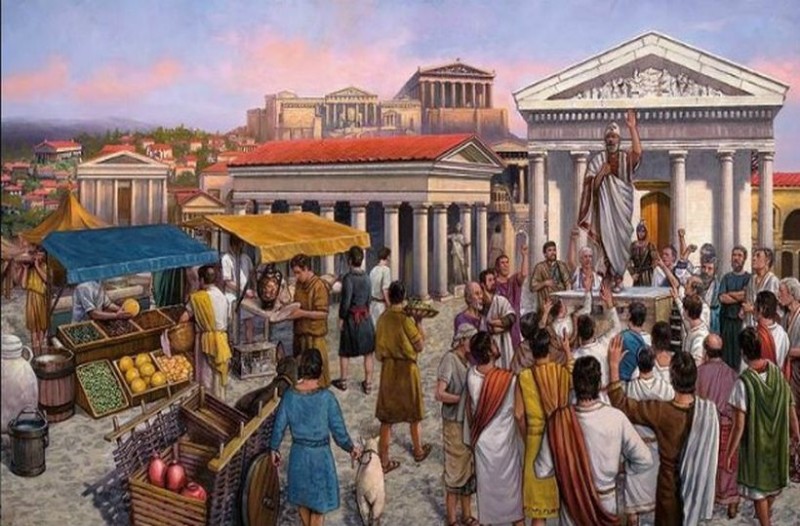
In the Western tradition, the roots of citizenship and the good citizen reach back to the ancient worlds of Athens and Republican Rome. The word “citizen” stems from the Latin word “civis,” meaning citizen. Citizens had both rights from and duties to the political body—the city-state. When the state—facing an emergency—summoned the citizen to military duty, the citizen had to respond, putting his allegiance to the state above allegiance to family, clan, faction, or tribe. Aristotle maintained that a human being could reach his full potential only through the city-state. To Pericles, living life aloof from the affairs of state was stupidity.
Since the divisive Sixties, the rights, duties, and norms of the “good American citizen” have been a subject of debate and division. They have become especially relevant in recent years with the actions of Edward Snowden and Colin Kaepernick, and now with the election of Donald Trump and his proposed policies on immigration reform and his accusatory statements against those who do not stand for the national anthem.
For the first two decades after World War II, American citizens were in general agreement as to the rights, duties, and norms of the good American citizen. Their fundamental rights were clearly enumerated and codified in the Constitution, though subject to various interpretations. With memories of the war still fresh and now facing Cold War competition with the Soviet Union, Americans were generally united in their duty to support their country’s leaders and policies against Soviet communism, the leader of which said that he would “bury” us.
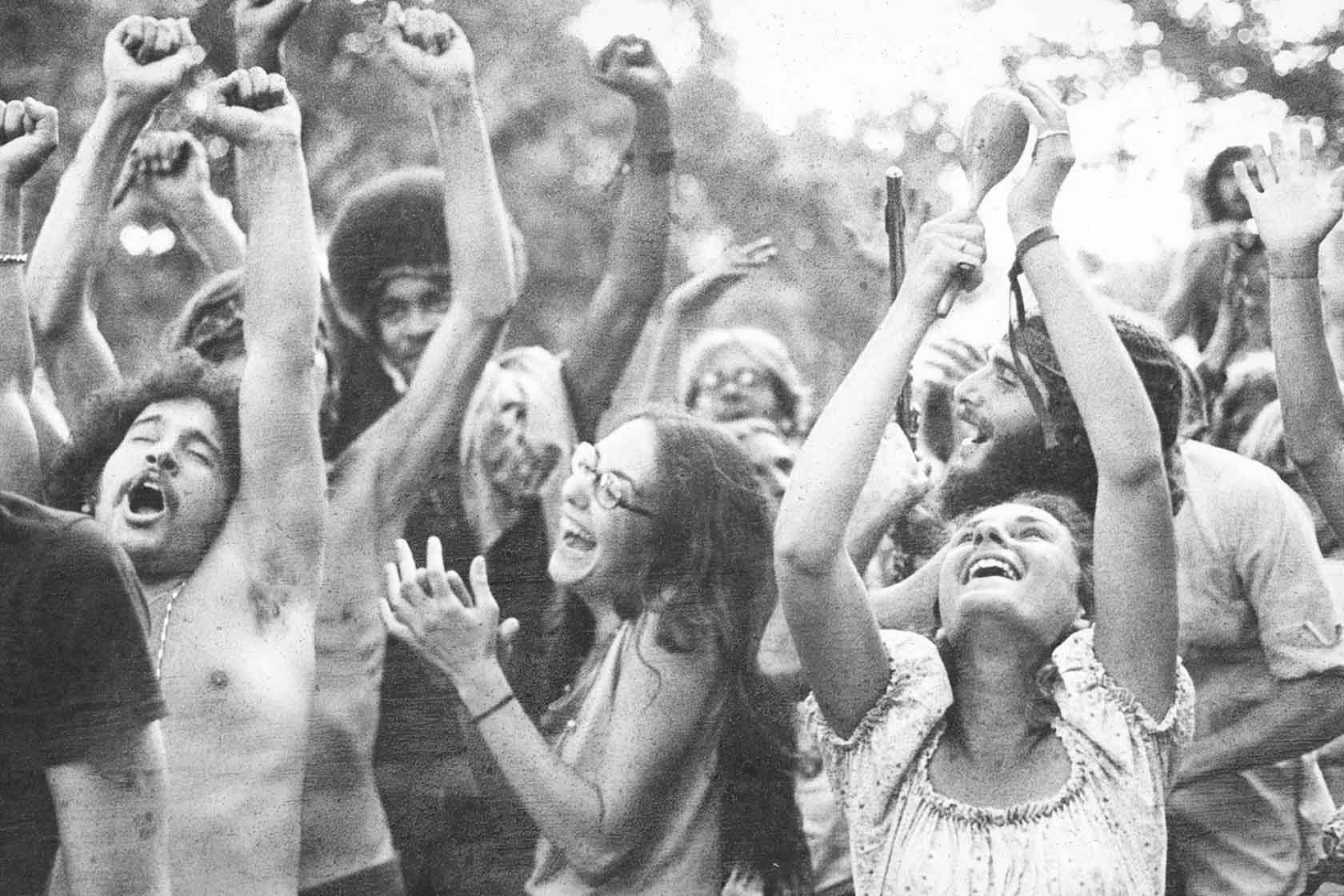
As the Sixties began and many movements for change proliferated, the consensus of the Fifties cracked. Large groups of mostly younger citizens, middle-class citizens, and African-Americans citizens split from the majority of American citizens who believed generally in the legitimacy of the American system, its leaders, and its policies. The rights to assemble and to free speech gained in prominence and allowed these groups to demand change. They asserted that America was not so beautiful; rather it was deeply flawed. The wonders and prosperity of capitalism were illusions and did not bring happiness and contentment. Social injustice was rife. They asserted that the arms race, especially the nuclear arms race, was dangerous and unnecessary. The country’s involvement in the Vietnam War had to end, some of them going so far as to actually visit with and break bread with the enemy. They asserted that the country’s authority figures were capable of great stupidity, could not be trusted, and had to be challenged. Finally, they asserted that a freer, more open lifestyle was better than mindless conformity.
The most significant legacy of the Sixties regarding citizenship was the breakdown of the single model of the “good American citizen” of the postwar period. Large portions of the population believed that a good citizen was no longer just a “red, white, and blue citizen”—“my country, right or wrong.” Now one could be accepted as a “good citizen” by being, let us say, a good “white citizen”—someone who is motivated on pure principle to disagree publicly with the country’s political leaders and policies. One could now be a “good black citizen”—one who is prepared to oppose publicly the country’s policies on minorities. Some would even condone a good “red citizen”—one who is prepared to use violence to change American policies or indeed the American system. After all, it was none other than the writer of the Declaration of Independence who said: “The tree of liberty must be refreshed from time to time with the blood of patriots and tyrants.” The “yellow citizen”—one who protests merely for self-interest—has never gained legitimacy or respect.
President Donald Trump in many ways has shown that he longs for the good old days, apparently the late 1940s and the 1950s. With his comments disparaging the members of the NFL who refuse to stand for the national anthem, he is saying that to “Make America Great Again,” the only good citizen is a “red, white, and blue” one. This is mere sentimentalism.
In the song, “American Pie,” Don McLean longed to hear some Buddy Holly music again, but the man at the “sacred store” told him “the music wouldn’t play.” Trump longs for the good old-time patriotism, but America–and the world–have changed.
(This essay was originally published abridged in the Providence Journal on August 5, 2023.)
The storied Gilded Age of American history, with its epicenter in New York City and eventually in Newport, RI, began 150 years ago. This age is at once part of the epic story of American capitalism’s astounding ability to create wealth, but also a cautionary tale of how great wealth can be squandered.
While most historians begin the age in 1870, the year 1873 is more apt. In that year Mark Twain and co-author, Charles Warner, published a novel entitled, “The Gilded Age,” in which they offer vivid portrayals of greedy industrialists and corrupt politicians in Washington, DC.
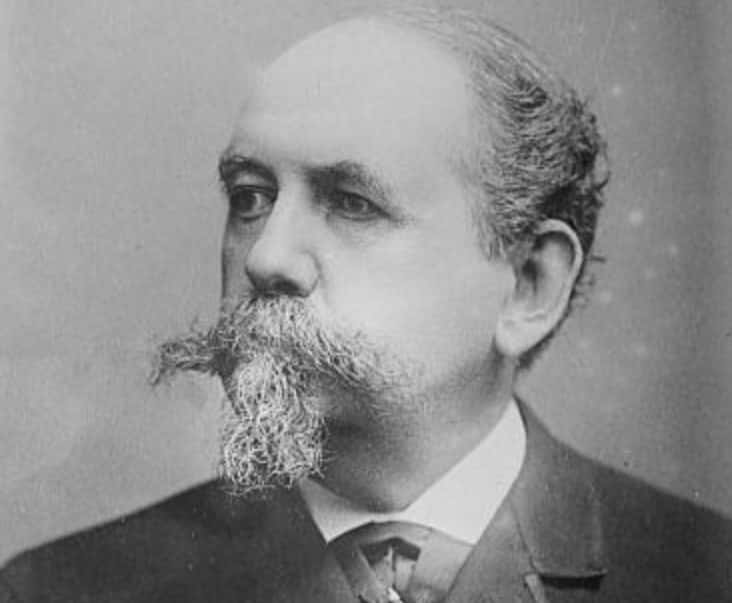
Also in that year two eventual leaders of New York City high society met: Ward McAllister, the self-made social maestro of all things that glittered, and the commanding Caroline Astor, wife of William Blackhouse Astor, Jr., the head of the Astor family, the richest in America in the mid-19th century. Looking to introduce her daughters to society, she brought her old-money wealth and prestige while McAllister brought his impeccable taste and manner. Theirs was a perfect match to dictate social custom, protocol and standing. She became the undisputed “Queen” of New York and then Newport society.
Ward McAllister
They both had been troubled by the many families who had only recently acquired wealth in the rapidly burgeoning American economy, thanks to the Industrial Revolution. These parvenus were attempting to wedge their way into high society; however, McAllister and “The Mrs. Astor” took it as their sacred duty to serve as the gatekeepers. Their mission was nothing less than to save society from the barbarians.
Each of these Patriarchs was charged with inviting four women and five gentlemen to the first annual Patriarchs Ball in the winter of 1873. This list eventually approached the figure of 400, a number which also served as the maximum capacity of Mrs. Astor’s ballroom in NY City.
A decade later the center of New York society moved—for only the two prime summer months—to Newport, RI. In the 1850s, Ward McAllister had bought farmland on the same island as Newport, a place of magnificent natural beauty and cool summer ocean breezes. With his encouragement, the Astors bought the Beechwood mansion in 1881.
Beechwood
By the late 1880s, the Vanderbilts, the Goelets, the Belmonts, the Fishes, and others followed, seeking to escape the heat of New York City summers. They bought, built, and staffed opulent mansions, which they called “cottages,” principally on Bellevue Avenue in Newport. Fifth Avenue shops also followed and opened outlets for the season. The “summer colony” was established.
The great wealth that these families had amassed allowed them to luxuriate in a carefree summer idyll, what economist Thorstein Veblen called “conspicuous consumption,” with social calendars packed not only with teas, dinners and balls, as in New York, not only with many picnics in the beautiful venues the Newport area offered, but also with expensive hobbies.
In 1880, James Gordon Bennett, publisher of the influential New York Herald, completed The Casino, described as the most lavish resort in America. Despite its name, there was no gambling; rather it offered cards, croquet, tennis, dances and concerts. The following year it hosted the first U.S. Nationals tennis tournament.
With its wonderful harbor leading to Narragansett Bay, leading to the Atlantic Ocean, Newport was a marvelous location for sailing and yachting.
In 1893, the Newport Country Club was established, hosting two years later the first U.S. (Golf) Open and the first U.S. Amateur Open.
Once trolley service allowed the masses access to Easton’s Beach, the main beach in Newport, the rich in the 1890s organized the Spouting Rock Beach Association and opened the exclusive Bailey’s Beach.
Daily in the late afternoon, after another wardrobe change for the ladies, they mounted their horse-drawn carriages and joined the daily procession down Bellevue Avenue. Ladies might bring up to 90 dresses for the summer season. Feathered hats and white gloves, three or four new pair each day, completed their ensembles.
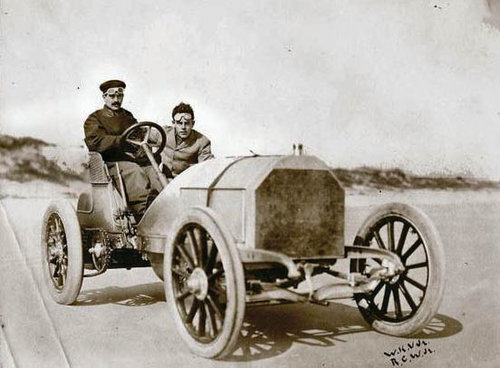
Once “automotive machines” appeared, the rich—of course—purchased the newest and most expensive and staged races and other auto events.
William K. Vanderbilt, 1904
For the most part, women ran this society, their husbands busy at work during the week and joining them on weekends. The four leaders of high society included Caroline Astor, Alva Vanderbilt (who eventually married Belmont), Marion “Mamie” Fish, and Theresa “Tessie” Oelrichs. They all owned opulent mansions on Bellevue Avenue or nearby Ocean Drive.
Though not one of the influential leaders, Alice Vanderbilt and husband Cornelius II built the largest of the Newport mansions, The Breakers: 70 rooms on a twelve acre plot overlooking the ocean, thirty baths with hot and cold fresh and salt water, costing $7 million ($254 million today) to build and certainly millions more to furnish.
The fortunes these families made in railroads, real estate, shipping, coal, the China trade, and other businesses allowed them to be waited on by platoons of servants. While a skeletal staff of a dozen might suffice, many more than this might be needed to complete the staff of one of these cottages. In 1895, there were 2,287 servants working in Newport, almost 10% of the population.
Not the case with all these families, but certainly for the Vanderbilts, America’s richest family for several generations, the Gilded Age offers a cautionary tale. Vanderbilt scion Anderson Cooper writes in his book (with Katherine Howe), Vanderbilt: “This is the story of the greatest American fortune ever squandered.” And Arthur T. Vanderbilt II writes in his book, “Fortune’s Children”: “When 120 of the Commodore’s [Vanderbilt] descendants gathered at Vanderbilt University in 1973 for the first family reunion, there was not a millionaire among them.”
A retired educator, Fred Zilian (pegasusenrichment.com) gives tours of Newport and lectures on its history.
(Note: This is the tenth and final essay in my series on “Notable Women.”)
Two women, Eve and Skywoman, play central but different roles in two creation stories, the former in the Judeo-Christian and the latter in many of the Indigenous.
In the Judeo-Christian creation story, Eve has a critical role, but clearly subordinate one to Adam who was the first to be created by God out of “the dust of the ground.”
After instructing man not to eat the fruit of the tree of the knowledge of good and evil, God says, “It is not good that the man is alone; I will make him a helper like himself.” (Genesis, Ch. 2: Verse 18) God casts man into a deep sleep, and takes one of his ribs to make woman.
In the Garden of Eden, the woman lacks the strength to resist the serpent’s temptation. She sins by eating the forbidden fruit and then gets man to eat it.
Once man confesses, God reprimands woman first, asking: “Why have you done this?” The woman says: “The serpent deceived me and I ate.” (3:13)
God indicates her future suffering: “I will make great your distress in child-bearing; in pain shall you bring forth children; for your husband shall be your longing, though he have dominion over you.” (3:16)
Turning to Adam, God underlines the culpability of woman by beginning: “Because you have listened to your wife, and have eaten of the tree ….”
God stresses to man that he, no longer in the lush, verdant Eden, must now work hard to draw food from the soil: “…thorns and thistles shall it bring forth to you, and you shall eat the plants of the field. In the sweat of your brow you shall eat bread ….”(3:18-19)
Adam decides to name woman “Eve,” a name in Hebrew relating to the verb, “to live.” Eve then is “the mother of all the living.” (3:20)
Whereas Eve plays a supporting and sinister role in that creation story, Skywoman’s role is vastly different. Robin Wall Kimmerer, in her book, Braiding Sweetgrass: Indigenous Wisdom, Scientific Knowledge, and the Teaching of Plants, relates the creation story of Skywoman, “shared by the original peoples throughout the Great Lakes.”
Through a shaft of light streaming from a hole in Skyworld, Skywoman falls down, like a twirling maple seed, clutching a bundle, her long black hair billowing.
All the animals below look up and recognize a being. Beating their wings to break her fall, the geese catch her.
The animals then gather in council to consider what to do with her. A great turtle floats by and offers its back to her. She steps on to it. The animals realize she needs land for a home, so they in turn dive deeply for mud, all failing.
Finally a tiny muskrat dives, returns, but perishes. However, in his tiny paw he manages to hold on to some mud. “He had given his life to help this helpless human.”
The turtle tells the others to place the mud on his back. Skywoman spreads the mud. She is so moved by the gifts of the animals, she begins to sing and dance in thanksgiving. From the small dab of mud, the entire earth grows, what the Indigenous call Turtle Island. This occurs, Kimmerer relates: “Not by Skywoman alone, but from the alchemy of all the animals’ gifts coupled with her deep gratitude.”
When Skywoman fell, she did not come empty-handed. She grabbed onto the Tree of Life, bringing with her fruits and seeds of all kinds. “These she scattered onto the new ground and carefully tended until the world turned from brown to green.”
The stories—especially creation stories—civilizations tell underline the values and principles important to them. They are also normative, indicating how we ought to live. In my study of world civilizations, I have found that civilizations may decline because they continue to cling to values which may have helped them rise and prosper, but because of changed circumstances are no longer useful or valid.
Perhaps, in this era of human-induced climate change, modern society can benefit from an examination of its creation stories and from a comparison with other creation stories, including the Indigenous story of Skywoman. The Judeo-Christian story is marked by desire, sin, punishment, and banishment from a Garden of Eden. The themes of this Indigenous story are: help and kindness from the animal world, gratitude, reciprocity and balance with all living things, and flourishment.
In the first, Eve—lacking in character—sins and is banished, along with Adam, from the Garden of Eden; in the second, Skywoman essentially creates our Garden of Eden.
Fred Zilian (zilianblog.com; Twitter: @FredZilian) is a retired educator (history and politics) and a regular columnist.
(Note: This is the ninth essay in a series on “Notable Women.” It was originally published as “The amazing career of the Queen of Soul” in the Newport Daily News on March 21, 2022.)
Fifty-five years ago Aretha Franklin’s recording, “I Never Loved a Man (The Way I Love You)” broke into the Top 40 Pop Chart, her first genuine commercial hit which went on to sell over one million copies.
The documentary, “Muscle Shoals,” describes how the song came to be. Jerry Wexler, a music producer at Atlantic Records, convinced her and manager/husband, Ted White, to travel to Fame Studios in Muscle Shoals, Alabama, a literal backwater in the world of music production.
In her interview for the documentary, Franklin describes Wexler’s pitch: “I’ve got these cats down in Muscle Shoals and they’re really greasy.” Once in the studio, Franklin and the all-white musicians had the words of the song but worked without written music, trying in vain to find the right groove. Singer-songwriter Dan Penn described the scene: “They had a song, they had an artist, but nobody knew what to do, not even these geniuses.”
Suddenly keyboard player Spooner Oldham started a five-note riff filled with melancholy. Aretha began belting out the lyrics. “You’re a no good heartbreaker/You’re a liar and you’re a cheat/And I don’t know why/I let you do these things to me.” The other musicians joined in; twenty minutes later the song was cut.
On March 18, 1967, it broke into the Billboard Top 40 Pop Chart, reaching number 9, giving Franklin her first top-ten pop single. The song reached number one on the R & B chart.
In an interview, Franklin highlighted the importance of her experience at Muscle Shaols. “Coming to Muscle Shoals was the turning point. That’s where I recorded my first million selling record. It was a milestone, THE turning point of my career.”
Franklin began her music career at a young age, singing gospel at New Bethel Baptist Church in Detroit, Michigan, where her father, C. L. Franklin, was a minister. In 1954 when she was twelve, her father began to take her along on his “gospel caravan” tours. In 1956 J.V.B. Records released her first single, “Never Grows Old,” releasing that same year the album, “Spirituals,” with five of her recordings.
From 1960 to 1966, Columbia Records had her under contract; however, genuine commercial success eluded her under its management. When her contract expired, music producer Jerry Wexler of Atlantic Records convinced her to join Atlantic.
After recording her hit in Muscle Shoals, Wexler brought her and the main musicians to New York City and recorded an album with the history-making hit “RESPECT.” As a single, it entered the Top 40 Pop Chart in May 1967, climbed to #1, and remained on the chart for eleven weeks.
The song and I have a history, as it was released when I was finishing my freshman (plebe) year at the US Military Academy. During the academic week, which ended only after Saturday morning classes, room inspection, and parade, it was academics, military discipline and measure, and martial music.
However, at the Saturday night “mixer” dance, it was a different universe. With girlfriends and the girls who came from surrounding colleges, it was time to dance to “Midnight Hour” and “Mustang Sally,” (Wilson Pickett), “We Gotta Get Outta This Place” (The Animals), “Baby, I Need Your Lovin’” (Four Tops), and “RESPECT.” My tight, black collar loosened; the gray jacket became unzipped. It was time to get down and get lost in soul music.
The following year, three classmates and I donned female attire and lip-synched the song in a talent show. I reprised this four years later with other classmates in a talent show in our military unit in West Germany.
The song “RESPECT” came to be her signature song and eventually also served as a civil rights and feminist anthem.
Overall, Aretha Franklin’s accomplishments are breath-taking. She recorded 112 charted singles, including 17 top-ten pop singles, and 20 number one R & B singles. She won 18 Grammy Awards, including the first eight awards given for Best Female R & B Vocal Performance, a Grammy Awards Living Legend honor and a Lifetime Achievement Award.
Aretha Franklin, 1975, receiving a Grammy Award
She was awarded the National Medal of Arts and the Presidential Medal of Freedom. In 1987 she became the first woman to be inducted into the Rock and Roll Hall of Fame.
By coincidence, my wife and I happened to be in Detroit the day after she died (August 16, 2018). With a group of friends, we were visiting the Motown Museum. Included in the group were all four of us who had “performed” the song in 1968.
We struck up the tune and tried to remember our old moves. A reporter from a major French news service invited me to comment. I said: “The country [back then] was riven by race relations tension and we—you can see are all white—we didn’t give a damn. It’s really a statement about the unifying effect that music can have.”
Fred Zilian (zilianblog.com; Twitter: @FredZilian) is a retired educator and a regular columnist.
Sources:
“Aretha: Lady Soul.” (album) Atlantic Recording Corporation, 1968.
(Note: This is the third essay in a series on “Race and Racism in America.” It was originally published by the Newport Daily News on March 2, 2022.)
In my 23-year teaching career at Portsmouth Abbey School, coming after my Army career, I not only educated students of numerous “races” and nationalities, I also served as the International Student Advisor, increasing my interaction with them. The school has been historically strong with Latino/a students since its founding in 1926. When I taught there (1992-2015), the number of Korean students surged followed by the Chinese. In my 20 years as their advisor, I recall that between 12% and 22% of the student population was international coming from 12 to 18 countries.
Portsmouth Abbey School is a boarding school. Therefore, I not only taught the students in the classroom, but also coached them on the fields and courts, ate with them, and tended them after dinner and on weekends.
My career at this school reinforced my experiences in the military. I came to know students of all colors, sizes, creeds, characters, and abilities: gifted and challenged, mature and immature, motivated and coasting, on track and astray.
To conclude this survey of my personal experiences, a look at race in my own family. I must have been home on leave from West Point when my close cousin, then in high school, told me she was going steady with a boy. I smiled. Then she said: “But he’s black.” “Oh, my goodness,” I said. Repeating the title of the famous movie, I said: “Ahh, ‘Guess Who’s Coming to Dinner.’” My cousin told me how troubled her parents—who happened to be my godparents—and our grandmother were. Eventually they were married, and a baby girl was born. That baby grew and now has her own child.
I barely came to know my maternal grandmother, as she always spoke Italian. On the other hand, my father’s parents had already passed when I was a child. No photos of them were on display in our home, and I remember only a few stories told about them. Gustave Zilian was born in Germany and had worked on the Panama Canal where my father was born. When I asked my father about his mother, Zenobia Dubois Zilian, he simply said: “She was from the island of Martinique.”
Zenobia Dubois Zilian
It was only in the last few years after joining an ancestry organization that I learned more about her from documents. Her parents were from Cuba and perhaps Jamaica. She was born in Panama and spoke Spanish originally. In the 1930 Census document, she, my father (19 years old at the time), and all his siblings were listed as “Negro.”
With this knowledge, I was not surprised when my DNA analysis revealed I am 12% African, and from the area sometimes referred to as the “slave coast”.
In discussions with my mother about my father’s parents, I came to learn that my grandfather did not treat my grandmother well. I wonder now if my grandfather, after coming to this country with his young family in 1918, came to resent marrying a “negro” and having five “negro” children. Before I was born, did my grandmother feel the sting of racism from my grandfather?
All the experiences I have related in these three essays help me to understand my affinity to African culture and my friendships with African Americans. However, as one of these friends cautioned me after learning of my African DNA, I should never equate this with having the “Black Experience.”
After all, because of the color of my skin, I have never heard the click of car doors locking as I walked by, had a security guard follow me around in a department store, been denied service at a restaurant, watched TV featuring only people who did not look like me, reached into a box of crayons and pulled out one marked “flesh” which did not match my skin color, felt compelled to demonstrate with a sign on my chest proclaiming: “I am a MAN.” I have never felt like a second class citizen or human being.
Also, while I had the sex talk as an adolescent, I never had “The Talk” about people calling me certain demeaning words and especially about what to do if stopped by a policeman, once I had a driver’s license. Ta-Nehisi Coates’ entire book, “Between the World and Me,” is essentially this “talk” to his son. My African American friend told me recently that not a day goes by that someone does not do something which reminds him of the color of his skin.
In short, though I have had many challenges in my life, I have never had to worry about the color of my skin.
Fred Zilian (zilianblog.com; Twitter: @FredZilian) is a retired educator and a regular columnist.
(Note: This is the second essay in a series on “Race and Racism in America.” It was published by the Newport Daily News on February 21, 2022.)
While I grew up hearing the normal racial and nationality slurs common among teenagers in middle class America of the 1950s-60s, it was in my first few months at the US Military Academy that I heard unvarnished racism with a southern drawl from the mouth of a classmate. I thought he was kidding, but he was dead serious when he challenged me about my intention to do something with an African American classmate.
Dreaming to lead the Army football team as quarterback over Navy on national TV, I played freshman football next to a small number of African American classmates.
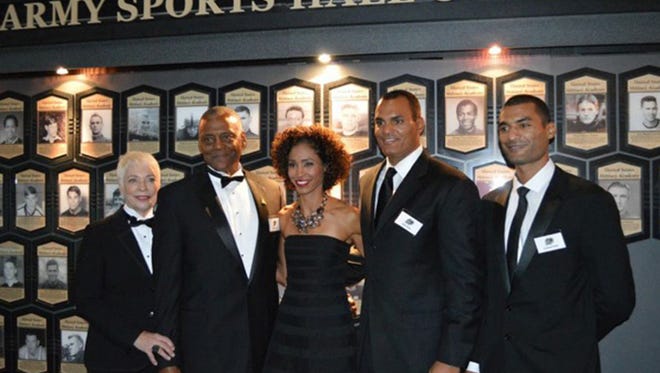
And then senior year came, and there was Gary Steele, a tall, athletic, handsome African American classmate, a star offensive end on the football team. We worked closely together during that year. Strong in body and in dedication to West Point’s values of “Duty, Honor, County,” he and I are still friends today.
Steele family, 2013, Induction of Gary into the Army Sports Hall of Fame (US Army)
Overall we had just a handful of African Americans in our class, certainly not a number representative of our country’s population. Of the 749 of us who graduated in the Class of 1970, I count seven apparent African Americans in my yearbook.
Following graduation in 1970, I reported to Airborne School and Ranger School at Fort Benning, Georgia. There I was taught by many sculpted, dedicated, long-serving, highly professional African American sergeants who instructed me on how to jump from an airplane, make a parachute landing fall, tie a bowline knot, rappel down a cliff, and navigate through a swamp. Most important, they taught me about myself and about leadership in stressful situations.
After all the academic schooling and military training, in March 1971, I reported to my first duty assignment in the 2nd Battalion – 509th Infantry, 1st Brigade, 8th Infantry Division, Lee Barracks, Mainz, West Germany. The US was locked in the Cold War with the Soviet Union; we stood watch in a reserve position on “freedom’s frontier” behind the Inter-German Border.
What a shock it was to meet my first platoon. This was still a conscript Army then; the draft did not end until 1973. The Vietnam War had decimated the Army, called frequently then a “hollow” army. I knew my platoon would not be its official size of 33; however, 14 soldiers? It was more aptly called a reinforced squad, rather than an infantry platoon.
The majority of my platoon was composed of people of color, mostly African Americans and also one Native American.
The culture of the troops was in stark contrast to the culture I experienced at West Point. Most of the troops had been to Vietnam and were just finishing the last few months of their draft enlistments. Some showed minimal and grudging respect for me; others had no qualms about showing their disdain for this young, over-zealous, white, pretty boy who had not tasted real combat. A small number displayed outright contempt and white-hot hatred. My first day I was called “pig” and “cracker” behind my back.
During my assignment, Major General Frederic Davison assumed command of the division, the first African American to command a division. Along with several other young officers, I had the opportunity to meet with him for an informal conference.
Major General Frederic E. Davison, Commanding General, 8th Infantry Division
And then, when I became a company commander, there was Sergeant First Class Thornton, whom I elevated to First Sergeant of the company. A well-built African American, he brooked no disrespect or nonsense. With his help, the company became more disciplined and professional.
In three and one-half years in that unit, I served with soldiers of color, jumped out of airplanes with them, marched, bivouacked, played lunchtime basketball, and socialized with them. I even had a great game of basketball with the one who called me “cracker.” I learned that sports could transcend the color/race line.
Several years after returning stateside, I had a teaching assignment in the Social Science Department at West Point. And here there were African Americans Fred Black and Bill Lowry. Both were great officers and educators, and colleagues and friends. Fred, as well as Gary Steele, will read this column.
In the early 1980s, after many years in the world of military education, I found myself back in a frontline unit on the DMZ in Korea, serving as a principal staff officer in a brigade of the 2nd Infantry Division.
And here there was short, sturdy, tough-as-nails, African American Sergeant Major Wall. Having been away from the front line army for so many years, I lacked much knowledge and experience for my position. SGM Wall took the time to teach me. Many times he would enter my office, close the door, and offer me counsel and direction. We developed a mutual respect which turned to admiration.
He rotated out of the unit before I did. At his official departure ceremony, after saluting him, I hugged him—totally unheard of and in contrast to normal military protocol.
In my 25-year military career, any negative stereotypes I may have harbored about African Americans were dismantled. I had met, worked with, played with, danced with, and soldiered with great ones, incompetent and unprofessional ones, and all in between.
Fred Zilian (zilianblog.com; Twitter: @FredZilian) is a retired educator and a regular columnist.
(Note: This is the first in a series of essays on “Race and Racism in America.” It was originally published in modified form by the Newport Daily News on February 1, 2022.)
Race and racism comprise one of the great fault lines which continue to haunt American society.
W.E.B. Dubois, the greatest African American voice of the first half of the 20th century, wrote in 1903: “… for the problem of the Twentieth Century is the problem of the color line.”
Martin Luther King Jr., in his final book before his assassination in 1968, wrote: “This long and callous sojourn in the far country of racism has brought a moral and spiritual famine to the nation. But it is not too late to return home.”
With the celebration of his birthday and with Black History Month approaching, I now force myself to consider and write about this fraught subject. If you have read my earlier columns, you know that I have written about it before, however, only on historical subjects. While integrating history, I hope with this series to engage its current dimensions.
For your benefit as well as mine, it is fitting as a first step to examine my own background on this subject. Come take this journey with me.
My earliest recollection of any type of racism—evidence of an attitude of superiority of one race over another—in my extended family is the use among my many Italian American aunts and uncles of the Italian word for eggplant (moulinyan) to refer to African Americans. As a boy, I could sense that this was a put-down word, however, not as demeaning as “n—–r.” I placed it next to the other words used to put down boys of other nationalities who made up our small town of Hasbrouck Heights, NJ: “kraut,” “mick,” and “spic.”
I grew up with no African Americans or people of color—none in elementary, middle, or high school. Certainly, there were darker skinned schoolmates, but none with other African physical traits. This stemmed from the absence of people of color in our town in the 1950s and early 1960s. I eventually became old enough to discern this and assumed some type of conspiracy among realtors.
In competitive, scholastic sports, I played against athletes of color, but never with any.
When my father, a lover of music, took my brother and me in 1960 and also in 1961 to “Murray the K’s Holiday Review” in Brooklyn, NY, I had never seen and mingled with so many Blacks. The audience was multi-racial because the show was, featuring many of the top rock and roll artists. There was Del Shannon and The Angels, but also Ben E. King and Smokey Robinson and the Miracles. There was even a multi-racial group, The Marcels, who—singing their Doo-Wop version of “Blue Moon”—sent me to the moon.
When the Isley Brothers sang their hit, “Shout,” for the finale of one show, blacks and whites mingled and danced in the aisles. At the early age of 12, I noted how music could transcend the color line.
During the summer months, my father, a massage therapist (mother was a housewife), took Thursdays off, allowing our family of five to drive the hour north to Lake Sebago in southern New York state. Friends and extended family often joined us, allowing much rough and tumble on the beach and in the water.
After lunch, we boys might explore the surrounding shore and woods. It was on one such Thursday perhaps in 1960, that we walked the shoreline. Several hundred yards from our beach we walked around the bend and found ourselves in another, well-populated beach area; however, this beach was filled with people of color.
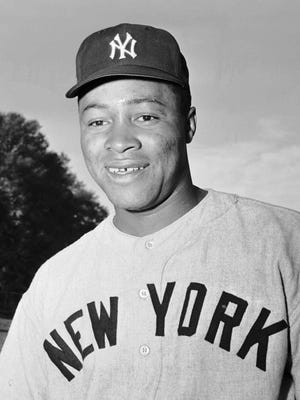
And then it happened. I thought I recognized Elston Howard. (I proceed with some trepidation, knowing I am talking about a NY Yankee here in Red Sox Nation.) Howard was the first African American on the Yankees, during that marvelous stretch when they usually won not only the American League pennant, but also the World Series. Howard spent 13 years with the Yankees, 1955-1967, their starting catcher 1960-66. He earned the American League MVP in 1963, becoming the first black player in AL history to accomplish this feat. I watched him on TV frequently as all of my family were avid Yankee fans.
Elston Howard
As a young teenager, I remember being a bit confused by this separation of the races at our favorite lake and by the fact that one of my baseball idols had to swim around the bend and out of sight from where I swam.
Fred Zilian (zilianblog.com; Twitter: @FredZilian) is a retired educator and a regular columnist.
(Note: This essay, abridged, was published at thehill.com on February 25, 2019; however, I failed to post it here.)
The Republicans and Democrats have reached a compromise on the border issue. President Trump, not happy with the mere $1.38 billion in the compromise bill for his wall, has declared a national emergency so that he can use other appropriated funds for this wall. However, the real national emergency is not keeping people out with a wall; rather, it is getting the right people to come to America to counter its very low fertility rate.
In the long term, human economic and personal insecurity and climate change will increase the flow of migrants and refugees from points known but also unknown. Now that the U.S. fertility rate has dropped to 1.76, well below the replacement rate, America’s challenge—if it wants to remain a superpower—is not to build walls and restrict migrant flow excessively, as the Trump Administration has, but rather to manage properly a more generous migrant flow so that its population continues to grow, with all the attendant benefits.
The World Migration Report for 2018, authored by the UN International Organization for Migration, estimates a total of 244 million migrants, including over 40 million internally displaced persons and 22 million refugees. The report cites the reasons for the recent increase in displaced people, including conflict, persecution, environmental change, and a lack of human security and opportunity.
Focusing on the United States, the PEW Research Center in November 2018, presented data on migration to the United States. The U.S. has more immigrants that any other country, about 40 million, about 20% of the world’s immigrant population, people born in another country, with just about every other country in the world represented. They make up 13.5% of the U.S. population. A total of 10.7 million are unauthorized or illegal (23.7% of U.S. immigrants). Unauthorized migrants tripled in size during the period 1990-2007, and then declined after the Great Recession of 2008-2009. In the period 2007-2016, unauthorized migrants from Mexico declined while those from Central America increased. Since 2010, more Asian than Hispanic migrants have arrived each year. Regarding refugees, in FY 2017, almost 54,000 were resettled in the U.S.; the largest came from the Democratic Republic of the Congo, then Iraq, Syria, Somalia, and Myanmar.
Several factors suggest that migrant flow to U.S. borders will increase in the future. Just beyond Mexico lie the three countries from whom the highly publicized “caravans” of migrants have come in recent years. Over the past five years Stephanie Leutert, writing in Foreign Affairs, indicated 875,000 migrants from Guatemala, Honduras, and El Salvador have come to the U.S. border, driven mainly by rampant gang violence and economic hardship. However, without a job or family in the U.S. these migrants, most moving in family groups, have no legal pathway into the U.S. Until the factors, pushing these migrants to leave, are dealt with, we can expect this migrant flow from Central America to continue.
A second factor which will increase migrant flow to the U.S., a land in what Thomas Friedman calls the “zone of order” , is climate change, an issue in which the U.S. once led but now, under the Trump Administration, dawdles and denies. Over three years ago at a Commencement for the Coast Guard Academy, President Barak Obama sketched the risks ahead. “Around the world, climate change increases the risk of instability and conflict. Rising seas are already swallowing low-lying lands, from Bangladesh to Pacific islands, forcing people from their homes. Caribbean islands and Central American coasts are vulnerable, as well. Globally, we could see a rise in climate change refugees. … Elsewhere, more intense droughts will exacerbate shortages of water and food, increase competition for resources, and create the potential for mass migrations and new tensions. All of which is why the Pentagon calls climate change a “threat multiplier.”
The Trump Administration has disallowed the Department of Defense from addressing the impact of climate change in any meaningful way, deleting it from the official list of national security threats. However, a recent DOD report maintains that it is, stating: “The effects of a changing climate are a national security issue with potential impacts to Department of Defense missions, operational plans, and installations.”
Climate change is manifesting itself in sea level rise here in the U.S. and beyond. Almost three years ago The New Scientist, using data from the National Oceanic and Atmospheric Administration, indicated that the sea level will rise 1.8 meters by the year 2100, probably displacing over 13 million people in the U.S.
Internationally, the effects of climate change were addressed at the two-week UN climate conference in Paris in December 2015. Sewall Chan’s reporting on the conference indicated that warming, in addition to other effects, can cause violence leading to the large-scale displacement of people. The conference’s report noted that between 2008-2014, an average of 26.4 million people were displaced each year by floods, storms, earthquakes, and other natural disasters (although most moved within their own countries). The accord called for developing recommendations “to avert, minimize and address displacement related to the adverse impacts of climate change.”
William Lacy Swing, a retired American ambassador who now leads the International Organization for Migration, said that climate change was adding to a “perfect storm” of “unprecedented human mobility,” a result of the quadrupling of the world’s population over the last century and wars, conflicts and persecution.
The world’s many glaciers continue to melt, a clear result of global warming. Dr. Twila Moon, University of Colorado, Boulder, wrote of this in the journal Science in May 2017: “The evidence is overwhelming: Earth is losing its ice. Much of this loss is irreversible and the result of human-caused climate change,” Glaciers all over the world are disappearing and should be the subject of “international concern.” Among other effects, millions of people will be forced to leave their homes by rising seas, crucial sources of water will run dry and wildlife will lose sources of nutrients and shelter. The US Geological Survey has reported that the Glacier National Park in Montana has lost more than 120 glaciers in the last century. And Dr. Moon said this was a pattern repeated all over the world from the Antarctic Peninsular to Patagonia, Kilimanjaro, the Himalayas, Greenland and the Arctic.
Also in the journal Science, in December 2017, a team of scientists, studying weather variations from 2000-2014 in 103 countries and their effects on asylum applications to the European Union concluded that “weather-induced conflicts in developing countries spill over to developed countries through asylum application.” “Our findings support the assessment that climate change, especially continued warming, will add another ‘threat multiplier’ that induces people to seek refuge abroad.”
The final factor arguing for a less restrictive immigration policy is the dramatic fall in the U.S. total fertility rate. This rate has dropped since the Great Recession of 2008 to 1.76 births per woman in 2017, well below the replacement rate of 2.1 needed to keep a population stable. Despite this drop, the Trump Administration has moved to restrict immigration.
This trend has significant negative implications for our Social Security and Medicare programs. As medical experts John Rowe, Dana Goldman, and S. Jay Olshansky have indicated: “The significant reduction in fertility in the U.S., if not offset by enhanced immigration or greater worker productivity, puts these programs at risk.”
The white population has a very low fertility rate among all groups within the U.S. population. Therefore, it is the minority groups who are contributing the most to the U.S. population. Demographer William Frey of the Brookings Institution has demonstrated where future gains will likely come. “The likely source of future gains among the nation’s population of children, teenagers, and young working adults is minorities—Hispanics, Asians, blacks, and others. Also Statista reported that Hispanics in 2017 had the highest fertility rate among significant minorities. (Native Hawaiians/Other Pacific Islanders had the highest.)
Military might, economic prowess, and natural resources have always been measures of a state’s power. Today we can add such things as technological capability and innovation, entrepreneurial talent, cybersecurity and strength. It is surprising that in an Administration filled with so many “realists,” including President Trump and National Security Advisor John Bolton, there is such a lack of concern with one of the most fundamental sources of a state’s power—population.
The trends discussed above suggest that the U.S. will continue to be a magnet for immigrants, pulled to our borders by order and economic opportunity, and pushed by violence and climate change in their home countries. With the dramatic drop in the U.S. fertility rate over the past decade, it would be wise for the United States—rather than overly restricting immigration—to streamline its immigration policies to accept the right combination of skilled and unskilled workers, innovative entrepreneurs and also families who can give us young Americans. Fred Zilian, Ph.D., is an adjunct professor of history and politics at Salve Regina University, Newport, Rhode Island. He is the author of “From Confrontation to Cooperation: The Takeover of the National People’s Army by the Bundeswehr.” Follow him on Twitter @FredZilian.










 Zilian Commentary