Unified Germany at 25: More Normal, More Independent

(This essay, abridged, was originally published as “Germany’s Unification a Huge Success,” in the Providence Journal on October 3, 2015. For more analysis, please see my book:  From Confrontation to Cooperation: The Takeover of the East German Army by the Bundeswehr.)

Twenty-five years ago, eleven months after the fall of the Berlin Wall, Germany was unified for the second time in modern history. The first time in 1871 it took three wars and was achieved over the objections of its neighbors. This time it was without bloodshed and with the support of its neighbors, including Soviet Union.

Shortly after the fall, Gerhard Herder, the East German ambassador to the US, said of the possibility of unification: “In my dreams, yes, but being a politician and standing with both my feet on the earth, I don’t see a possibility in the foreseeable future.” He was wrong.

On the international level, the Soviet Union’s position evolved over the months after the Wall fell, not only to endorse unification, but also to a withdrawal of its 546,000 troops and dependents in East Germany. The United States gave early and unwavering support for unification, eventually convincing Great Britain and France to follow. The six countries began the 2+4 Talks in May, 1990, concluding and signing the Final Settlement on September 12.

In 1989 within East Germany, das Volk (the people) had chanted “No Violence!” and then “We Are the People.” But soon after the Wall fell, the chant changed to “We are One People” and “Germany, Fatherland.”

Within the space of five months, the East German Communist Party had lost its legitimacy, clearly shown in the March 1990 elections, in which it received only 16% of the vote. Economic union followed in July, and at midnight October 2, 1990, East Germany was joined to the Federal Republic of Germany, making the new Germany the most populated country in Europe with 82 million people.

Today, despite the huge amount of money that had to be invested in the new eastern federal states, the postwar German Wirtschaftswunder (economic miracle) continues. It has the fourth largest economy (GDP) in the world, expected to grow 1.8% this year. Relying on its small and middle-size manufacturing companies, it is clearly the most powerful economy in Europe, described as an “economic juggernaut,” and the “economic powerhouse of Europe.” Its unemployment rate remains stable at 4.7%, the lowest in the Eurozone. By 2011 it had become the world’s second largest exporter (after China) and now has the world’s largest current-account surplus.

On the domestic political level, there is no question this united Germany has continued its course, set after WW II by the allies, as a Western liberal democracy, its authoritarian past buried. Since Unification, it has peacefully and democratically installed several governments of various political hues. In 2005 Angela Merkel became its first female chief executive (chancellor) and the first from the former east. In addition to its three traditional parties, it has had a Greens Party for decades and since 2013 a new party on the right, Alternative for Germany. The political system has shown resilience: the CDU/CSU conservative parties are now in coalition with the Social Democrats, the former opposition. Finally, Roger Karapin has argued that citizen activism has become a major force in domestic politics—German citizens are more prepared to be disobedient and assertive, belying the earlier passive, obedient stereotype.

Its foreign policy, however, is in flux. The “German Question” has returned, at least in part. In its original form, this Question related to the 19th century debate over the proper means and ends for the envisioned unification of the many Germanic states in the heart of Europe at the time. In its post-WWII version, the Question has had at least two parts: What borders for Germany? Second, what role for Germany? With German Unification in 1990, the first was answered categorically; the second has not.

Though accused by its NATO allies of foot-dragging at times, it has moved from a country militarily hand-cuffed—restricted by its Constitution, its national culture, and its past—to a more confident, “normal” country that is prepared to assert itself and even send its soldiers abroad. In 1999 it committed its military forces to combat for the first time since WW II as part of a NATO force to protect Kosovo. Beyond the Balkans it has also sent military forces to the Middle East, Africa, and Afghanistan. Recently its top political leaders approved the delivery of thousands of machine guns, grenades, and antitank missiles to Kurdish forces battling Islamic militants in Iraq.

Germany’s foreign policy actions during the past five years suggest a role, grounded in Western values and interests, committed to human rights, mindful not to repeat the mistakes of its past—including reliance on military force—and more prepared to lead Europe, commensurate with its power. The United States can expect a more independent and less docile Germany—perhaps cold water for the US, but something good for Europe and for the world.

As I stood in Bonn’s central market place on Unification Day twenty-five years ago—oompah music playing, balloons rising, flocks of pigeons darting, the crowd swaying—I was hopeful that the Germans would succeed in their unification. Today the Germans can be proud of their achievements, and Americans can be proud of the role they played in ending the Cold War and supporting the Unification. Shortly after Unification, I spoke to a former East German sergeant who indicated how it might have been had the Soviets won the Cold War. He told me that “Germany would have been one big concentration camp.”

An educator at Salve Regina University, Newport, RI, Mr. Zilian was a US Army liaison officer to the German Army during Unification. Contact: www.zilianblog.com

 

Posted in Uncategorized | Tagged , , , , , , , | Leave a comment

Civil War Changed U.S. Forever

(This essay was originally published by the Newport Daily News on June 24, 2015.)

This year our country concludes its sesquicentennial celebration of the Civil War, fought 1861-1865, in which Americans fought, wounded, and killed each other in astounding numbers. For many years, the conventional number of soldiers killed was 620,000. In recent years, sources have raised the figure to over 700,000.

Over 2.2 million men served under arms in the Union military and perhaps 1.5 million served in the Confederate military. One in 65 died in combat, one in 13 died of disease, one in 10 was wounded. The last Civil War veteran died in 1959.

The average Civil War soldier was 25 years old, five feet eight inches tall, and weighed 143 pounds. Though the minimum legal age for enlistment was 18, an estimated 100,000 soldiers in the Union Army were under 15, some drummer boys being as young as nine.

While many Americans consider Gen. Robert E. Lee’s surrender at Appomattox Court House on April 9, 1865, to be the end of the war, this is not true. Other Confederate units continued to exist and remained at large for the next few months. Confederate President Jefferson Davis was captured on May 10.

The final engagement in which there were casualties took place at the Battle of Palmito Ranch, May 12-13, on the banks of the Rio Grande, east of Brownesville, Texas.  Union Private John J. Williams of the 34th Indiana Regiment, who died in this battle, was the final soldier to die in the war.

John_J__Williams, Civilwar-online

Private John J. Williams, the final soldier killed in the Civil War

(www.civilwar-online.com)

The final Confederate surrender took place on November 6, 1865, when the Confederate warship CSS Shenandoah surrendered at Liverpool, England.

The Civil War forced our country to face four key issues. Were we a federation of states in which the central government has higher authority than the individual states, or were we a confederation of states in which the individual states had more power than the central government? One of these powers was, of course, the right to secede from the Union. The answer: a federation

Second, if one of our first principles was that all men are created equal, how did we reconcile this with the existence of slavery in our country?  The Atlantic slave trade had been banned since 1808; however, slavery was still lawful. Eighteen states had passed laws banning slavery; fifteen states did not. The war eliminated this contradiction, even if true social equality in our country has, to this day, still proven elusive.

Third, in a national crisis, what civil liberties could justifiably be restricted and too what extent in order to quell the crisis? While President Lincoln believed that he could do just about anything to quell the insurrection, the war provided no definitive answer to this question. The civil liberties and rights curbed after the 9/11 terrorist attack continue to be a source of debate.

Finally, could a democracy sustain itself through such a crisis? Not only did it endure the storm, it had a national election in the midst of it, reelected its leader, and saw the crisis through to its conclusion.

The war took the life of President Abraham Lincoln who, in most surveys, is rated our greatest president. On April 14, 1865, he was assassinated by John Wilkes Booth, a southern sympathizer who believed that slavery was one of God’s greatest gifts to humankind.

At the outset of the war, people referred to the country as “the United States are,” while afterward people said “the United States is.” At first the conflict was about the existence of the Union and about states’ rights, but it eventually rose to a higher plane. The subtext of slavery surfaced and recast the war into one fought about a new birth of freedom for our country and about dictating that the Southern way of life based on slavery must be gone with the wind.

The Civil War is a cornerstone in America’s national identity. Civil War writer Shelby Foote stated that any understanding of our nation must be based on an understanding of the Civil War. “The Civil War defined us as what we are and opened us to what we became ….” It was an “enormous catastrophe” and the “crossroads of our being.” Civil War historian James McPherson has stated that: “From the war sprang the great flood that caused the stream of American history to surge into a new channel ….”

This brings to an end my series of essays on the Civil War. I hope in the past three years I have educated and enlightened, and perhaps inspired you to renew your civic commitment to our country. My thanks to all of you who have given me such kind feedback.

A retired Army officer, Fred Zilian teaches history and political science at Salve Regina University and is a member of the Rhode Island Civil War Sesquicentennial Commemoration Commission Advisory Council. Send him email at zilianf@aol.com or check out his blog at www.zilianblog.com and his Abe Lincoln website at www.honestaberi.com.


Posted in Uncategorized | Tagged , , , , , , , | Leave a comment

Climax at Appomattox

(This essay was originally published as “Defeat, denial, and surrender,” in the Newport Daily News, April 9, 2015.)

Despite the victory delusions of Confederate President Jefferson Davis, the fortunes of the South deteriorated dramatically in March 1865. Gen. Robert E. Lee’s Army of Northern Virginia was now reduced to 55,000 men, hunkered down defending Petersburg and shielding the southern capital of Richmond as it endured the siege of Gen. Ulysses S. Grant’s army of 120,000. Having lost hope in their cause, Lee’s men were hungry, despondent, and now deserting in increasing numbers.

By March 24, Gen. William T. Sherman had completed the second leg of his devastating march through the deep south, pulverizing anything of value and punishing the people in an effort to sap the last vestiges of their will to endure. The army reserved its harshest treatment for South Carolina, the first state to secede from the Union. He now moved north to assist Grant.

After nine months of siege, Grant sensed Lee’s vulnerability and on April 2 ordered a general offensive along the entire front. On this pleasant spring Sunday, President Davis attended church. A messenger suddenly came to him with a telegram. It was from Gen. Lee: Richmond must be evacuated. Davis hurried from the church, signaling the congregation with his ashen face the ill tidings.

Escorted by ten sailors, President Lincoln arrived in Richmond shortly after the first Union soldiers. Admiral David Porter nervously scanned the windows for assassins. Lincoln was soon surrounded by black people shouting: “Glory to God!” “Bless the Lord!” “The great messiah!” “Come to free his children from bondage. Glory, hallelujah!” One black man fell to his knees. “Don’t kneel to me,” Lincoln said. “That is not right. You must kneel to God only….”

Lee’s Army was now reduced to a mere 35,000 men. He planned to link up with Gen. Joseph E. Johnston at Danville, Virginia. Already there was President Davis who asserted: “Relieved from the necessity of guarding cities … with our army free to move from point to point … nothing is now needed to render our triumph certain, but… our own unquenchable resolve.”

But resolve, itself in short supply, would not be enough. On April 7, Gen. Grant sent Gen. Lee a note calling for him to surrender, which Lee rejected. On the morning of April 9, Lee tried one final breakout which failed. Surrounded and outnumbered five to one, Lee decided to surrender. He said: “there is nothing left for me to do but go and see General Grant, and I would rather die a thousand deaths.”

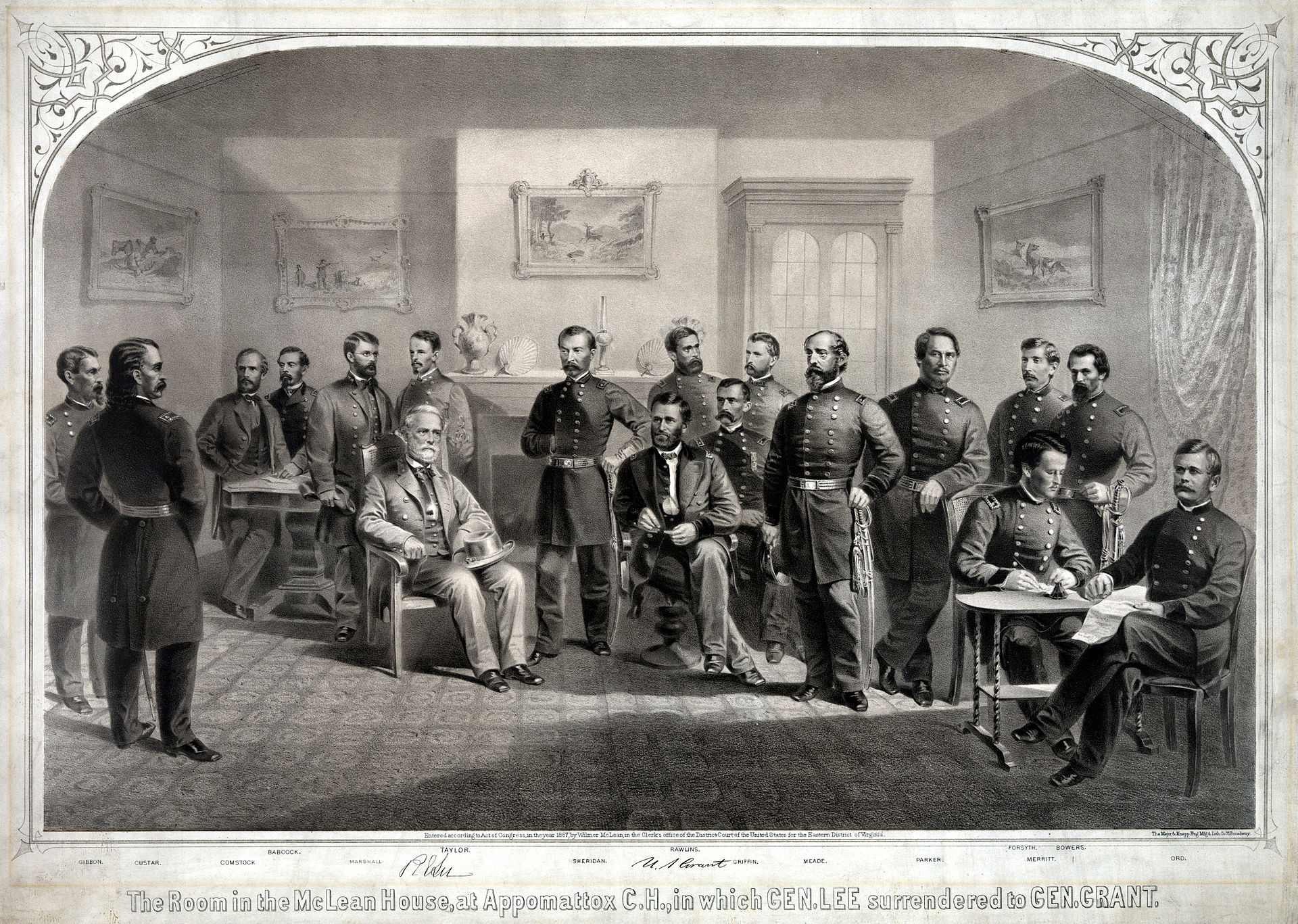
One hundred and fifty years ago today, the two generals met at the home of Wilmer McLean in the village of Appomattox Court House, Virginia. Four years earlier, McLean had lived near Manassas, Virginia, the site of the first real battle of the Civil War, First Bull Run. A Union artillery shell had crashed into his dining room. Vowing to avoid the war, he had moved to this location. He justifiably asserted: “The war began in my front yard and ended in my parlor.”

There in McLean’s living room, the two generals presented quite a contrast: Lee, taller, resplendent in impeccable, full-dress uniform, with sash and engraved sword; Grant with muddied trousers and muddy boats, wearing a simple soldier’s blouse, apologizing for his shabby appearance. The West Point graduates talked informally for a while. Lee, having graduated 14 years before Grant, said he did not remember meeting Grant during the Mexican-American War. Lee eventually directed their conversation to the matters at hand.

Lee_Surrenders_to_Grant_at_Appomattox, wiki

(Wikipedia.org)

          The surrender terms were generous, reflecting President Lincoln’s earlier guidance to Grant. The Confederate officers and men could return to their homes, “not to be disturbed by U.S. authority so long as they observe their paroles and the laws in force where they may reside.” They could keep their horses “to put in a crop to carry themselves and their families through the next winter.” Officers could keep their side-arms. Lee was grateful: “This will have the best possible effect upon the men and will do much toward conciliating our people.”

After the signing, Grant introduced Lee to his staff. As Lee shook the hand of Grant’s military secretary, he realized that the secretary was a native American. Lee remarked: “I am glad to see one real American here.” Ely Parker, a Seneca Indian  remarked: “We are all Americans.”

Two days later President Lincoln gave a prepared speech from a balcony of the White House praising Grant and the army and addressing the reconstruction of the Union. He included his view of favoring the enfranchisement of literate and veteran blacks. In the crowd listening was John Wilkes Booth who vowed: “That means nigger citizenship. Now, by God, I’ll put him through. That is the last speech he will ever make.”

Posted in Uncategorized | Tagged , , , , , , , , , | Leave a comment

Lincoln’s Second Inaugural Address

(This essay was originally published by the Newport Daily News as Lincoln looks to the future on March 5, 2015)

On March 4, 1865, Abraham Lincoln was sworn in to his second term as the president of the United States, giving a speech which many consider his best, even better than the Gettysburg Address.

He was elected for a second term in the election of November, 1864, an election which many argued should not take place under the press of war. Republicans were understandably concerned about conceding power to the Democrats who settled on former commander of the Army of the Potomac, Major General George B. McClellan, as their candidate. However Lincoln believed that such an event, so fundamental to democracy, could not be deferred, even in wartime.

Lincoln admitted: “…I have the common pride of humanity to wish my past four year’s Administration endorsed.” He believed that he could “better serve the nation in its need and peril than any new man could possibly do,” and wanted the chance “to finish this job of putting down the rebellion, and restoring peace and prosperity to the country.”

Lincoln, ironbrigader

Abraham Lincoln

(ironbrigader.com)

          March 4, 1865, broke wet and stormy. After the swearing in of Vice President Andrew Johnson in the Senate chamber, the presidential party moved to the east front of the Capitol to repeated cheers. In the large audience stood John Wilkes Booth and Frederick Douglass.  As he began his speech, like amazing grace from above, the sun pierced through the gray sky and uplifted the rain-soaked crowd. Chief Justice Salmon Chase took it as “an auspicious omen of the dispersion of the clouds of war and the restoration of the clear sun light of prosperous peace.”

The speech was a mere 703 words and took about seven minutes, the second shortest inaugural speech in US History. It was decidedly impersonal. After the opening paragraph, he did not use the word “I”; neither did he refer to any of his previous statements or actions. Rather he sought to understand the great conflict and to look with hope and compassion toward the future.

“All dreaded it—all sought to avert it.” “Both parties deprecated war; but one of them would make war rather than let the nation survive; and the other would accept war rather than let it perish.”

Turning to slavery, Lincoln said: “All knew that this interest was, somehow, the cause of the war.” He continued by indicating the faulty assumptions both sides made about the magnitude and duration of the war.

Lincoln then turned at length to a markedly religious vein: “Both [sides] read the same Bible, and pray to the same God; and each invokes His aid against the other. … The prayers of both could not be answered—that of neither has been answered fully. The Almighty has his own purposes.”  He then quoted the Bible: “Woe unto the world because of offences! for it must needs be that offences come; but woe to that man by whom the offence cometh!” In referring to the offense of slavery, Lincoln stated: “He now wills to remove [it], and … He gives to both North and South, this terrible war, as the woe due to those by whom the offence came ….”

2nd Inaugural,abrahamlincolnonline

“Abraham Lincoln Second Inaugural Address” by Alexander Gardner

(Library of Congress)

And then harshly he continued, “if God wills that [the war] continue,” until all the wealth of the slaveholder vanishes and until every drop of slave blood is repaid, “so still it must be said, ‘The judgments of the Lord are true and righteous altogether.’”

Lincoln ends with majestic compassion and magnanimity: “With malice toward none; with charity for all; with firmness in the right, as God gives us to see the right, let us strive on to finish the work we are in; to bind up the nation’s wounds; to care for him who shall have borne the battle, and for his widow, and his orphan—to do all which may achieve and cherish a just and lasting peace, among ourselves, and with all nations.”

After concluding, he turned to Chief Justice Chase and took the oath of office, ending with an emphatic: “So help me God!” He then kissed the Bible to the sound of an artillery salute and a cheering crowd.

Lincoln was not phased by the tepid initial reaction to the speech. He mentioned to Thurlow Weed that he expected it “to wear as well as—perhaps better than—any thing I have produced.” “Lots of wisdom in that document, I suspect.”

Frederick Douglass attended the reception which followed. Initially stopped by guards, he pushed his way through. Lincoln called out: “Here comes my friend Douglass. … There is no man’s opinion I value more than yours. What do you think of it?” Douglass responded, “Mr. Lincoln, it was a sacred effort.”


A retired Army officer, Fred Zilian teaches history, ethics, and political science at Portsmouth Abbey School and Salve Regina University and is a member of the Rhode Island Civil War Sesquicentennial Commemoration Commission Advisory Council. He is writing an occasional series of columns highlighting various aspects of the Civil War and their impact on Newport County and Rhode Island for The Daily News. Attend the Tribute to the Civil War and Abraham Lincoln on April 17 at the Jane Pickens Theater. Tickets at www.janepickens.com.


Posted in Uncategorized | Tagged , , , , , , , | Leave a comment

Women and the Civil War

(The essay was originally published as “Women and the War,” by the Newport Daily News on February 4, 2015.)

While most women were content to remain at home and to focus on the home and their families when their husbands went off to war, others took more active roles, some even hiding their gender to accompany their husbands to battle.

There were women who became notable for the roles they or their husbands played in the Civil War. Mary Todd, the daughter of a prosperous merchant and banker in Lexington, Kentucky, met and married Abraham Lincoln in 1842. Mary’s sister, Elizabeth, stated that Lincoln “was charmed with Mary’s wit and fascinated with her sagacity—her will—her nature—and culture.” They married in 1842 and had four children, all boys. Robert Todd Lincoln was the only son who reached full maturity. In 1861, they moved to the White House and lived there until the President’s death April 14, 1865.

  Mary_Todd_Lincoln, wiki

Mary Todd Lincoln, circa 1861

(wikipedia.com)

          Julia Grant, the wife of General Ulysses S. Grant, accompanied her husband at numerous times during the war. She was taken into custody by Confederate troops in Mississippi in 1862, probably the only time this happened to a wife of a general. When Confederate Brig. Gen. Nathan Bedford Forrest became aware of her identity, he reportedly said, “Pass that woman through the lines, and waste no time.” When Grant was at City Point, VA, for the long siege of Petersburg near the end of the war, she traveled there and made sure he frequently had “good home-cooked food.”

Julia Ward Howe, a talented, independent-minded woman—poet, writer, playwright, preacher, lecturer, and reform leader—spent much of her life at her “Oak Glen” country home in Portsmouth, RI. She is best remembered for writing “The Battle Hymn of the Republic” in 1861. She traveled to Washington, DC, met President Abraham Lincoln, and visited military camps in the area. During these visits she heard the tune popular at the time, “John Brown’s Body,” celebrating his martyrdom for the anti-slavery cause. As she lay in her hotel bed early one morning, the words came to her.  The poem was first published in February, 1862, was quickly put to the tune of “John Brown’s Body,” and became an unofficial anthem of the Union.

julia-ward-howe, poetryfoundn.org

Julia Ward Howe

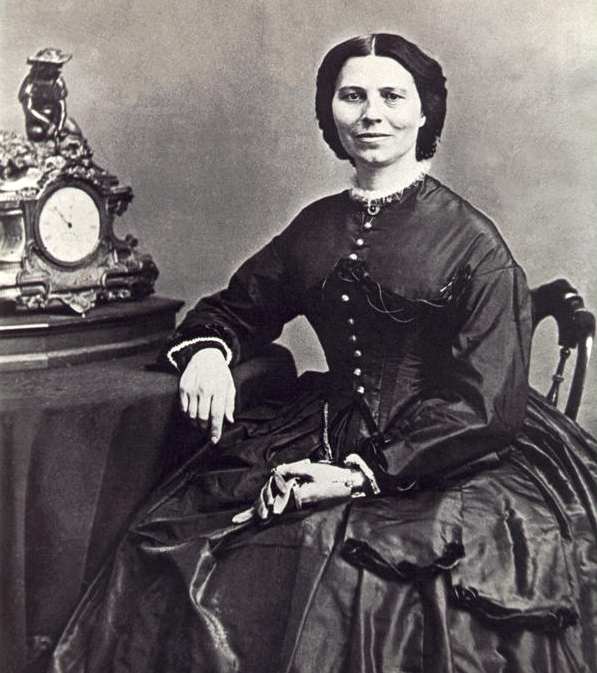
          Clara Barton of Massachusetts became convinced it was her Christian duty to help comfort and care for Union soldiers. In August 1862 she obtained permission to administer to soldiers on the front lines. She performed her mission at several battles, including Cedar Mountain, Second Bull Run, Antietam, and Fredericksburg. She became known as the “Angel of the Battlefield,” and after the war founded the American Red Cross.

wcbbrady

Clara Barton, circa 1866

(Photo by Matthew Brady, wikipedia. Com)

          A good many other women played less prominent roles. Some accompanied their husbands to war and served to meet their needs as well as the others around them, often acting as unofficial nurses. Harriet W. F. Hawley managed to stay with her husband when he took command of the 7th Connecticut Regiment. When Pastor Stephen Barker joined the 13th Massachusetts Regiment, his wife became a nurse for the unit. Mrs. John A Logan, the wife of an Illinois colonel, was able to find her wounded husband aboard the steamer New Uncle Sam and tended to his needs and other wounded men.

Mrs. John B. Turchin, wife of a colonel in the 19th Illinois Regiment, accompanied her husband to war and served as a nurse. In a campaign in Tennessee, her husband became very ill. Veterans of the unit stated that she essentially took command of the unit for ten days and briefly led it in combat.

The men of the 26th North Carolina Regiment noticed that Sam and Keith Blalock had a very close relationship. Keith explained that they had grown up in the same town and were distant relatives. The officers of the unit eventually discovered that Sam’s real name was Malinda, Keith’s wife.

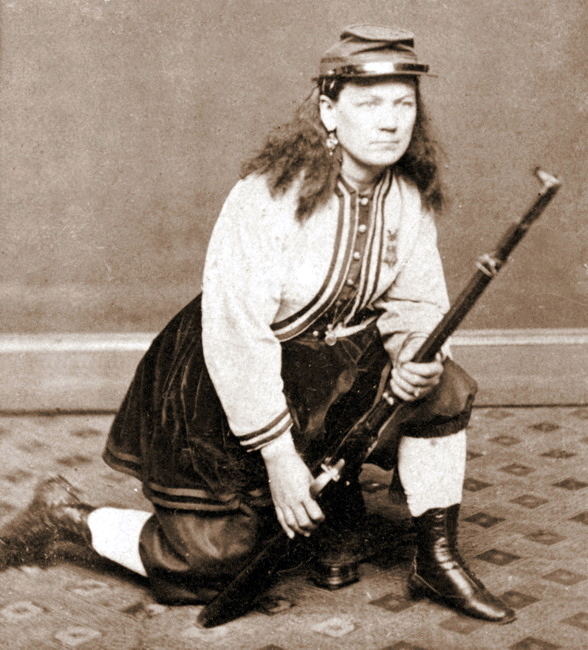
Robert Brownell and his wife Kady lived in Providence at the outset of the war. When Robert enlisted in the 1st RI Regiment and the unit left for the nation’s capital, Kady made her way there.  Both took part in the First Battle of Bull Run, Kady serving as temporary color bearer. She also accompanied her husband later in the war with the 5th RI Heavy Artillery when the unit saw action in North Carolina. Kady served as nurse and standard bearer.

Kady_Brownell, wiki

Kady Brownell of Providence wearing her self-made uniform

(wikipwedia.com)

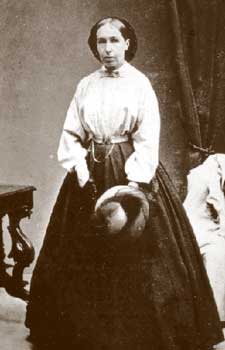
          Newport’s own Katharine Prescott Wormeley was one of the first women during the war to assist the Medical Bureau and Sanitary Commission in caring for sick and wounded soldiers. She was eventually named “Lady Superintendent” of Portsmouth Grove Hospital, here in Portsmouth, RI. She accepted the position in August 1862, and was responsible for its “domestic management.” The hospital came to be quite sizeable, with 28 ward buildings and 60 patients per ward.

katherine-prescott-wormeley

Katharine Prescott Wormeley of Newport

Posted in Uncategorized | Tagged , , , , , , , , , | Leave a comment

Amid Horrors of 1864, R.I. Soldier Perseveres

Through the battles, death, mud and misery of 1864, Elisha Hunt Rhodes, a Civil War soldier from the village of Pawtuxet, Cranston, was sustained by his indomitably positive spirit, a deep religious faith, and a firm commitment to the Union cause. Rhodes entered military service for the Union in July 1861, as a private and left it four years later as a colonel, serving most of his time with the 2nd RI Volunteer Regiment (Infantry).

He began this year with the rank of 1st lieutenant in the position of regimental adjutant. On June 7 he assumed command of the regiment and on June 26, achieved the rank of captain.

elisha_hunt_rhodes

          The miseries of warfare during his fourth year of the war continued. There was the stifling heat in summer and the frigid cold in winter. In early July he states that the temperature reached 124° and “the men are suffering severely.” On Dec 12 near Petersburg he writes: “It was so cold that riding was an impossibility, and as the snow turned to rain the men’s clothes became stiff with ice.” “We had no tents….” “We hovered over our fires half frozen until daylight ….”

Death at times surrounded him. In the Battle of the Wilderness in early May, Rhodes states: “The line surged backwards and forwards, now advancing and now retreating until darkness put an end to the carnage. Many men were lying upon the ground dead or wounded ….” The following day, he states: “Our Brigade charged in to the swamp six times, and each time were driven out. Darkness again put an end to the fighting, and we lay down amid the dead and wounded. During the night the brush caught fire, and many of the wounded burned to death.”

At the Battle of Cold Harbor in June, he writes: “Constant roar of Artillery and bursting of shells. Even as I write I saw one poor fellow shot down as he left his shelter.” In September after the Battle of Winchester, he indicates: “Our first duty was to bring in such of the wounded as were not found last night. The Taylor house and the Virginia House, the two principal hotels are used as hospitals and are full of wounded, while the churches as well as private houses are put to the same use.”

Rhodes himself was shot several times but miraculously escaped death. On May 6 he was struck in the right forefinger, which “only hurt me a little.” On May 12 he was hit in his right breast, tearing his coat, and bruising his right arm. It turned out to be just a surface wound.

On the lighter side, Rhodes writes about some of the simple pleasures he enjoyed, including animals. In September he writes: “My mare Katie is a beauty, and I enjoy the rides both on duty and for pleasure which I take every day.” He writes also of a new pet for his unit. “I selected one lamb from our flock, and we are to make a pet of it. We have named him ‘Dick’ and he is already a great favorite.” Unfortunately, in December the officers, short of cash, “sacrificed our sentiment and sold poor Dick to a butcher for $5.00 ….”

On July 4, he invited his officers to a dinner to celebrate the holiday. The bill of fare: stewed oysters (canned), roast turkey (canned), bread pudding, tapioca pudding, apple pie (made in camp), lemonade, cigars.

Rhodes witnessed black military units in action this year which changed his view of their fitness for combat. In June near Petersburg (VA) he writes: “I have not been much in favor of colored soldiers, but yesterday’s work convinced me that they will fight. So Hurrah for the colored troops!”

Having been at war for over three years, it is remarkable how Rhodes was able to maintain his positive spirit. At Cold Harbor in June he writes: “Every few minutes a shell comes screaming over, and then we run to our holes. It is amusing as well as dangerous. We are covered with dirt, but still I am happy.” Near Petersburg in July he states: “The Army presents a rather motley appearance now …. Still I am happy and probably the best contented man in the Army of the Potomac.” In December he states: “Two nights without sleep has a tendency to make me sleepy. Winter campaigning is cold work, but it is all for the Union, and I will not complain. I thank God that I have such good health and can stand it.”

His abiding faith in God and the Union cause clearly sustained him throughout this year. He regularly attended Protestant services on “the Sabbath” in many towns in the South, often noting the rebellious nature of the sermons.

He was determined to see the war through to its end, hoping for a Union victory. After campaigning in the ShenandoahValley under Gen. Philip Sheridan in October, he writes: “…I am tired of the bloodshed. But God has been good to me, and I hope I shall live to see the end as I saw the beginning of the Rebellion.” A few months later he writes: “I was sorry to leave the Shenandoah, for we have had a fine campaign, but duty is duty, and I do not complain. If it will end the war I am satisfied to go to any point they choose to send me.”

His final entry of 1864 comes in winter camp near Petersburg: “Goodbye old 1864. Your departure is not regretted, as it brings us so much nearer the end of the war. May God grant us success in the year about to open.”

(Note: This essay is based on Rhodes’ diary, published as “All for the Union,” Robert Hunt Rhodes, ed.)

Posted in Uncategorized | Tagged , , , , , | 1 Comment

The Great (Berlin) Wall of China

(This essay was originally published as “1989: A year of protests,” in the Newport Daily News on November 8, 2014.)

 Twenty-five years ago on November 9, 1989, the Berlin Wall fell, leading not only to the unification of East and West Germany but also to the toppling of communist regimes throughout Eastern Europe and in the Soviet Union.

By coincidence 25 years ago this year, student-led demonstrations in Tiananmen Square, Beijing, were suppressed by the Chinese armed forces, an event which my Chinese students tell me does not appear in Chinese history books—a non-event. The death toll is disputed; the government figure is 241 while others place it in the thousands.

Reminiscent of Tiananmen, demonstrations mainly by students and disaffected people in their 20s and early 30s have occupied central Hong Kong, wearing “Freedom Now” T-shirts, demanding a truly free election process for the chief executive of Hong Kong in 2017. Understandably the Chinese Communist Party worries over the potential damage to its “Berlin Wall”—the wall of its inviolable supreme sovereignty—if concessions are given to the protestors.

The Berlin Wall, built during the Cold War in 1961, isolated free, democratic West Berlin geographically within communist East Germany. It was built not so much to keep foreign forces out but rather, as is characteristic of totalitarian regimes, to keep East Germans—fleeing in ever increasing numbers—within. During its 28 years of existence, 408 people died trying to flee from East Germany.

The immediate factors which led to its fall came from outside the German Democratic Republic (East Germany). The most important factor was the set of reforms which Mikhail Gorbachev implemented in the Soviet Union and the Warsaw Pact. In 1988 he announced “freedom of choice” for socialist states within the Warsaw Pact, eliminating the requirement for ideological conformity. The Soviet Union followed by acquiescing in the first free elections in Poland. When Gorbachev visited Bonn in June of 1989, the possibility of genuine change was palpable when he agreed to a joint declaration that expressed “”respect for the right of peoples to self-determination.”

After these changes, Hungary decided in August 1989, not to honor the 1969 mutual assistance treaty that required the capture and return of individuals seeking to flee their own countries. On September 10, the border between Hungary and Austria was opened; the exodus to the west began.

Over the next months the initial trickle of refugees swelled into a river of refugees. During 1989 nearly 340,000 East Germans left for the west. The crowds in Leipzig, East Germany, grew from 70,000 on October 9 to 450,000 on November 6. The chants for the Wall to come down were soon joined by a new chant: “Germany, fatherland.”

General Secretary Egon Krenz and the reschuffled leadership decided to take a gamble and open the Wall on November 9. In the first week nine million Easterners visited the West. This was the breach which led ultimately to a national movement for German Unification on October 3, 1990.

It is not surprising that today’s protests in China are taking place in Hong Kong. Great Britain, with its history of constitutional monarchy, ruled it as a colony for 155 years. After a British-Chinese agreement in 1984, Hong Kong became in 1997 a “Special Administrative Region” of China under the principle of “one country, two systems.”

The Chinese leadership correctly fears a breach in its wall of supreme sovereignty. An essay in the Party’s main newspaper, the People’s Daily, indicated that allowing multiple parties in the Hong Kong legislature would spell trouble: “…competitive elections with ‘one man, one vote’ would be sure to quickly lead to a state of turmoil, chaos, even civil war.” Hong Kong’s leader, Leung Chun-ying, in late October stated that full democracy would involve a “numbers game” that would allow the poor too much power. If the report about party officials studying the French Revolution is true, one wonders if they see the parallel with the deadlock over voting in the Estates General in 1789.

With all the many differences between Hong Kong today and Berlin in 1989, the statements by party officials referring to unspecified “foreign forces” and the veiled references to the United States and Great Britain remind me of what former East German officers told me in 1991 when I asked them about their failure to intervene militarily in the demonstrations. They were also told that American agents were inciting the crowds; however, when they looked at the people they realized that they were common East Germans. Second, there were so many. Lastly, they stated that the demonstrators were so peaceful.

It is clear that along with studying the French Revolution, party officials should also be studying the fall of the Berlin Wall.

Posted in Uncategorized | Tagged , , , , , , , , , , , , , , | 2 Comments

The Columbus Day Debate

(This essay was originally published as “Don’t junk Columbus and other heroes,” in the Providence Journal on October 13, 2014.)

Like the celebration of Thanksgiving, which has been squeezed severely by the commercialism of Halloween at one end and Christmas on the other, Columbus Day has diminished in importance as an American holiday since FDR made it a national holiday in 1934 and therefore as a source of American identity.

Hawaii, Alaska, Oregon, and South Dakota do not recognize it at all. South Dakota renamed it “Native American Day,” and California and Texas do not recognize it as a paid holiday for government workers. Several cities, such as Berkeley, California, have replaced it with “Indigenous People’s Day.”

Here in Rhode Island, Columbus’ image is still strong, even though my US History students shrug in indifference when I mention his name. Once again Newport should be celebrating Columbus Day with its annual Columbus Day Parade through the heart of the city, ending at the Columbus statue at Memorial and Bellevue. It is a handsome statue with Columbus atop, holding a small globe in one hand. In the granite pedestal are engraved the words: “Discoverer of America.”

Critics of Columbus and this holiday argue from two primary vantage points. The first emphasizes the negative effects of what he began: Historians call it the Columbian Exchange, a tremendous exchange of plants, animals, insects, disease, technology, and humans. The second strand of criticism focuses on his undesirable character traits, such as his self-promotion and desire for noble status. These criticisms suffer in that they judge him by our ethics and not those existing at the time. Also, the critics may not fully appreciate or admit how they, themselves, might have acted at that time. Let’s not forget that native American tribes could be bitter enemies and sometimes welcomed European settlers for their technology and their support in seeking to dominate other tribes. Cortes and the Spanish, for example, were able to conquer the Aztecs in part because of the allied support from other native American tribes who hated the Aztecs.

Our own Ivy League school, Brown University, founded ironically with money in part from the slave trade beginning with the Columbian Exchange, eliminated “Columbus Day” in 2009. The student group, Native Americans, led a protest “after controversy arose over the nature of Christopher Columbus’ conquests and treatment of Native Americans.” By a voice vote, the faculty voted to end Columbus Day in favor of “Fall Weekend.” Quite understandably, John Brown (more irony), the medicine man of the Narragansett Indians, was delighted and said, “… people are beginning to see from a historical point of view that Christopher Columbus was no real hero.”

Heroes and role models are part of the glue which holds civilizations together. The ancient Greeks had their Odysseus and other warriors whose exploits, in the works of Homer, provided for centuries the moral code Greeks used to educate and socialize their children. The ancient Romans had their Aeneas and also their Romulus and Remus.

(USA Today)

We must use caution in chiseling away too many of our heroes if we are to endure as a vibrant civilization. Granted we still have other sources of shared identity: our remarkable, oft-plagiarized Constitution, American Jazz, baseball, our vibrant entertainment culture, and our ethos of freedom and democracy as sources of American identity. However, fiddling too much with these well-springs, especially our heroes, can prove perilous. Are we to dethrone Thomas Jefferson, the principal writer of our Declaration of Independence, not only for owning slaves but probably siring six children with one of those slaves, Sally Hemings? Are we to dethrone Franklin Delano Roosevelt for his adulterous affairs? And what of Martin Luther King, the only person for whom we have dedicated a national holiday? Should his courageous deeds be ripped from our history books because of his infidelity to his wife? Like Christopher Columbus, these men—along with even George Washington and Abraham Lincoln—had what could be viewed as character flaws. This does not deny their heroism; rather, it confirms their humanness.

We should keep Columbus on his pedestal and teach our children, in increments, both his virtues—his courage, tenacity, leadership, and vision –and his foibles. However, let’s be sure to continue to name our streets, towns, counties, lakes, community colleges, and parks after native Americans. (I myself was born in Passaic, NJ; my first car was a Pontiac.) Along with statues of Columbus, let’s also erect statues of Squanto, Massasoit, and Geronimo, and tell our children about their virtues … and shortcomings.

Posted in Uncategorized | Tagged , , , , , , , , , , | Leave a comment

To Help Climate: Decrease Footprint; Increase Handprint

(This essay was originally published in the Providence Journal on October 7, 2014.)

President Obama’s speech at the United Nations on September 23, underlining the urgency for action on climate change to over 100 assembled world leaders at the UN Climate Change Summit, was a welcomed antidote to the continued ominous scientific data on our climate.

This summer was the hottest on record (since 1880), 1.28° F warmer than the 20th century average. In early September, the UN’s World Meteorological Organization announced that the level of carbon dioxide—the most significant greenhouse gas—in the atmosphere had reached 396 parts per million in 2013, an increase of 2.9 ppm from the 2012 level. Before the Industrial Revolution of the 18th-19th centuries, the level was 280 ppm. The huge glaciers on Greenland and West Antarctica continue to melt, contributing to the rise in sea levels, potentially threatening such coastal cities such as Boston, New York, Miami, New Orleans … and our own Providence and Newport. The evening news no longer seems complete without some type of extreme weather event. Such news has gone from the extraordinary to the commonplace.

In addressing the UN General Assembly, the president asserted that the United States would succeed in its pledge to reduce no later than 2020 its carbon emissions by 17% from 2005 levels. As he is pushing our power plants to curb their carbon emissions, he called on China—the world’s largest polluter—to follow suit. He went on to state: “We can only succeed in combating climate change if we are joined in this effort by every nation, developed and developing alike.”

The Sunday before the summit, grass roots’ concern and hopes were on display in New York in the form of a People’s Climate March in which over 300,000 marched a 2.2 mile route through the city. One of the many banners on display said, “There is no Planet B.” Marches also took place in other cities around the globe.

Close to home this summer, I was pleasantly surprised to see for the first time recycle bins at the entrance to Clements Market here in Portsmouth. There are three separate bins: a brown one for trash, a blue one for cans and bottles, and a green one for paper products, reminding me of the containers I had seen in Germany in 1990.

My friends have asked me: What can we as individuals do to combat climate change? The first imperative is attitudinal: We must change the way we think of the environment. Instead of thinking of it as a bottomless trash dump, able to take all the pollution we dish out without any negative repercussions, we must recognize that the environment has its limits and that it will answer back. We must appreciate the impact our actions have on the environment and strive to adopt a model of sustainable living. Former Secretary of the Treasury Henry M. Paulson, Jr. has written: “Climate change is the challenge of our time. Each of us must recognize that the risks are personal. We’ve seen and felt the costs of underestimating the financial bubble. Let’s not ignore the climate bubble.”

Practically speaking, here are some ideas for reducing one’s individual “footprint” (negative impact on the environment) and increasing one’s “handprint” (positive impact). 1. Start a compost heap. Recycle appropriate food waste including egg shells, fruit & vegetable waste, and coffee grinds. 2. Start a vegetable garden. Place the composted matter into the garden each year. 3. Buy produce locally—less transportation and packing. 4. Reduce the use of plastic products, especially drinks in plastic bottles and plastic bags. The bags take years to decompose and can find their way into our water supplies and oceans. 5. Drive the car less. Car pool, ride a bike, and walk more. Be sensitive to your next vehicle’s miles-per-gallon rating. 6. Turn off lights not in use and install energy-saving bulbs. 7. In winter, wear a heavier sweater and turn down the thermostat; in summer, turn up your air conditioning. 8. Plant a tree. Trees eat carbon dioxide and release oxygen. 9. Install a clothes line in the yard. Use the dryer less and the line more. Heating elements draw much electricity. 10. Recycle, of course, and be sure to recycle all that junk mail.

Posted in Uncategorized | Tagged , , , , , , , , , | Leave a comment

World War II Begins

(This essay was originally published by the Newport Daily News as “Long March Back to War,” on August 30, 2014.)

Seventy-five years ago today, Nazi Germany attacked Poland and began World War II, a war that lasted until August 1945, killing at least 50 million people and witnessing the only use of nuclear weapons in war. This war, even more than WWI, was a “total war:” forcing participants to mobilize and employ all segments of their societies.

The roots of this war lay in World War I and its aftermath. Indeed some historians consider the two wars as one war containing twenty-one years of unstable peace. In this view the most important factor in explaining its outbreak is the failure of the peace settlements at the end of WW I to establish a sufficiently stable international system, leaving too many major powers angry or unsatisfied. Germany, disallowed from the negotiations, felt that the Treaty of Versailles was “dictated” and that it was unduly harsh. Its army was reduced to 100,000, its navy was diminished, and its air force was eliminated. Most irritating was the so-called “War Guilt Clause,” declaring that Germany (and Austria-Hungary) was responsible for the war and ordering Germany to pay reparations for all the damages “imposed upon them by the aggression of Germany and her allies.”

Italy, one of the victors, was so upset that it abruptly left the peace conference when the lands it desired were given to other countries or given independence under President Woodrow Wilson’s principle of “self-determination.”

Even before World War I, the modernizing government of Japan—one of the victors in the war—sought to build an empire. It defeated the Chinese in the First Sino-Japanese War of 1894-95, defeated the Russians in the Russo-Japanese War of 1904-05, and annexed Korea in 1910. WW I seemed to whet its appetite for empire even more. When Western powers rejected its recommendation for a racial equality clause in the charter of the new League of Nations, it began its tilt away from the West.

After the WW I armistice, sincere efforts were made to ensure peace and to prevent aggression. The single most important demand of President Wilson during the peace negotiations was the formation of a “league of nations” to prevent future wars. While Wilson’s proposal was eventually adopted, the US Senate never ratified the Versailles Treaty and hence never joined the newly-created League of Nations. In 1921-22 the US hosted the Washington Arms Conference, the first arms control conference in history, resulting in three major arms limitation treaties. In1928 the US and France negotiated an international agreement, the Kellogg-Briand Pact signed by sixty-three states, which pledged “to renounce war as an instrument of national policy.”

Despite such efforts, world leaders seemed unable to make World War I truly the “war to end all wars.” The Great Depression only exacerbated the political tensions already in place, especially regarding Italy and Germany and their new ideology of fascism, named after the fasces of the Roman Empire. (This was a bundle of rods and an ax with a blade projecting outward, a sign of authority of a Roman magistrate.) This ideology was totalitarian in that it sought complete control of all segments of society. It was hyper-nationalistic and also pro-capitalism, seeking to exploit both for the benefit of the state.

roman-fasces

Roman fasces

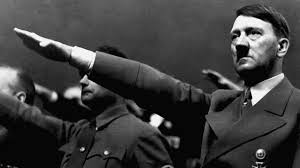
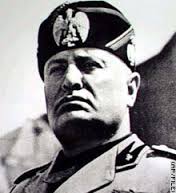
        In both Italy and Germany, strong, charismatic leaders took control of the governments and used intimidation and force to eliminate enemies and quickly control society. In Italy Benito Mussolini and his Fascist blackshirts took control of the government in 1922. In Germany an aging President Hindenburg appointed Adolf Hitler chancellor in 1933.

Hitler

 Adolf Hitler

(bbc.co.uk.com)


Mussolini

Benito Mussolini

(resourcesforhistoryteachers.wikispaces.com)

 Next to the failure of the WW I victors to establish a stable peace, the second factor in the coming of WW II was the rise of Hitler and his Nationalist Socialist Workers’ Party (Nazis). Hitler quickly moved to instill a sense of hope and pride in the German people and to reverse the terms of the Versailles Peace Treaty. In 1935 he publicly announced the rearmament of Germany, in violation of the Treaty. In 1936, Germany reoccupied with military forces the Rhineland, an area on Germany’s border with France which had been demilitarized after WW I. In 1938 it annexed the Germanic country of Austria (portrayed in the famous musical, The Sound of Music). He next demanded that the Sudetenland, a mostly German populated area within the boundaries of Czechoslovakia, be given to Germany. At the infamous Munich Conference of September 1938, the British and French government leaders acquiesced, an act that has become the most referenced example of ignominious “appeasement.” British Prime Minister Neville Chamberlain proclaimed that he had achieved “peace in our time.” In several months however, Germany seized the rest of Czechoslovakia. A third factor then in the coming of WW II was the inability of the key Western powers to stand up to the rising fascist states.

2Q==

Germans Marching through Warsaw

(National Archives)

         After concluding a Non-Aggression Pact with the Soviet Union on August 23, Germany invaded Poland on September 1, 1939. The Soviet Union joined the attack on September 17.

Posted in Uncategorized | Tagged , , , , , , , , , , | 4 Comments