
This is the text of the speech I presented at the 250th event at Bulgarmarsh Park, Tiverton, RI, on June 14, 2026.
Ladies and Gentlemen, thank you for inviting me to speak today on this historic occasion. My subject: The Liberty Pole and American Freedom. Let me begin by explaining the origin of the liberty pole. Then let’s jump to the liberty pole and the American Revolution. Finally, some thoughts on American Liberty & Freedom today.
I. Origin:
The liberty pole, that is, a wooden pole, or perhaps a spear, topped by a “cap of liberty,” originated in 44 BCE, when a group of senators assassinated the Roman dictator, Julius Caesar. You recall that he had been declared dictator and then eventually dictator for life. This was too much for a large group of senators of republican Rome.
After he was killed, the assassins marched through the streets with their bloody weapons held up. One was carrying a pileus, a hat of a freed slave, on the tip of a spear. This symbolized that the Roman people had been freed from the rule of Caesar, which the assassins claimed had become a tyranny.
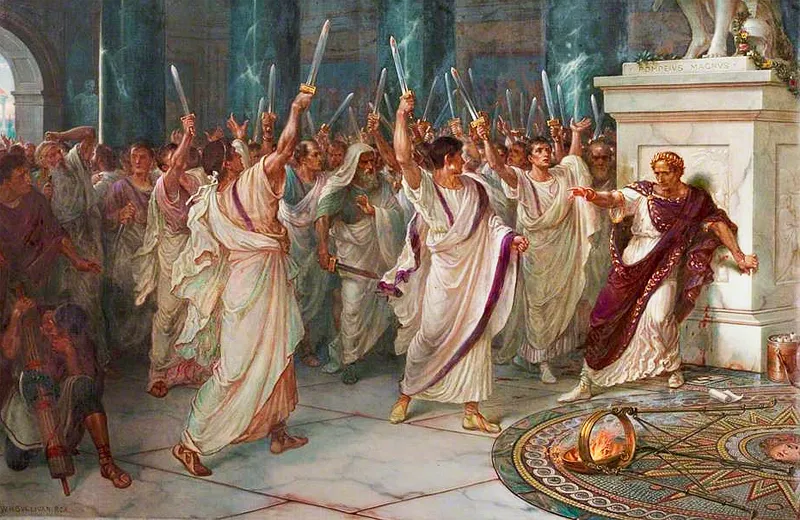
By the 1600s, the liberty pole had become a common element in the depiction of liberty, perhaps in small images, but later also as an actual large physical object planted in the ground, used as a type of flagstaff.
II. American Revolution
During the revolutionary period, 1763-83, liberty poles were often erected in town squares where they became symbols of dissent and resistance to British rule. For example, they appeared in Concord, Massachusetts, Newport, Rhode Island; Caughnawaga, New York; Savannah, Georgia and Englewood, New Jersey. Some colonists erected liberty poles even on their own private land.
The British royal authorities would have them torn down, only to be replaced by new ones erected probably by the Sons of Liberty, an organization of men who led the resistance against British rule.
In New York City, an often violent struggle over liberty poles raged for 10 years during the revolutionary period. For example, in January 1770, a group of off-duty British soldiers became enraged with the insults of the colonists. They decided to ransack the Golden Hill Tavern, frequented by the Sons of Liberty, and topple the liberty pole nearby. The Sons gathered in protest and attacked the soldiers who retreated back to their fort. The Sons then erected a new, massive pole, 80 feet tall, and topped it with a weather-vane inscribed with the word, “Liberty.”
During the Siege of Boston on August 1, 1775, a tall liberty pole was erected on Prospect Hill, a fortified high-ground in Cambridge overlooking the road to British-occupied Boston.
When a flag, usually red, was raised on a liberty pole, it would signal the need for the Sons of Liberty or townspeople to meet on some matter of British rule.
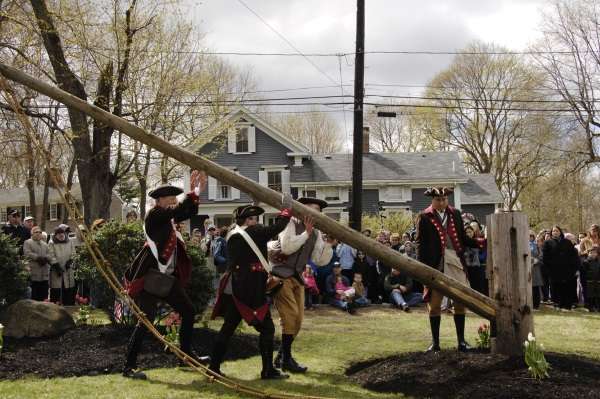
In some locales—notably in Boston—a liberty tree rather than a pole served the same political purpose. You may know that this year in virtually every RI municipality we are planting liberty trees to commemorate the 250th. In April the town of Newport planted its fifth Liberty Tree since 1766, when Newporters gathered at the tree to protest the Stamp Act.
III. American Liberty & Freedom Today
Now in my final section, let me challenge all of us a bit as citizens of these United States celebrating our Liberty & Freedom.
These words have always been important to Americans. Today they are ubiquitous in our economy and culture.
- In my personal life, I see it all the time. I do business with Liberty National Life Insurance, Liberty Wealth Advisers, and Liberty Tax Services (Middletown)
- The other day I drove by Liberty Laundromat in Bristol
- The word “freedom” frequently appears in our songs. I think of songs by The Eagles and Aretha Franklin. At Woodstock in the summer of 1969, Richie Havens was plugged in as the first performer. When he ran out of songs, what song did he improvise? “Freedom”
- About 31 cities in the US named Liberty (or with liberty in name)
- In the TV ad, Ted Danson asks us to switch to Consumer Cellular commercial: to switch, call 888.FREEDOM
- The New Hampshire license plate: Live Free or Die; Pennsylvania: Let Freedom Ring
- Our highest civilian award: Medal of Freedom
My hope is that we all take this occasion of the 250th of the American Revolution, not only to raise liberty poles and plant liberty trees in celebration and commemoration, but also to raise and face the hard questions of democracy, of self-government, that we enjoy not only the fruits and fun of freedom, but also do the hard work required to perpetuate that freedom.
So, I have a recommendation and three challenges for all of us.
My recommendation relates to the time period of our commemoration. I think we misrepresent this year as a celebration of the American Revolution. It’s more appropriate to call it a celebration of the signing of the Declaration of Independence, marking the revolution in our relationship to Great Britain.
A true celebration of the entire Revolution would last not one year but 12. It was not until 1788, after the failure of the Articles of Confederation and the ratification of our new Constitution, that we had a viable national governmental system.
Twelve years sounds like a long time for a celebration; however, we have much work to do. Let me challenge us with at least three things we need to do to keep this exercise in self-government alive—to perpetuate and perhaps even extend real freedom for more people.
First, we need to get to know each other again. We are a nation of nations; that is a collection of different peoples with different languages, religions, and cultures. There were many Native American nations here when the first European settlers arrived, and many disparate immigrant groups arrived in the succeeding centuries, not to mention the hundreds of thousands of Africans who were forced to come to British North America since 1619.
We had great success in building a common country which in the 20th Century became a superpower and the leader of the free, democratic West. However, many forces have pulled us apart over the past 60 years. The latest of these are the Smart Phone, Cable TV, and the COVID pandemic. The first two have given us so many conveniences and options for information but have also weakened our inter-personal bonds. And these are the bonds that count when a country comes under stress.
Second, we must elect leaders of character and force them to act with integrity. We cannot have leaders who, once elected, retreat into personal gain and incivility to us and to their fellow political leaders. We must restore a code of honor and civility if we want to maintain a democracy. Other forms of government, especially authoritarian types, do not need this. However, in a democracy civility is a necessary oil to keep the machine running smoothly. Without it, genuine communication and that all important activity in a democracy—compromise—wither and die.
Third, because we are a democracy, living in the same house, we need to reaffirm our fundamental beliefs. Ultimately, we are a nation bound not by blood, background, or wealth, but by common values and ideas. Thomas Jefferson, although a slave holder of hundreds of enslaved Africans, wrote the first and unalienable one: that all human beings are created with the same fundamental rights, not related to one’s skin color, name, gender, religion or background. During these twelve years, let us discuss and debate, ask and argue, and try to define those fundamental beliefs. And after we do this—after we redefine and reaffirm our American Creed—let us engrave it in stone somewhere high and prominent for all to see.
Ladies and gentlemen, let us celebrate today, this month and next, let us tip our glasses together, play some John Philip Souza music, and watch some fireworks. But let us also gird ourselves for the necessary work of democracy and freedom to be done these next 12 years.
Let me leave you with the words of that latter day Founding Father, Abraham Lincoln. He said: “If destruction be our lot, we must ourselves be its author and finisher. As a nation of free men, we shall live through all time or die by suicide.
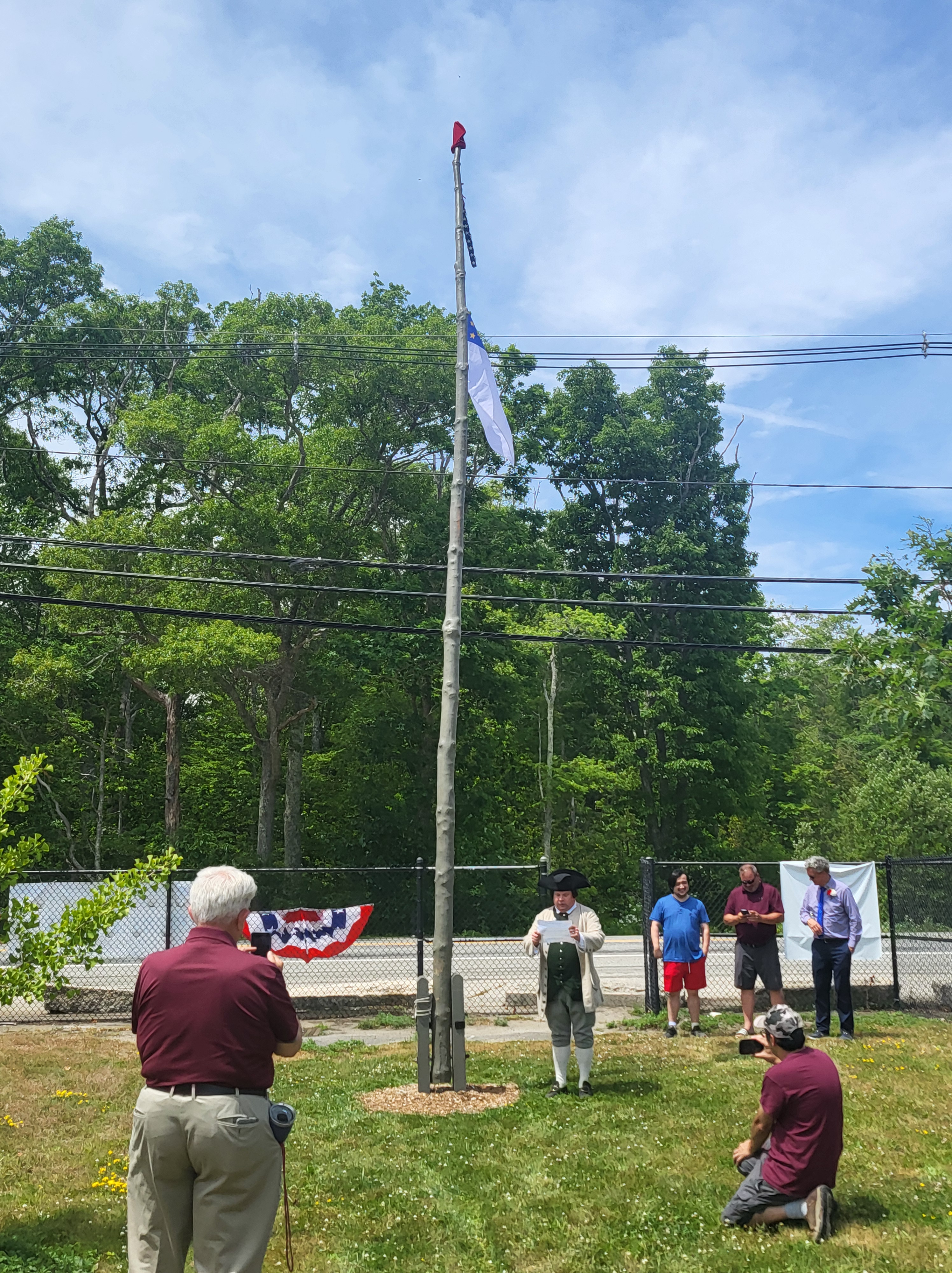
Raising of the Liberty Pole, Tiverton, RI, June 14, 2026


