From Slavery to Greatness

(This essay was originally published by the Newport Daily News on May 7, 2014.)

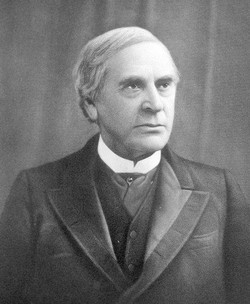
Next to Martin Luther King, Frederick Douglass was probably the greatest African-American in US history. Unlike King, Frederick Douglass—born Frederick Bailey in February 1818—was not killed by an assassin’s bullet, but rather lived until January 9, 1895.

Douglass was born a slave. His mother, Harriet Bailey, was black, while his unknown father was white, perhaps Colonel Edward Lloyd, the plantation owner, or one of Lloyd’s sons. He lived on the eastern shore of Maryland and also in Baltimore until the age of 20 when he and his future wife, Anna Murray—a free black—escaped. With a sailor’s garb and false free black seaman’s papers, Douglass and his wife in 1838 made their way through Philadelphia, New York City, and Newport to their final destination of New Bedford, Massachusetts, a town with a total population of 12,354, including 1051 blacks. Having never been to a free state, Douglass was surprised at the “wealth, refinement, enterprise, and high civilization” of the city, believing that “poverty must be the general condition of the people of the free states.” Before he left Baltimore, he had changed his name to Johnson. On the advice of his friends, he now changed his name to Douglass. Working as a free man and earning decent pay, he was “imbued with a spirit of liberty.” Within a few years, Douglass, Anna, and their three children became respectable members of the black community.

During his years in New Bedford, Douglass came to realize his tremendous gift of oratory which he soon employed in the great cause of the day—abolitionism. William Lloyd Garrison led this movement, and soon Douglass was reading his newspaper, The Liberator. Garrison’s words, ideas, and unwavering conviction helped to crystallize Douglass’ calling. This gift of oratory made its debut at the annual meeting of the Massachusetts Anti-Slavery Society on August 16, 1841, on Nantucket. With his personal story of slavery and his powerful voice, he succeeded in transfixing the audience. He had found his calling, and he would be heard.

Over the course of the next two decades, Douglass made over one hundred speeches each year in the antislavery crusade leading up to the Civil War in 1861. This young man, who learned the power of words early as a slave boy studying Webster’s Spelling Bee and then later The Columbian Orator, was not only a great orator but also a great writer. He wrote for Garrison’s newspaper and other publications, including his own antislavery newspaper, The North Star, and eventually the Douglass’ Monthly. During his lifetime he also wrote three books, all autobiographical. With his violin he enjoyed playing Mozart, Haydn, and Haendel.

Douglass_c1860s, wikipedia

Douglass circa 1860s

 (Wikipedia.com)

         During the Civil War, Douglass worked tirelessly for the emancipation of slaves and for equal rights for African-Americans. In 1848 he first met the zealously antislavery John Brown and learned of his bold scheme to foment a slave insurrection and to establish a black state in the Appalachian Mountains. Douglass resisted participating in Brown’s seizure of Harpers Ferry, Virginia, in 1859; however, he had knowledge of it and was pursued by his enemies. Douglass fled to first Canada and then Great Britain, returning the following year after the death of his daughter.

Striving to maintain as many states as possible in the Union, President Abraham Lincoln emphasized until September 1862, that the paramount goal of the war was to restore the Union and not to abolish slavery. Douglass and other abolitionists attempted to change his mind. “Sound policy … demands the instant liberation of every slave in the rebel slaves,” said Douglass. He also argued for the recruitment of blacks into the Union military forces. In January 1862, he said, “We are striking the guilty rebel with our soft, white hand, when we should be striking with the iron hand of the black man.”

After Emancipation on January 1, 1863, Douglass had his first of three meetings with President Lincoln. During the first in August 1863, Lincoln defended his policies toward blacks and hoped that Douglass saw this not as “vacillation” but as slow but steady progress in securing the rights of blacks. Douglass left the meeting jubilant over Lincoln’s gracious and respectful manner toward him.

After the Civil War he championed the vote for blacks—and women, and served as the president of the Freedman’s Bank in Washington, D.C., as the marshal of that city, and as the American minister to Haiti. These years were filled with frustrations, defeats, as well as triumphs; however, Douglass never relinquished his efforts for full racial equality in America, or—like Martin Luther King—for our country to live up to the promises in its founding documents.

Posted in Uncategorized | Tagged , , , , , , | Leave a comment

The Seeds of Inhumanity: Rwanda’s Genocide

(This essay, abridged, was originally published by the Newport Daily News on April 8, 2014, as “After Rwanda, can world say: ‘Never again?.'”)

Twenty years ago this month, the world watched what was probably the fastest genocide in modern history take place in Rwanda, killing some 800,000 Rwandans in just over three months. The United Nations dithered; the United States balked. While the international system has made some progress during these two decades in preventing such horrors, the genies of genocide still persist.

Within the space of 100 days, April-July, 1994, extremist Hutu Rwandans massacred mostly Tutsi Rwandans and the more moderate Hutu Rwandans. The figure totaled almost 10% of the population of this small, central east African country. A comparable massacre in the U.S. would equate to killing over 30 million. Kingsley Chiedu Moghalu, Special Counsel and Spokesman of the International Criminal Court for Rwanda, has asserted that this genocide was three times faster than the Holocaust: 333 murders per hour; five and one-half lives per minute. While guns and hand grenades were employed, mostly used were thousands upon thousands of machetes, along with hoes and clubs studded with nails. A witness indicated: “there are no more devils left in hell; they are all in Rwanda.”

Numerous factors, underlying and immediate, have been cited to explain this mammoth massacre. Underlying factors included: European colonial rule by the Germans and then Belgians who favored the generally lighter-skinned Tutsis; the historical domination of the Tutsis, about 14% of the population, over the Hutus, about 85% of the population; repeated, mutual killings over the three decades between Rwanda’s independence in 1962 and the genocide; the Hutu formation of the Rwandan Patriotic Front and its Army’s subsequent invasions into Rwanda from neighboring countries; world economic conditions along with drought which caused an economic crisis in Rwanda; the presence of many desperate young Rwandan male refugees which fed the formation of armed militias; competition among rival Hutu political groups; population pressure on limited arable land; and finally venomous racism. The spark that set Rwanda ablaze was the downing on April 6, 1994, of the plane carrying Juvénal Habyarimana, the Hutu president, an event Hutu extremists blamed on the Tutsis.

By illuminating demographic and environmental factors, Jared Diamond, in his book, Collapse, enriches our understanding. With a population growth averaging 3% over many decades, Rwanda, by 1990, had a high average population density of 760 people per square mile. He clarifies the genocide was not simply a matter of an angry, ethnic majority—economically and politically disadvantaged for centuries—finally seizing power and settling scores gruesomely. Not only were Hutus massacred, so were the Twas (pigmies). Also, three rival, mainly-Hutu factions were vying for power. In Northwest Rwanda, most people were Hutu, but there were mass killings there almost on the scale as in other parts. Lastly, as Hutus killed Tutsis, Hutus also started to kill other Hutus. He concludes that population pressures on limited arable land was also a key underlying factor. It was not uncommon to hear Rwandans say that violence is sometimes necessary to bring population in line with available land resources.

The small land-locked country of Rwanda, in an economically anemic continent, did not have the strategic pull to provoke the United Nations, a major power, of any “coalition of the willing” to intervene to stop the fast-paced slaughter. The UN Security Council president’s statement of April 30 avoided the use of the term “genocide,” deleted from an earlier draft by pressure from the US supported by China and Great Britain. The UN Assistance Mission for Rwanda (UNAMIR), the peacekeeping operation there since 1993, was feckless. The United States, still smarting from the loss of 18 Americans in the debacle in Somalia in 1993, could not muster the will to intervene, either alone or with its French or Belgian friends. The US also rejected proposals from the UN to jam the Hutu-dominated radio hate campaign, one which clearly fanned the massacre’s flames. The Department of Defense argued that it would cost $8500 an hour to fly the necessary aircraft over the country and also raised the issue of Rwanda’s sovereignty.

Happily, the world did intervene afterward judicially. On November 8, 1994, the UN created the International Criminal Tribunal for Rwanda, “established for the prosecution of persons responsible for genocide and other serious violations of international humanitarian law…” in that country, since then completing 75 cases. This progress in international law notwithstanding, it would be a mistake to believe our inhumanity toward each other has been vanquished. Was this not believed after the Holocaust, Bangladesh, Cambodia, and the former Yugoslavia? And recently, we have Darfur, Sudan. The genies of genocide still abide: fear, revenge, prejudice, power, desperation, resource limitations, and devotion to the commands of a diety, a state, an identity group, or a demagogue.

Posted in Uncategorized | Tagged , , , , , , , , , , , , , | 5 Comments

Julia Ward Howe, Author of Battle Hymn, Spent Much of Her Life in Portsmouth

(This essay was originally published as “Beyond the ‘Battle Hymn,'” in the Newport Daily News on March 22, 2014.)

Julia Ward Howe, a talented, independent-minded woman of the 19th century—poet, writer, playwright, preacher, lecturer, and reform leader—spent much of her life at her “Oak Glen” country home in Portsmouth, Rhode Island.

She is best remembered for writing “The Battle Hymn of the Republic” in 1861. She traveled to Washington, DC, met President Abraham Lincoln, and visited military camps in the area. During these visits she heard the tune popular at the time, “John Brown’s Body,” celebrating his martyrdom for the anti-slavery cause. As she lay in her hotel bed early one morning, the words came to her.  She explained: “I awoke in the gray of the morning twilight; and as I lay waiting for the dawn, the long lines of the desired poem began to twine themselves in my mind. Having thought out all the stanzas, I said to myself, ‘I must get up and write these verses down, lest I fall asleep again and forget them.'”

        The poem was first published in the Atlantic Monthly magazine in February, 1862, and was quickly put to the tune of “John Brown’s Body,” becoming an unofficial anthem of the Union. For it, she received a mere $5.00 from the magazine editor.

julia-ward-howe, poetryfoundn.org Julia Ward Howe circa 1865

(poetryfoundation.org)

        Howe’s other notable achievements are often forgotten. She was clearly a woman ahead of her time on many fronts. Even as a young woman, she clashed with her father and eventually her husband, Dr. Samuel Gridley Howe, twenty years her senior, both of whom wished her to be the more conventional, deferential, domestically-oriented type of woman. A gifted writer, she achieved great literary success. By the age of 17, she was contributing to literary magazines. In 1852, she published Passion Flowers, dealing with Italian and Hungarian patriots, and in 1853, Words for the Hour. She soon became a regular contributor to the new periodical, The Atlantic Monthly. When she and her husband joined the anti-slavery crusade, she became an editor and writer for her husband’s journal, The Commonwealth. She also co-edited and wrote for The Woman’s Journal. She had many other published works, including: Sex and Education, Modern Society, Is Polite Society Polite?, Reminiscences, and two tragic plays Lenore and Hippolytus.   Fluent in seven languages, she was the first woman elected to the Society of Arts and Letters.

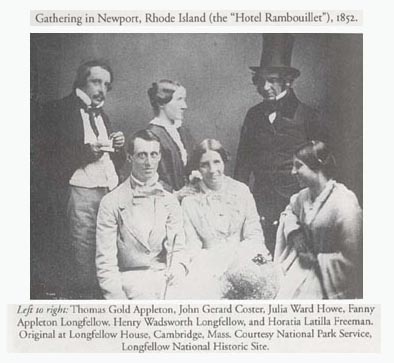
Howe and Friends, juliawardhowe.org (juliawardhowe.org)

        While contributing to such causes as the abolition of slavery, education reform, and prison reform, her greatest energy was devoted to women’s suffrage. She wrote and lectured widely on it for most of her life both in the US and in England and eventually served as the president of the New England Woman’s Suffrage Association.

Howe was deeply distressed by the physical, social, and psychological devastation she had witnessed during the Civil War. With the wars of German Unification erupting in Europe, she called on women everywhere to oppose war in all its manifestations. Howe hoped to join women across nationalities in the cause of universal peace, issuing a “Mother’s Day Proclamation” in 1870.

Arise then …women of this day!

Arise, all women who have hearts!

Our husbands will not come to us, reeking with carnage

Our sons shall not be taken from us …

Her efforts helped to lay the foundation for the establishment of Mother’s Day as a national holiday in 1914.

This distinguished, national celebrity spent much of her life at her beloved country home, “Oak Glen,” now 745 Union Street, in Portsmouth, Rhode Island. The Howes bought the 4.7 acres, overlooking Lawton Valley, in 1852. She and her husband had homes in both Boston and Newport; however, they decided to establish this home “out in the country.” Other wealthy individuals like Cornelius Vanderbilt and H.A.C. Taylor, also had farms in Middletown or Portsmouth to grow crops and flowers and to maintain prize horses and livestock.

oakglen, juliawardhowe.org

Oak Glen in later 19th century

(juliawardhowe.org)

        At Oak Glen the Howes were primarily focused on their six children, outdoor activities, the reception of literary and artistic friends, and certainly their own work and interests. They lived there several months each year, sometimes as long as eight months. Their guests included famous people from the US as well as Europe, including Henry Wadsworth Longfellow, George W. Curtis, Thomas Higginson, and Oscar Wilde, who were treated to picnics, sailing parties, and theatricals. Oak Glen must have come to be one of the centers of New England’s reform and intellectual movements of the later 19th century, with Julia continuing this after the death of her husband in 1876.

frontpiece, juliawardhowe.org

(juliawardhowe.org)

        It was at Oak Glen in 1910 that Howe died. In summing up her life she stated: “I have written one poem which … is now sung South and North by the champions of free government. I have been accounted worthy to listen and to speak at the Boston Radical Club and at the Concord School of Philosophy. Lastly and chiefly I have had the honor of pleading for the slave when he was a slave, of helping to initiate the women’s movement … and of standing with illustrious champions of justice and freedom for woman’s suffrage when to do so was a thankless office involving public ridicule and private avoidance.” Some have referred to her as “The Queen of America.”

Posted in Uncategorized | Tagged , , , , , , , , , , | 3 Comments

Rhode Island’s Industrial Might Boosted the Union’s War Effort

(This essay was originally published by the Newport Daily News on February 19, 2014.)

Many historians consider the Civil War the first “modern war,” by which they are referring to two things. It was the first war to mobilize the entire resources of a country. Second, it was the first war in which such a tremendous scale of resources and weapons were employed, a result of the Industrial Revolution.

        This Revolution began in the mid-18th century in Great Britain, spread to the European continent, and leaped to America when Samuel Slater, an Englishman, built the first successful “factory” in the United States in 1793, a cotton spinning facility which happened to be in Pawtucket. The Revolution eventually enabled the mass production of textiles, tools, nails, screws, sewing machines, and steam engines, improving the quality of life for millions. Nefariously, it also allowed the mass production of instruments of war.

Rhode Island’s economic contribution to the Union war effort is nicely covered in Maury Klein’s chapter, “Rhode Island’s Civil War Economy,” in the book, The Rhode Island Home Front in the Civil War Era, recently published by the state’s Civil War Sesquicentennial Commission.

The war’s increased demand for uniforms and blankets boosted the already substantial textile manufacturing industry in our state. As the war began, Rhode Island had 176 cotton mills and 57 woolen mills. To meet the demand, this sector expanded greatly. For example, the Atlantic Delaine Mills grew in size and the Wanskuck Mill was founded, both north of Providence.

The cotton textile industry was dominated by such groups as Brown and Ives and also the Sprague family. As the war opened, 26-year-old William Sprague, brother Amasa, and cousin Byron headed the Sprague businesses.

William Sprague

William Sprague

(Wikipedia.com)

        The astute and capable William took charge of the newly-formed A. & W. Sprague Company. Headquartered in Cranston, it operated nine mills with some 300,000 spindles. (Young William successfully ran for governor in 1860, the same year Lincoln was elected and the southern states began seceding from the Union.

Overall, the value of the state’s cotton goods rose from $20 million in 1860 to $55 million in 1865; woolen goods from $4 million to $11 million.

Beyond textiles, Rhode Island factories contributed greatly to the Union war effort in a wide variety of metal-related industries.

In 1856 the Corliss Steam Engine Company opened a foundry in the Providence area which produced engines, boilers, shafting, gears, and heavy castings. By 1861 its steam engines were reputed as the best in the country. The company eventually produced the large metal ring that allowed the turret of the ironclad ship Monitor to turn. The company’s advanced steam engine with its patented automatic cut-off valve was the mainstay in the industry for decades after the war.

George Corliss

George Corliss

(findagrave.com)

        In addition to steam engines, the state’s factories produced hinges, nuts, bolts, screws, nails, agricultural tools, sewing machines, valves, winches, rivets, stoves, safes, files, cutlery, and springs.

        The Brown and Sharpe Company in Providence manufactured a precision gear-cutting machine, dividing machine, automatic screw machine, and gyroscopic top, along with other innovations. In 1858 it had invented the new Gibbs sewing machine; by 1863 it had produced 20,000 of them.

The great leap in production quantities was made possible by the development of a system of interchangeable parts on a large scale. “Each part is so made that it can be supplied to any machine and is thoroughly gauged, tested and inspected before it reaches the assembly room to be finally put in its place,” reported the Providence Journal in December 1863.

Perhaps the most significant of Brown’s inventions was the universal milling machine which allowed the machining of rifle barrels. This invention eventually enabled the Providence Tool Company to produce over 70,000 rifles. It also manufactured 10,400 cavalry sabers, and its sewing machines were used to mass produce clothing for soldiers.

Also adding to the war effort was the Builders Iron Foundry in Providence which produced 11-inch smoothbore Dahlgren guns and shells and 13-inch cannons.

The Bristol Firearms Company was founded by Ambrose E. Burnside who rose to become a general and command the Army of the Potomac. This company evolved into the Burnside Rifle Company which eventually produced 100,000 carbines, a weapon that Burnside had patented.

Other notable companies that contributed to the war effort included the Providence Steam Engine Company, the Hope Iron Foundry, the Mansfield and Lamb Company (bayonets), Congdon & Carpenter (horseshoes), the American Ship Windlass Company, Jeremiah Heath and Bowen & Clark (military clothing), L. Chapman (cavalry boots), and M. H. Sullivan of Providence (military saddles).

Klein concludes, “Rhode Island’s contribution was wholly out of proportion to its size and did much in those critical areas not only to define the new face of warfare but also to achieve victory for the Union.”

Posted in Uncategorized | Tagged , , , , , , , , , , , | 1 Comment

What the Robins Tell Me: Climate Change Is Our Problem

(This essay was published originally by the Newport Daily News on February 12, 2014.)  

Even before Rachel Carson’s book Silent Spring in 1962, I was environment-curious. Sixty years ago in northeast New Jersey, I watched the trash men haul away our garbage and wondered where it went. As I lay awake on those warm summer nights, I wondered where the acrid stench originated, drawn into our home by our attic fan. A few years later I stood, eyes skyward, and watched jet upon jet at a quickening pace on their short final approaches to an expanding Newark Airport. As I watched the jet fumes disperse, I wondered about the air I breathed.

            Perhaps twenty years ago, the first time I taught the Industrial Revolution in a European History course, I became environment-concerned. The text books always contained at least one picture of the smokestacks of some British city belching the horrid black fumes from its factories. How could the atmosphere absorb so much pollution these 250 years and not strike back?

            And now there are the robins. As a boy, I remember the robins vanishing silently as the dipping temperatures turned summer greens to autumn golds. It was indeed a true harbinger of spring when the first robins arrived in late February. This year on Aquidneck Island I observed the robins in late December; did they ever actually leave?

            The international community and the United States have made some progress the last few decades addressing climate change. In 1992 the first international treaty on climate change was signed. The Framework Convention on Climate Change sought the “stabilization of greenhouse gas concentrations in the atmosphere at a level that would prevent dangerous anthropogenic [human-induced] interference with the climate system….” This was followed by the Kyoto Protocol in 1997 which gave specific emissions targets for each industrialized country over a five-year period, a protocol ultimately the U.S. did not ratify. In 2009, agreement was nearly reached for a more meaningful “Copenhagen Accord;” however, several nations raised insurmountable objections and success proved elusive. In the U.S., the Obama Administration has succeeded in mandating that the average fuel economy for cars and light trucks must be 35.5 miles per gallon by 2016. In the president’s recent state of the union address, he took a strong stance in asserting: “But the debate is settled. Climate change is a fact.” However, he stopped short of advocating a tax on carbon emissions.

            Nonetheless, over the past ten years, with so many strange weather events here and around the globe, with so many scientific indicators of unprecedented climate change, and with so much of the scientific community waving red flags, I have become environment-troubled. These small steps may be too little, too late. The carbon will kill us. The World Meteorological Organization reported in November that the carbon dioxide level had reached 393 parts per million (ppm) in 2012. More recent measurements have placed it at more than 400 ppm, the highest level some say in hundreds of thousands of years, if not millions. Before the Industrial Revolution in the mid-18th century, the level was 280 ppm.

            There is little genuine disagreement among scientists on the role of humans in this. The Intergovernmental Panel on Climate Change, composed of hundreds of scientists from many countries, concluded in its 2007 report: “Most of the observed increase in global average temperatures since the mid-twentieth century is very likely due to the observed increase in anthropogenic [human-induced] greenhouse gas concentrations.” Carbon dioxide is the most significant of these gases.

            This clearly is not a challenge that our grandchildren will face; rather, it is a challenge which confronts us today.  In its world energy outlook in late 2011, the International Energy Agency said the world has about five years to make dramatic changes to avoid severe impacts from climate change. Other agencies and scientists have made similar exhortations for meaningful steps now.

            Clearly needed is a change in attitudes the world over; however, let’s start with our own.  After all, while China has surpassed us as the world’s largest polluter, we Americans are the greatest polluters per capita. Since the Scientific and Industrial Revolutions, we have tried first to understand how Nature works and then control Nature to serve “progress.” We must move from an attitude of control over to harmony with Nature.

            With a certain irony then, we may have to borrow from the culture of our Native Americans. Susan Jeffers, in her book, Brother Eagle, Sister Sky, tries with words and beautiful artwork, to have us experience the meeting in the 1850s between Chief Seattle, and Isaac Stevens, the Commissioner of Indian Affairs for the Washington Territory. “When the last Red Man and Woman have vanished with their wilderness, and their memory is only the shadow of a cloud moving across the prairie, will the shores and forest still be here? Will there be any of the spirit of my people left? My ancestors said to me, ‘This we know: The earth does not belong to us. We belong to the earth.’”

            Without such a change in attitude, I fear that we may need an “environmental 9/11” to shake us from our complacency.


Posted in Uncategorized | Tagged , , , , , , , , , , , | 5 Comments

Did American Education Forget Gettysburg?

 (This essay was originally published in The Lincoln Forum Bulletin, Fall 2013.

On the 150th anniversary of the greatest, most significant battle since the Revolutionary War, America—but for historical circles and the celebrations in Gettysburg itself—appears disinterested. Abe Lincoln, our most admired president, would be disappointed and would shudder at the implications for our country.    

        In probably the greatest land battle ever fought in the Western Hemisphere, Union and Confederate forces clashed at Gettysburg, Pennsylvania, July 1-3, 1863. During these three days some 70,000 Confederate soldiers, led by General Robert E. Lee, engaged 90,000 Union forces, led by Major General George Gordon Meade, in command of the Army of the Potomac for only three days. Lee had invaded the North with the hope, militarily, of scoring a decisive victory which, politically, might strengthen the Northern peace movement and force President Abraham Lincoln to negotiate for peace.

        The battle witnessed uncommon valor and good and poor tactical decisions on both sides, culminating in the ill-fated Confederate assault led by Major General George Pickett. Of the 14,000 Southern troops who attacked that July 3, only about one-half returned. While the Union won a resounding victory, the human toll on both sides was very costly: 23,000 Union casualties (killed, wounded, and missing) and 28,000 Confederate casualties, more than a third of the Confederate force.

        Lee and his Army of Northern Virginia would fight and win many other battles after Gettysburg; however, their former dominance in tactics and initiative was now matched by experienced Union forces, soon to be led by Lieutenant General Ulysses S. Grant.

        Many Americans who have heard of this battle may not know of its magnitude and significance. Many perhaps make facile assumptions about the inevitability of the North’s victory in the Civil War, similar to the common view of World War II—we all know the conclusion and casually assume the Allied victory was inevitable.

        Not so. The Battle of Gettysburg could have gone either way, and with it the Civil War. If Lee had prevailed over Meade, there was no guarantee that the North’s superiority in manpower, finances, and industry along with Lincoln’s Emancipation Proclamation would win the war. If the Confederacy succeeded in stifling the North sufficiently so that public opinion shifted dramatically, we would have become two separate nations. Lincoln’s greatest nightmare would have come true: that self-government was a chimera.

        Given the magnitude and significance of this battle, it is surprising how little commemoration, apart from the city of Gettysburg and historical circles, appears to be taking place. This past year Hollywood has given us Spielberg’s Lincoln; however, this is focused on Lincoln and the abolishment of slavery. Also, Copperhead, a movie about the peace movement in the North, opened in late June. The Postal Service has given us some marvelous stamps featuring the Emancipation Proclamation, the Battle of Gettysburg, and the Battle of Vicksburg. Minnesota is remembering its famous 1st Minnesota Volunteer Infantry Regiment, which sustained an 82% casualty rate at the battle. Here in Rhode Island we have a program at the state capitol on July 3 remembering the battle and the uncanny story of our famous “Gettysburg Gun.” A musical-theatrical “Tribute to the Battle of Gettysburg” is also planned for later in the month.

        Beyond this, there seems to be an absence of major commemorations. Our country seems disinterested or preoccupied. Honest Abe would be very disappointed. During this past year the weekly newspaper Education Week, self-described as “American Education’s [K-12] Newspaper of Record,” has had no articles on the Battle or the Civil War, focusing on such things as the implementation of the Common Core standards, assessment of students, and teacher education and evaluation. Likewise, Independent School, the quarterly magazine for independent schools, has also ignored this pivotal battle and our Civil War, focusing on such themes as technology, experiential learning, safety and security in schools, and accomplishing school missions in an era of fiscal restraints. Even the PBS Catalog for June features neither the Battle nor the War. Its cover emphasizes “Constitution USA” and its rear cover features British dramas.

        The implications of this neglect are serious. Societies and civilizations require glue to bind and sustain them, and one important source of this binding is a significant historical event, such as the Battle of Gettysburg. It was the so-called “high water mark of the Confederacy.” It was along with Vicksburg the pivotal battle of the Civil War which forged for us a new identity. It eliminated a way of life based on slavery. Before the war it was common to say “the United States are;” afterward, it became “the United States is.”

        With the former prominence of Columbus Day now diminished, and Thanksgiving now overtaken by a commercialism which whisks us from Halloween almost directly to Christmas, the remembrance of such key events becomes even more important.

        Secondly, our neglect of Gettysburg may signal a complacency about the longevity of our country. One of the great insights Lincoln gives us is his reminder of the contingent nature of our democratic system, a system which needs tending by its people for its survival. In his July 1861 message to Congress, he stated: “It [the War] presents to the whole family of man, the question whether a constitutional republic, or a democracy … can, or cannot, maintain its territorial integrity, against its own domestic foes.”

        With the rise of China and The Rest, America is again faced with maintaining its interests in a changing and challenging world. Lincoln also gives us insight into our greatest challenge: “If destruction be our lot, we must ourselves be its author and finisher. As a nation of freemen we must live through all time, or die by suicide.”

Fred Zilian is an educator at Portsmouth Abbey School and Salve Regina University, RI. For fifteen years he has been an Abraham Lincoln presenter/impersonator (www.honestaberi.com)


Posted in Uncategorized | Tagged , , , , , , , , , | Leave a comment

Rhodes Remains “All for the Union”

(This essay was originally published by the Newport Daily News on December 31, 2013, as “Despite hardships, soldier remained ‘for the Union.'”)

The year 1863 was filled with mud, battles, hunger, comradeship, and firmness in commitment to God and country for Elisha Hunt Rhodes, a Civil War soldier from the village of Pawtuxet, Cranston, who entered military service for the Union in July 1861, as a private and left it four years later as a colonel.

In February of this year, the 2nd R.I. Volunteer Infantry Regiment received a new commander, Colonel Horatio Rogers, Jr., whom Rhodes and the other soldiers quickly grew to respect and admire. Rhodes writes: “Colonel Rogers is a splendid fellow, and we like him already.” “Instead of making a great show of authority, he was very mild in his manner and it has had a good effect.”

 ColRogers

COL Horatio Rogers, Jr.

(angelfire.com)

            Rhodes was delighted on March 21 to reach the age of twenty. “I am a man today.” “I begin to feel that I am an old man if hard work makes one old.” He is very happy to receive a birthday “present” of a ten-day leave to visit home.

During this year Second Lieutenant Rhodes served as the commander of Company D for a short period of time, but mostly he led Company B. In April he showed great character in not accepting promotion to captain, which COL Rogers offered to him.  He declined the offer, “because I did not care to step over the heads of ten First Lieutenants who are my seniors.”

His living conditions throughout most of the year remained challenging; however, he continued to show great resilience, remaining reasonably healthy and upbeat. In poor weather, mud was a constant companion. Early in the year at Pratt’s Landing, VA, he writes: “So the gallant Second [R.I Vols.] is again shoveling Virginia.” On January 24 near Falmouth, VA, he states: “Men, Horses, Artillery, pontoons, and wagons were stuck in the mud.” The wagons began to turn over and “mules actually drowned in the mud and water.” On November 24 at Camp Sedgwick, he writes: “It is raining, and we all live in mud, sleep in mud, and almost eat in mud.”

Rhodes clearly had good rapport with his men, as they often built him shelters and modest houses, so-called “shebangs.” On February 1 he indicates: “The men of Company D have built me a house.” It is outfitted with a fireplace and table on the first floor, a partial second floor with bed, walls of timber and mud, and the roof is pieces of tent. In August in camp at Warrenton, VA, he states: “My Co. ‘B’ built me a fine house of stone and put on a canvas roof.” On October 7 his men again built him a house: “One of my men found me a desk, so I am living in style.”

At several times during the year, he complains of lack of food. On a few such occasions, the unit is lucky enough to find blackberries. The men had had nothing to eat for two days when they discovered the gems. “On halting last night we found high blackberries very plenty and everybody ate their fill. They were good, too, for we were nearly starved.”

Remarkably, Rhodes was able throughout the year to keep his positive attitude. In April before a battle, he states: “I am well and confident of successful tomorrow.” After the battle, he indicates: “I am well and happy.” At the beginning of July, he writes: “I am tired—in fact I never was so tired in my life. But Hurrah! ‘It is all for the Union.’” In mid July, “I have not changed my clothes for five weeks, but still I am happy….” Finally in October: “… I am happy and feel well all the time.”

 elisha_hunt_rhodes

 Second Lieutenant Elisha Hunt Rhodes

(civilwartalk.com)

             During this year the 2nd R.I. was involved in numerous skirmishes, battles, and encounters with Confederate forces. In early May in fighting near Fredericksburg, Rhodes writes: “One iron bullet struck me upon my foot causing me to jump into the air, but only lamed me a little. I picked up the iron bullet and put it into my pocket and will send it home.” On several occasions he describes encounters with Southern troops with whom agreements were made not to fire. In February near Falmouth, VA, he describes such an agreement, allowing men to visit the river banks. “It seemed queer to see them only a few yards away in their gray clothes. One of their bands played every day, and we enjoyed the music with them.”  In April near Franklin’s Crossing (Rappahannock River), Rhodes states: “Gen. Thomas J. Jackson (Stonewall) came down to the river bank today with a party of ladies and officers. We raised our hats to the party, and strange to say the ladies waved their handkerchiefs in reply.” The 2nd R.I. also saw limited action at Gettysburg. On the climactic third day, he writes: “As we were only a few yards in rear of our lines we saw all the fight.” “But what a scene it was. Oh the dead and the dying on this bloody field.”

Late in the year, a big change occurs: Rhodes is moved to the regimental staff and becomes the Adjutant, allowing him to purchase two horses. “So good bye sore feet ….”

At year’s end, Rhodes is wistful but remains committed to service. On December 31 he closes: “The United States need the services of her sons.” … “I am going, if God wills, to see the end of this wicked rebellion.”

(For further reading, see Robert Hunt Rhodes, ed., All for the Union.)

See the final essay in the series: “Amid Horrors of 1864, RI Soldier Perseveres.

Posted in Uncategorized | Tagged , , , , , , , , , | 1 Comment

The Decline of Thanksgiving

(The essay was originally published by the Newport Daily News on November 27, 2013.)

An important threshold was crossed two years ago when Wal-Mart and Toys R Us moved their opening or early bird specials from very early Black Friday into Thanksgiving Thursday. Last year they moved these times even earlier and were joined by Sears and Target who both opened Thanksgiving evening. Santa’s commercial floodgates appear to be opening and swallowing up our national holiday of thanks.

The decline in the importance and integrity of Thanksgiving is regrettable. The common story of Thanksgiving, celebrated in elementary schools across the country, is a tale of the perseverance of Pilgrims and of cooperation and common thanks between two different peoples who had been until the early 1600s worlds apart. It is one of the stories that defines us as Americans. And civilizations need stories to serve as their connective tissue, helping them endure.

        Over the past fifty years, Thanksgiving has diminished in importance as Christmas commercialism has expanded. Since the early 1960s Christmas radio programming has steadily expanded into November.  A few years ago for the first time, one of my favorite radio stations started solid holiday music beginning the day after Thanksgiving. Last year some radio stations began playing holiday music as early as November 15. Such Christmas commercial creep has also taken place on television and in the print media. With regret I witnessed on November 2 this year the first Christmas TV commercial of the season.

        At the local pharmacy and drugstore, merchandise relating to Thanksgiving seems to have become extinct. The past few years the passing of Halloween has immediately brought Christmas goods to the shelves.

        This yuletide commercial creep is simply a part of the general increased commercial penetration of American society over the past fifty years. For example, fifty years ago it was the Sugar Ball football game; now it is the Allstate Sugar Bowl. The Orange Bowl became the FedEx Orange Bowl and is now the Discover Orange Bowl. The Granddaddy of Them All, the Rose Bowl, is now the “Rose Bowl Game presented by Vizio.” Insurance companies have paid for their names to be said and seen in baseball and football games, one as a player slides into home plate “safe and secure,” the same one appears on the line of scrimmage just before the play begins, and another mysteriously appears between the goal posts as I watch the point after touchdown.

        Sports stadiums have also succumbed. The Phillies no longer play at Veterans Memorial Stadium, but at Citizens Bank Park. The San Francisco Giants once played at Candlestick Park; now they play at AT&T Park. Thank goodness for Fenway Park and Yankee Stadium.

        Fifty years ago at the movies we would settle in with the newsreel, previews, and a few cartoons. Now we grow impatient as we are forced to view not only hyper-fast trailers but also commercial ads.

        Even our homes are no longer immune from commercial attacks. Fifty years ago when the phone rang, we answered it. The call was just about always from someone we knew—family, friend, acquaintance—who was not trying to sell us something. Today even placing one’s phone number on the no-call list does not ensure immunity from commercial offensives. Clearly our homes are no longer our protected castles.

        It was President Abraham Lincoln who made Thanksgiving a national holiday. In the fall of 1863, the pivotal year of our Civil War, Lincoln issued a proclamation declaring that the last Thursday in November would be a day of national thanksgiving. It was first celebrated on November 26 of that year, a week after his Gettysburg Address. “It has seemed to me fit and proper that they [God’s gracious gifts] should be solemnly, reverently, and gratefully acknowledged as with one heart and one voice by the whole American people.”

        Clearly Lincoln would not be happy with what American capitalism has done to push Christmas before Thanksgiving. He believed, as did the ancient Greek philosopher Aristotle, that government should always promote policies and execute laws that seek to elevate the condition of human beings and that enable the pursuit of those high ideals that all humans truly need in order to pursue happiness. He would be saddened to know what has happened to the holiday and would certainly strive to give the holiday a rebirth. If Descartes, the great thinker of the Enlightenment, were alive, he might, in looking at our society, restate his famous dictum as: “I consume; therefore, I am.”

        I was recently traveling over the Newburgh-Beacon Bridge across the Hudson River above New York City. On the toll gate arm I saw in large letters, FROST, but I could not read the remainder. I am wondering whether it said FROST ON BRIDGE or FROSTY FREEZE.

Posted in Uncategorized | Tagged , , , , , , , , , , | 3 Comments

The Gettysburg Address

(This essay was originally published in the Newport Daily News, November 19, 2013, as “Gettysburg Address Defined Our Purpose as a Free People.”) 

One-hundred fifty years ago, on November 19, 1863, at a ceremony to honor the fallen in the Battle of Gettysburg, President Abraham Lincoln gave his famous Gettysburg Address, bequeathing to us some of the central words of the American Creed, words that we as Americans live by.

        To understand the Address, it is important to understand its context. The speech came two and one-half years into the bloodiest war in American history and about five months after the actual Battle of Gettysburg, fought July 1-3. The day after the battle Major General Ulysses S. Grant succeeded in his siege of the Confederate city of Vicksburg on the Mississippi River, giving Union forces for the first time complete control of that strategic waterway and splitting the Confederate States of America.

        These two key Union victories, coming after two years of meager wins and many defeats, proved to be a turning point in the war. The war would continue for another two years with more Union defeats, such as at Chickamauga, fought just two months later, in which Union forces sustained the second largest toll of casualties of the war after Gettysburg. Nonetheless, the South would never again invade the North, and its earlier dominance in tactics and military leadership had vanished.

        The year 1863 had begun with another key event. On January 1, 1863, Lincoln signed into force the final Emancipation Proclamation, freeing over 3 million slaves within rebel-held territory. It took an additional dramatic step by stating that slaves “will be received into the armed service….” Historian James McPherson has called the enlisting and arming of blacks to fight the South a “revolution in earnest.”

        This Proclamation codified the changed nature of the Union war aims. For the first year of the war, its main goal was to patch the breach in our country—to return back to the Union the eleven states which had seceded from it. The Proclamation lifted the war to a higher plane. The Union now fought also to eliminate slavery in the South and hence the Southern way of life based upon it.

        In this Proclamation Lincoln asserted his devotion to the Declaration of Independence, a document he said was the basis of all his political beliefs, specifically the passage: “We hold these truths to be self-evident, that all men are created equal; that they are endowed by their creator with certain unalienable rights; that among these are life, liberty, and the pursuit of happiness.”     

lincoln1 

(Library of Congress)

        In the late morning of November 19, 1863, about 15,000 people gather outside the unremarkable town of Gettysburg in Pennsylvania, on a patch of land designated as the cemetery after the battle, to pay tribute to the fallen. Only about one-third of the bodies have actually been given permanent graves.

        President Lincoln is not the main speaker; Mr. Edward Everett, a famous speaker of the time, gives the “Oration.” This lasts about two hours, not uncommonly long for the time.

        Then President Lincoln with a sheet or two in his hands rises to give “a few appropriate remarks.” He is interrupted by applause five times as he reads the 272 words, lasting about three minutes. It is a challenge to project his high-pitched voice to such a large crowd; however, he has had practice in this.

        After honoring “the brave men, living and dead, who struggled here,” Lincoln summons us to the “great task remaining before us,” which evidently has two parts. The first is that with this address, Lincoln moves America forward another giant step in our march of freedom, one that began in 1776 with our break from Great Britain and that continues today. His speech connects the Civil War, the Battle of Gettysburg, and the fallen with “a new birth of freedom” for our country. The old circumscribed definition of freedom, not applicable to blacks, is now obsolete. Before the war, our country faced the grim contradiction between our founding ideal of freedom and the existence of slavery in our country. That contradiction has now dissolved. The Proclamation and the Address anticipate the final necessary act, the Thirteenth Amendment, adopted in 1865, abolishing slavery entirely in our country.

        The second part of the “great task” is to continue to strive in this exercise of self-government; there is no guarantee that it shall abide. He finishes with “so that government of the people, by the people, for the people shall not perish from the earth.” Lincoln believes in democracy, wants to see it endure, and calls us to continue to actuate it and protect it.

        Historian Garry Wills said of the Address: “In the crucible of the occasion, Lincoln distilled the meaning of the war, of the nation’s purpose, of the remaining task, in a statement that is straightforward yet magical.” Writer William Safire stated that the speech “is recognized …widely as the best short speech since the [Jesus’] Sermon on the Mount.”

        The Gettysburg Address is probably the greatest speech in American history, greater than Washington’s Farewell Address, Franklin Delano Roosevelt’s famous speeches of the Depression, and even Martin Luther King’s “I Have a Dream” Speech. It is the speech that so many Americans have had to memorize in elementary and junior high school, including the author.

(For further reading, see: Garry Wills, Lincoln at Gettysburg.)

Posted in Uncategorized | Tagged , , , , , , , | 6 Comments

The Monotonous Diet of Billy Yank

(This essay was originally published by the Newport Daily News as, “War Meals Were for Survival, not Great Taste,” September 6, 2013.)

The Union soldier’s diet during the Civil War was sufficient to keep him alive and fighting, and distinctly monotonous. His staples were meat, bread, and coffee. His official daily allowance for most of the war included 12 ounces of pork or bacon, or one pound and four ounces of salt or fresh beef; one pound and six ounces of soft bread or flour, or one pound of hard bread, or one pound and four ounces of corn meal. These were to be supplemented with beans or peas, rice or hominy, coffee or tea, sugar, vinegar, salt and pepper, potatoes, and molasses.

Bread might be in loaves, but more likely it was a flour-and-water cracker or biscuit, commonly known as “hardtack.” Each measured about three inches by three inches by one-half inch, ten to twelve making up the daily bread ration. Sometimes called “Lincoln pies” or McClellan pies,” these crackers were so hard they were labeled “tooth dullers” and ‘sheet iron crackers.” One soldier indicated that they “would make good brest works” since they would surely stop a musket ball. Soldiers stated that they had to beat them with the butts of their muskets to make them edible. One soldier offered this Grace before eating them:

Oh! Lord of Love, look from above, upon we hungry sinners.

Of what we ask ‘tis not in vain for what has been done can be done again.

Please turn our water into wine, and bless and break these crackers.

Soldiers softened them by crumbling them in their coffee, soup, or milk. They also toasted them over coals, fried them in bacon grease, or beat them into a powder, mixed it with cooked rice, and ate the mix as griddle cakes. When time precluded creative cooking, the Union soldier just ate the hardtack from the box with a slice of meat.

Hardtack  Hardtack (history.com)

             Unfortunately, hardtack was often infested with worms and weevils, leading to the name “worm castles.” One soldier stated: “We found 32 worms, maggots, &c in one cracker….” Another indicated: “It was no uncommon occurrence for a man to find the surface of his pot of coffee swimming with weevils after breaking up hardtack in it … but they were easily skimmed off and left no distinctive flavor behind.”

The meat portion of the ration was normally pork or beef, though occasionally fish. The pork might be cured bacon or ham; however, it was normally salt pork which soldiers called “sowbelly.” The soldier would fry it, roast it on a stick, bake it with beans, or add it to a soup or stew. Soup seasoned with pork and thickened with hardtack made a dish called lobscouse.

Beef was issued fresh or pickled. Pickled beef, called “salt horse” or “old bull,” had to be soaked in water to make it edible. A Massachusetts soldier indicated that it was “ten times saltier than salt itself & almost blistered the tongue.” An Ohio soldier stated: “Yesterday morning was the first time we had to carry our meat for the maggots always carried it till then.”

Among all food items, coffee was the most cherished. Soldiers generally carried a coffee-sugar mix in a bag to which they simply added boiling water.

The army did try a number of processed foods, including something it called “essence of coffee” (not well-liked), desiccated potatoes, and desiccated vegetables. The latter was named “desecrated vegetables,” came in hard, dry cakes, and included turnips, carrots, beets, onions, and string beans. Beans were also part of the diet and were especially liked by New England soldiers, who had a relatively sophisticated method of preparing them which called for slowly cooking them overnight in a hole in the ground. Other miscellaneous treats included Indian pudding, doughnuts, pies, honey from Southern apiaries and fruit from Southern orchards.

There were a number of other sources of food which supplemented the Army diet. The Union soldier might receive a package from home as did a New York soldier near Fredericksburg who wrote home: “We have been living on the contence of those boxes you and George sent us….” Voluntary organizations, such as the Sanitary Commission also distributed food. Sutlers, merchant camp followers, also relieved the monotony of the Army diet with such things as cakes, pies, butter, cheese, and apples. Enterprising blacks might sell food or set up a makeshift food stand.

The most common method of supplementing the diet was through foraging, which normally meant taking food supplies from Southern civilians without compensation. Much of it was done by official parties; however, the individual soldier also foraged on his own.

Army-of-the-Potomac-the-way-they-cook-dinner-in-camp

Soldiers of the Army of the Potomac (pbs.org)

             A typical camp scene might be a small group of soldiers lounging around a fire, each making his own coffee in his dipper, broiling his sowbelly on a stick, and munching on his hardtack. The smoke from the fire would make even darker their weathered faces, making them “smoked Yanks.”

Commenting on the diet, one soldier sent this poem to a Nashville editor:

The soldiers’ fare is very rough,

The bread is hard, the beef is tough;

If they can stand it, it will be,

Through love of God, a mystery.

(For further reading, see: Bell Irvin Wiley, The Life of Billy Yank, 1971.)


Posted in Uncategorized | Tagged , , , , , , , , , , , , , , , , , , , , , | 6 Comments