Thomas Zilian–Obituary & Eulogy

(Contributions for his children: Checks should be made to the Alex and Sonie Zilian Fund and sent to BankNewport, 2628 East Main Rd, Portsmouth, RI, 02871.)

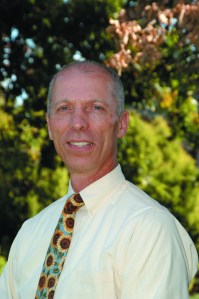
Thomas Zilian, 46, of Portsmouth, RI, died unexpectedly at his home on April 2, 2019.

Tom was born into his military family in Wiesbaden, Germany, and attended high schools in Portsmouth and also Bonn, Germany. He earned a bachelor of fine arts degree (painting) from the Massachusetts College of Art. He founded and owned Madstone, a company specializing in creating fine finishes for concrete surfaces.

Tom loved many things: first and foremost, his family, and also camping and fishing with his two children, music, Italian food, chunky monkey ice cream, his mother’s cooking, Nicki’s warm and welcoming home, James’s unfailing support and devotion to Tom’s talent, and his father’s example. Art and painting were his passions.

Tom is survived by his fiancée Anna Lubiner, son Alex 10, daughter Sonie 13, mother Geri, father Fred, brother James, sister-in-law Zoe Zilian, sister Nicole Milici, and brother-in-law, Marc Milici; his nieces and nephews, Mary Jane, Sofia, Vincent, and Anthony Milici, and Ava and Mia Zilian. He is also survived by his ex-wife and mother of his children, Dorota Hapek.

Visiting hours at Connors Funeral Home, 55 W. Main Rd, Rte 114, Portsmouth, RI, 02871, 3-5 and 7-9 pm, Tuesday, April 9, and funeral mass at 10 am, Wednesday, April 10, at St. Barnabas Catholic Church 1697 East Main Rd, Portsmouth, RI .

In lieu of flowers, our family would prefer contributions to a fund established for his children. Checks should be made to Alex and Sonie Zilian and sent to BankNewport, 2628 East Main Rd, Portsmouth, RI, 02871.

Eulogy—Thomas Zilian

(Note: I delivered this eulogy at the Mass of Christian Burial at St. Barnabas Church, Portsmouth, RI, on April 10, 2019.)

Even as a little boy, we knew that Tom had a wonderful heart. I do not remember how old he was, perhaps five or six. Our young family was merrily rolling along in our car. We asked him whether he liked his mom’s casserole from the night before. He did not want to hurt his mother’s feelings, but down deep I guess he really didn’t like it. He fumbled with some words and then said: “Well, I like it, cept, cept I hate it.”

Thank you for this opportunity to address you. I would like to do this for you and for me, and also for Tom. In this holy house, I draw strength from God and from the steady and faithful pulse of your love I can feel by your presence and your faces, especially those of my grandchildren. My son is gone, but he lives on in so many ways, especially in Sonie & Alex.

Physically, Tom clearly had more of Geri’s side in him. His face, good nature and good heart reminded us all of her and my father-in-law, Jim Maida, “Pop,” as we called him. Some of you may remember him. And if you do, you know that this was a very good thing to be cut from the same cloth as my father-in-law, who never said an ill or evil word of anyone.

However, I will take some responsibility for his rich and vibrant sense of humor. I hope you got to know it. He loved reaching out to people, getting to know them, and having a laugh.

In the last few years, Tom was again back to his passion—painting fine art. I will give my wife and the Maida side credit for his vast artistic creativity, talent and passion; his steady and sure hand with a pencil and paint brush.

This talent was nurtured at the Massachusetts College of Art. In his last two years there his paintings became abstract. This was a challenge for me. Picture me standing in front of a large canvas with broad strokes of paint—brown, black, white, gray—and swatches of other stuff, perhaps a bit of burlap mixed in and raised up from the surface. Eventually I began to appreciate this type art. I might stand back, point to one corner of the painting, and say: “Tom, I think I see some tension and anger here.” “That’s it, dad,” he would say, “now you’re getting it.”

Tom could be a man of contradictions. Though a free-wheeling artist who loved unusual music from, say, Frank Zappa, he also loved physical order. No messes and misalignments. Like both his parents, he was more a hugger and lover, than one who confronts and fights; however, he could get fighting mad about principles, such as truth and social justice.

My friends & my family, we must be careful in looking for an explanation for his death. I hope that none of us are angry with God. There are no good answers here, and there is no future in being angry with God.

As he faced life’s challenges the last few years, my son launched on to a spiritual journey and found God. And God gave him strength to overcome. What a gift!

How he loved his two children, Alex and Sonie, sitting here, taking them camping and fishing, taking them to the Newport Creamery. Dorota, I thank you for bringing them into this world and for nurturing them. Geri and I pledge our support to help them grow in Tom’s image.

And how he loved his sister Nicole, his brother James, and brother-in-law, Marc, and all his nieces and nephews. We stood by him when he was troubled, and as he became healthier and stood ever stronger, yes, he aggravated us with his quirks and incessant ukulele playing, but also lifted us when we were in need.

Last September, Tom met Anna and his life soared. This is his journal entry for October 19: Brilliant, compassionate, thoughtful, conscientious, authentic, and open-minded are just a few words that come to mind when thinking of Anna. And I could go on and on about how she has integrity and is tenacious and silly and adorable and my perfect Love. During the first weeks of getting to know her, as these characteristics were revealed, I asked myself these two questions: How did she get like this? and, Why me?

Anna, now and forever, you shall be a part of our family. We are so happy and not surprised that Tom made you believe in miracles. The love that blossomed between you two was truly a miracle.

We will all miss Tom. I shall miss him coming into our house for breakfast—messy hair, leather jacket, and paint-splattered clothes. I would feed him oatmeal as we talked the issues of the day. Geri would make him a lunch, super-charged with food and love. I see him now in the next dimension, showing Saint Peter how to paint, with all the cadmium blue his heart desires.

Here is what I am going to do for my son. I am going to love my wife and family every day. Second, I will love my neighbors and friends. Even more now, shall I remember what the ancients said: “Be kind because people are engaged in great battles.” Third, I shall not take one day of life for granted. Lastly, I shall look at others who struggle with life’s challenges, not as inadequate, unredeemable human beings, but as real and genuine people who need other people who have the courage to care and who can show them the spiritual imperative.

The day Tom died, I turned to my book of daily prayer. The reading was from Psalm 37: Verse 37, and was entitled “Peace in Death”: But for the good man, the blameless, the upright, the man of peace—he has a wonderful future ahead. For the end of that man is peace.
Here is the poem which accompanied the verse:
How bless’d the righteous when he dies,
When sinks a weary soul to rest!
How mildly beam the closing eyes!
How gently heaves the expiring breast!
Life’s labor done, as sinks the clay,
Light from the load the spirit flies;
While heaven and earth combine to say,
“How bless’d the righteous when he dies!”

Posted in Uncategorized | Tagged , , , , | 6 Comments

With Low Fertility Rate, America Needs Future Migrants

(Note: This essay, abridged, was originally published at thehill.com on February 25, 2019.)

The Republicans and Democrats have reached a compromise on the border issue. President Trump, not happy with the mere $1.38 billion in the compromise bill for his wall, has declared a national emergency so that he can use other appropriated funds for this wall. However, the real national emergency is not keeping people out with a wall; rather, it is getting the right people to come to America to counter its very low fertility rate.

In the long term, human economic and personal insecurity and climate change will increase the flow of migrants and refugees from points known but also unknown. Now that the U.S. fertility rate has dropped to 1.76, well below the replacement rate, America’s challenge—if it wants to remain a superpower—is not to build walls and restrict migrant flow excessively, as the Trump Administration has, but rather to manage properly a more generous migrant flow so that its population continues to grow, with all the attendant benefits.

The World Migration Report for 2018, authored by the UN International Organization for Migration, estimates a total of 244 million migrants, including over 40 million internally displaced persons and 22 million refugees. The report cites the reasons for the recent increase in displaced people, including conflict, persecution, environmental change, and a lack of human security and opportunity.

Focusing on the United States, the PEW Research Center in November 2018, presented data on migration to the United States. The U.S. has more immigrants that any other country, about 40 million, about 20% of the world’s immigrant population, people born in another country, with just about every other country in the world represented. They make up 13.5% of the U.S. population. A total of 10.7 million are unauthorized or illegal (23.7% of U.S. immigrants). Unauthorized migrants tripled in size during the period 1990-2007, and then declined after the Great Recession of 2008-2009. In the period 2007-2016, unauthorized migrants from Mexico declined while those from Central America increased. Since 2010, more Asian than Hispanic migrants have arrived each year. Regarding refugees, in FY 2017, almost 54,000 were resettled in the U.S.; the largest came from the Democratic Republic of the Congo, then Iraq, Syria, Somalia, and Myanmar.

Several factors suggest that migrant flow to U.S. borders will increase in the future. Just beyond Mexico lie the three countries from whom the highly publicized “caravans” of migrants have come in recent years. Over the past five years Stephanie Leutert, writing in Foreign Affairs, indicated 875,000 migrants from Guatemala, Honduras, and El Salvador have come to the U.S. border, driven mainly by rampant gang violence and economic hardship. However, without a job or family in the U.S. these migrants, most moving in family groups, have no legal pathway into the U.S. Until the factors, pushing these migrants to leave, are dealt with, we can expect this migrant flow from Central America to continue.

A second factor which will increase migrant flow to the U.S., a land in what Thomas Friedman calls the “zone of order” , is climate change, an issue in which the U.S. once led but now, under the Trump Administration, dawdles and denies. Over three years ago at a Commencement for the Coast Guard Academy, President Barak Obama sketched the risks ahead. “Around the world, climate change increases the risk of instability and conflict. Rising seas are already swallowing low-lying lands, from Bangladesh to Pacific islands, forcing people from their homes. Caribbean islands and Central American coasts are vulnerable, as well. Globally, we could see a rise in climate change refugees. … Elsewhere, more intense droughts will exacerbate shortages of water and food, increase competition for resources, and create the potential for mass migrations and new tensions. All of which is why the Pentagon calls climate change a “threat multiplier.”

The Trump Administration has disallowed the Department of Defense from addressing the impact of climate change in any meaningful way, deleting it from the official list of national security threats. However, a recent DOD report maintains that it is, stating: “The effects of a changing climate are a national security issue with potential impacts to Department of Defense missions, operational plans, and installations.”

Climate change is manifesting itself in sea level rise here in the U.S. and beyond. Almost three years ago The New Scientist, using data from the National Oceanic and Atmospheric Administration, indicated that the sea level will rise 1.8 meters by the year 2100, probably displacing over 13 million people in the U.S.

Internationally, the effects of climate change were addressed at the two-week UN climate conference in Paris in December 2015. Sewall Chan’s reporting on the conference indicated that warming, in addition to other effects, can cause violence leading to the large-scale displacement of people. The conference’s report noted that between 2008-2014, an average of 26.4 million people were displaced each year by floods, storms, earthquakes, and other natural disasters (although most moved within their own countries). The accord called for developing recommendations “to avert, minimize and address displacement related to the adverse impacts of climate change.”

William Lacy Swing, a retired American ambassador who now leads the International Organization for Migration, said that climate change was adding to a “perfect storm” of “unprecedented human mobility,” a result of the quadrupling of the world’s population over the last century and wars, conflicts and persecution.

The world’s many glaciers continue to melt, a clear result of global warming. Dr. Twila Moon, University of Colorado, Boulder, wrote of this in the journal Science in May 2017: “The evidence is overwhelming: Earth is losing its ice. Much of this loss is irreversible and the result of human-caused climate change,” Glaciers all over the world are disappearing and should be the subject of “international concern.” Among other effects, millions of people will be forced to leave their homes by rising seas, crucial sources of water will run dry and wildlife will lose sources of nutrients and shelter. The US Geological Survey has reported that the Glacier National Park in Montana has lost more than 120 glaciers in the last century. And Dr. Moon said this was a pattern repeated all over the world from the Antarctic Peninsular to Patagonia, Kilimanjaro, the Himalayas, Greenland and the Arctic.
Also in the journal Science, in December 2017, a team of scientists, studying weather variations from 2000-2014 in 103 countries and their effects on asylum applications to the European Union concluded that “weather-induced conflicts in developing countries spill over to developed countries through asylum application.” “Our findings support the assessment that climate change, especially continued warming, will add another ‘threat multiplier’ that induces people to seek refuge abroad.”

The final factor arguing for a less restrictive immigration policy is the dramatic fall in the U.S. total fertility rate. This rate has dropped since the Great Recession of 2008 to 1.76 births per woman in 2017, well below the replacement rate of 2.1 needed to keep a population stable. Despite this drop, the Trump Administration has moved to restrict immigration.

This trend has significant negative implications for our Social Security and Medicare programs. As medical experts John Rowe, Dana Goldman, and S. Jay Olshansky have indicated: “The significant reduction in fertility in the U.S., if not offset by enhanced immigration or greater worker productivity, puts these programs at risk.”

The white population has a very low fertility rate among all groups within the U.S. population. Therefore, it is the minority groups who are contributing the most to the U.S. population. Demographer William Frey of the Brookings Institution has demonstrated where future gains will likely come. “The likely source of future gains among the nation’s population of children, teenagers, and young working adults is minorities—Hispanics, Asians, blacks, and others. Also Statista reported that Hispanics in 2017 had the highest fertility rate among significant minorities. (Native Hawaiians/Other Pacific Islanders had the highest.)

Military might, economic prowess, and natural resources have always been measures of a state’s power. Today we can add such things as technological capability and innovation, entrepreneurial talent, cybersecurity and strength. It is surprising that in an Administration filled with so many “realists,” including President Trump and National Security Advisor John Bolton, there is such a lack of concern with one of the most fundamental sources of a state’s power—population.

The trends discussed above suggest that the U.S. will continue to be a magnet for immigrants, pulled to our borders by order and economic opportunity, and pushed by violence and climate change in their home countries. With the dramatic drop in the U.S. fertility rate over the past decade, it would be wise for the United States—rather than overly restricting immigration—to streamline its immigration policies to accept the right combination of skilled and unskilled workers, innovative entrepreneurs and also families who can give us young Americans.

Fred Zilian, Ph.D., is an adjunct professor of history and politics at Salve Regina University, Newport, Rhode Island. He is the author of “From Confrontation to Cooperation: The Takeover of the National People’s Army by the Bundeswehr.” Follow him on Twitter @FredZilian.

Posted in Uncategorized | Tagged , , , , | 1 Comment

The Lives of the Enslaved in Colonial Newport

(Note: This essay was originally published on February 28, 2019, in the Newport Daily News. It is the fourth essay in a series on “Slavery in Rhode Island.”)

Enslaved African Americans of colonial Newport lived and worked, and even sometimes prayed and played next to their white masters; however, without basic human and civil rights, without ownership of their own bodies and destinies, their lives were always less than whole.

It is a challenge to obtain a genuine understanding of the lives of any enslaved people because of the sparseness of original documents. Slave masters certainly did not see any value in documenting the lives of their property and most of the enslaved did not have the education, wealth or certainly the luxury of time to create documents and images of themselves for posterity.

Of the 10-15 million slaves taken to the New World, Richard Youngken, in his book African Americans in Newport, estimates that only about 2% were actually brought to Newport and sold to Newporters. The rest were sold in the West Indies (Caribbean) and southern American ports.

Anthropologist Akeia Benard, in her forthcoming book, Strangers and Outcasts in a Strange Land: The Early African American Community of Newport, RI, summarizes data from several sources on the black population in 18th century Newport. In 1730, the African American population represented 14% of the city’s population (1649 individuals) and in 1748, 17% (1105 individuals). The African American population peaked in 1755, representing 18% of Newport’s population (1,234 individuals). By the time of the first census in 1774, which was the first to give data on both enslaved and free blacks, it dropped to 14% of the population (1,246 individuals). Of these, 145 individuals, approximately nine percent, were listed as “Free.”

In colonial Newport, the enslaved—generally referred to as “servants” rather than “slaves”—lived and worked probably throughout the city. Whites and enslaved blacks must have lived near each other, with the enslaved living primarily in the attics, kitchens, or perhaps out-buildings of their masters.

It was primarily enslaved women, children, and elderly who worked as domestic servants. The males worked in rum production, barrel-making, wharf-warehousing, and ship-building and all its associated trades. In the maritime trades the enslaved worked as pilots, sailors, divers, linguists, porters, stewards, cooks, cabin boys, and riggers. Males were also employed in animal care, teamster and livery services, blacksmithing and silversmithing, candle-making, masonry, wood-working, furniture-making, and printing. It is tragic irony that many of the enslaved worked in trades connected to the very business system responsible for their enslavement.

Enslaved men were regularly “rented out.” Newport merchant John Banister regularly did this. In 1747 “Negro Mingo” and “Negro Toney” were rented out to help prepare the Swan for a voyage to the West Indies. “Negro Anthony” was rented six times in a two-year period to help outfit merchant ships.

Slavery corrupted and distorted the marriage and family life of the enslaved. Marriages of course had to be approved by both masters, and married slaves only rarely resided together. As property of their masters, husbands and wives could not live the normal lives of married couples by Western or African standards. The reality of slavery laced through their marriage vows. This can be seen in the “Form of a Negro Marriage” used by Rev. Samuel Phillips of Andover, Massachusetts. The vow was made contingent: “so far as shall be consistent with ye Releations [sic] which you now sustain, as a Servant.” It also included a warning: “…both of you, bear in mind, that you Remain Still as really and truly ever, your Master’s Property….”

Caesar Lyndon, the secretary and purchasing agent of Gov. Josiah Lyndon, was the rare enslaved person who kept a journal which is available to us. He was certainly well off compared to other enslaved. A successful businessman, he bought and sold items to whites and blacks, lent money, and had enough leisure time and means to go on a “pleasant ride out to Portsmouth” with friends on August 12, 1766. Their picnic included roast pig, wine, bread, rum, green corn, limes for punch, sugar, butter, tea, and coffee. Upon his death in 1826, his obituary in the Newport Mercury praised him as “well known in this town as a man of color of remarkable attainments.”

Headstone cut by Pompe Stevens for brother Cuff Gibbs

(Fred Zilian, 3-14-19)

Pompe Stevens was a slave of William Stevens, who owned a stone carving and masonry shop on Thames Street. Pompe would have laid bricks and built foundations, chimneys, steps and walks. In Newport’s Common Burying Ground stands the headstone he carved and signed for his brother, Cuff Gibbs, who died in 1768.

The enslaved Newport Gardiner, originally Occramer Marycoo, arrived in Newport in 1760 from the African coast. His master’s wife urged him to learn English, French, and western music. Oral history on him indicates he taught music in a rented room on Division Avenue in the late 1700s. He eventually became a leader of the African-American community, and founded and became first president of the African Union Society.

Two local organizations now exist to raise our level of awareness of slave history in Rhode Island, making it more complex and comprehensive. The Newport Middle Passage Port Marker Project seeks to remember, honor and commemorate the contributions of those Africans who perished in the middle passage journey and to acknowledge those survivors who helped build Newport and the nation economically and culturally. (www.Newportmiddlepassageproject.org )

The Rhode Island Slave History Medallions organization seeks to increase public awareness of the state’s slave history by marking pertinent locations with medallions linked to a dynamic, informative website. (RISHM.org)

(See Essay #5: The Enslaved Resisted.)

Sources

Benard, Akeia. Strangers and Outcasts in a Strange Land: The Early African American Community of Newport, RI. (forthcoming)
Clark-Pujara, Christy. Dark Work, The Business of Slavery in Rhode Island. NY: New York University Press, 2016.
Crane, Elaine F. A Dependent People: Newport, Rhode Island, in the Revolutionary Era. NY: Fordham University Press, 1992.
Woodward, Carl R. Plantation in Yankeeland: The Story of Cocumscussoc, Mirror of Colonial Rhode Island. RI: Narragansett Publishing, 1985.
Youngken, Richard C. African Americans in Newport, An Introduction to the Heritage of African Americans in Newport, Rhode Island, 1700-1945. Rhode Island Historical Preservation & Heritage Commission, 1998.

Posted in Uncategorized | Tagged , , , , , , , , , | 1 Comment

The Business of Slavery in Colonial Newport

(Note: This is the third essay in a series on “Slavery in Rhode Island.” This essay was originally published by the Newport Daily News on January 26, 2019.)

The histories of colonial Newport and of slavery in the New World are intimately connected.

The first slaves in the colony of Rhode Island were Native Americans, prisoners of war from the two major Indian wars in southern New England in the 17th century—the Pequot War (1636-37) and King Philip’s/Metacom’s War (1675-76).

Sometime after 1638, the first African slaves entered Rhode Island. They were sparse in the colony throughout the 17th century, with only 175 total slaves in 1680. The first record of Rhode Islanders buying slaves directly from Africa came on May 30, 1696, when 14 enslaved Africans were bought from the ship Seaflower in Newport “for betwixt 30£ and 35£” (British pounds).

From this beginning, Rhode Island slave traders by 1730 came to dominate the American trade in slaves, and Newport became the most important slave-trading port of departure in North America, according to historian Christy Clark-Pujara, in her book, Dark Work. Slaves were one commodity in the greater Atlantic trading system. Newport, Bristol, and Providence merchants, with their proximity to and affinity for the sea, engaged in commerce with West Africa, the West Indies (Caribbean), and North American port cities, exporting lumber, beef, pork, salt cod, butter, cheese, onions, cider, candles, horses and rum; and importing sugar, molasses, cotton, ginger, indigo, linen, woolen clothes, Spanish iron and slaves.

In his 1740 report to the British Board of Trade, Rhode Island colonial governor Samuel Ward described the many goods Rhode Island ships provided to “neighboring governments” and also the West Indies—rum, sugar, molasses, lumber, beef, pork, flour, horses, “and our African trade often furnishes them with slaves for their plantations.”

Newport today is dotted with the names of many of the merchants who took part in this commerce: Malbone, Banister, Gardner, Wanton, Brenton, Collins, Vernon, Channing, Champlin, and Lopez.

Between 1761 and 1774, Aaron Lopez and father-in-law Jacob Rodriguez Rivera, among the many ships they launched, sent 14 slave ships to the west coast of Africa. Their first voyage contained flour from Philadelphia, beef from New York, and 15,281 gallons of rum from Newport distilleries. Over the 14 year period it is estimated that their ships brought over 1100 slaves from West Africa to the West Indies and the southern colonies of America. The trade with the West Indies was key because this is where the molasses was acquired for the Newport rum distilleries. Lopez personally owned five slaves, and Rivera owned twelve.

The sloop Adventure, owned by Christopher and George Champlin, sailed from Newport in 1773, outfitted with slave shackles, vinegar, pork, beef, sugar, molasses, wine, beans, tobacco, butter, bread, flour, and 24,380 gallons of rum for the purchase of slaves. Enslaved women cost at the time an average of 190 gallons of rum, while men averaged 220 gallons.

Sea Captains Carousing in Surinam, Philip Greenwood circa 1750. Public domain. Depicts various notable Rhode Islanders, including (all seated at the table): Nicholas Cooke, Esek Hopkins, Stephen Hopkins, and Joseph Wanton (passed out, being doused with vomit and punch).

Many of the trades and occupations in Rhode Island during this period were somehow related to slavery. Slave traders kept busy shipbuilders, sailors, caulkers, sailmakers, carpenters, rope-makers, painters, barrel-makers, and dock workers. Clerks and warehouse managers administered the system. In addition to these tradesmen, additional crew members were needed to control the enslaved during the voyages.

In his book, African Americans in Newport, Richard Youngken reports that Newporters prior to the Revolution took a total of 59,067 individuals from the West Coast of Africa, a small number compared to the total 10-15 million slaves taken to the New World. He estimates that only about 2% were actually brought to Newport and sold to Newporters. The rest were sold in the West Indies and southern American ports.

Anthropologist Akeia Benard, in her forthcoming book, Strangers and Outcasts in a Strange Land: The Early African American Community of Newport, RI, summarizes data from several sources on the black population in 18th century Newport. In 1730, the African American population represented 14% of the population (1649 individuals) and in 1748, African Americans represented 17% of the population (1105 individuals). The African American population peaked in 1755, representing 18% of Newport’s population (1,234 individuals). The population dropped to 14% of the population (1,246 individuals) by the time of the first census (1774) that gave figures for both enslaved and free African Americans. Of the 1,246 African Americans in the census that year, 145 individuals, approximately nine percent, were listed as “Free”.

Youngken indicates that during the middle decades of the 18th century about 30% of white families in the city owned slaves. Clearly slave trading and the “renting out” of the enslaved must have been normal in Newport, and enslaved people must have been common throughout the city.

In Newport, enslaved women worked primarily as domestic servants while the men worked in candle-making, rum distillery, husbandry, metal-smithing, sailing, whaling, and manual labor. It is tragic irony that many of the enslaved worked in the very business of slavery.

Merchants from Newport paid significant taxes and duties to the city, which allowed public works projects. Clark-Pujara concludes: “The streets of Newport were paved and its bridges and country roads mended through the duties collected on slave imports. In many ways, the business of slavery literally built Rhode Island.”

Two projects now exist to raise our level of awareness of slave history in Rhode Island, making it more complex and comprehensive. The Newport Middle Passage Port Marker Project, led by Victoria Johnson, seeks to remember, honor and commemorate the contributions of those Africans who perished in the middle passage journey and to acknowledge those survivors who helped build Newport and the Nation economically and culturally. (www.Newportmiddlepassageproject.org )

The Rhode Island Slave History Project, led by Charles Roberts, has as its mission increasing public awareness of the state’s slave history by marking pertinent locations with medallions linked to a dynamic, informative website. (www.RISHM.org)

(See essay #4: The Lives of the Enslaved in Colonial Newport.)

Sources

Benard, Akeia. Strangers and Outcasts in a Strange Land: The Early African American Community of Newport, RI. (forthcoming)
Clark-Pujara, Christy. Dark Work, The Business of Slavery in Rhode Island. NY: New York University Press, 2016.
Coughtry, Jay. The Notorious Triangle, Rhode Island and the African Slave Trade, 1700-1807. Philadelphia: Temple University Press, 1981.
Crane, Elaine F. A Dependent People: Newport, Rhode Island, in the Revolutionary Era. NY: Fordham University Press, 1992.
Johnson, Cynthia M. James DeWolf and the Rhode Island Slave Trade. Charleston, SC: History Press, 2014.
Stensrud, Rockwell. Newport, A Lively Experiment, 1939-1969. London: D Giles Limited, 2015.
Youngken, Richard C. African Americans in Newport, An Introduction to the Heritage of African Americans in Newport, Rhode Island, 1700-1945. Rhode Island Historical Preservation & Heritage Commission, 1998.

Posted in Uncategorized | Tagged , , , , , , , , | 3 Comments

The Great Influenza Pandemic of 1918-19

(This essay was originally published as “Remembering the Great Influenza Pandemic” by the Newport Daily News on December 17, 2018.)

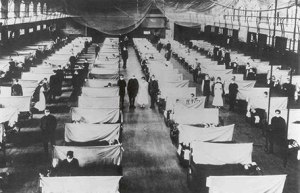
One hundred years ago this month the world was celebrating the end of World War I; however, it was still contending with what the Centers for Disease Control (CDC) claim was “the most severe pandemic in recent history,” the 1918 influenza pandemic.
It was caused by an H1N1 virus with genes originating in birds. A total of about 500 million people worldwide were infected with the virus, one-third of the world’s population. At least 50 million people died, with some estimates as high as 100 million; indeed, far more deaths than the fallen in World War I.

The sickness was first identified in the United States in the spring 1918 among military personnel, and it eventually claimed 675,000 lives in the US. It was so severe that in the period 1917-1918, the life expectancy in the US declined about 12 years, to 36.6 for men and to 42.2 for women, according to the CDC. It struck most age groups; however, it was unique in that it hit the 20-40 year age group especially hard.

Treatment facility in large warehouse
(cdc.gov)

There were three phases of the pandemic in the U.S. It first broke out in military camps and some cities in the spring 1918. Because of the desire to keep wartime morale high, officials suppressed information on the sickness. It is commonly known as the Spanish Flu Pandemic, not because it originated in Spain, but because Spain was neutral during WW I and had no reason to censor information on its impact.

The second wave, the most lethal, hit in September 1918. It began in Fort Devens, an Army post west of Boston, and also at a naval facility in Boston. About 100,000 Americans died in October alone. The third wave came in early 1919 and lasted through the spring. The pandemic finally subsided during the summer 1919.

At a symposium on the 1918 Influenza Pandemic in May, 2018, historian John M. Barry explained the progression of the disease. He repeated the words of a military doctor at the time: “…they very rapidly develop the most vicious type of pneumonia that has ever been seen. Two hours after admission, they have the mahogany spots over the cheekbones, and a few hours later, you see the cyanosis extending from the ears and spreading all over the face, until it is hard to distinguish the [black] men from the white. It’s only a matter of a few hours, then, until death comes.”

In a 1986 interview, Navy nurse Josie Mabel Brown, who survived the influenza, said, “The morgues were packed almost to the ceiling with bodies stacked one on top of another.”
The influenza pandemic inspired great fear. Barry quoted one person who lived through it, saying: “It kept people apart. You couldn’t play with your playmates, your classmates, your neighbors. The fear was so great, people were afraid to leave their homes. You had no school life, no church life, nothing. It destroyed all family and community life. People were afraid to kiss one another, afraid to eat with one another. Constantly afraid.”

It must be remembered that at this time there were no vaccines for protection against the infection, no antiviral drugs for treatment, and no antibiotics to treat secondary bacterial infections like pneumonia. Efforts to control the pandemic were limited to such things as the promotion of good personal hygiene, isolation and quarantine, and the closure of public places, such as schools and theaters. Some cities passed ordinances requiring face masks in public. New York City enacted an ordinance which fined or jailed people who did not cover their coughs.

The CDC maintains that for “more than 60 years, [the] CDC has worked to address the continuing threat of flu and prepare for the next pandemic.” There now exists a “global influenza surveillance system” which includes 114 World Health Organization member states. The Center’s Influenza Division is one of six global influenza centers which monitor and track flu activity worldwide.

Fred Zilian (zilianblog.com; Twitter: @FredZilian) is an adjunct professor at Salve Regina University, an opinion contributor for The Hill, and a monthly columnist for The Newport Daily News

Posted in Uncategorized | Tagged , , | Leave a comment

The Armistice Ends the “Great War”

(This essay was originally published by The Newport Daily News on November 10, 2018.)

One hundred years ago, at the 11th hour, of the 11th day, of the 11th month of 1918, the armistice—the cessation of fighting—took effect, ending the First World War.
The first global war, fought with the massive means of the Industrial Revolution and involving close to two dozen countries, had many effects on the maps of Europe and Asia and the states which participated. Politically, four European-Asian empires fell: the German, the Austro-Hungarian, the Russian, and the Ottoman. In terms of population, a generation of men was essentially killed or maimed in France, Great Britain, Russia, Austria-Hungary and Germany. About nine million combatants died and about seven to ten million civilians perished as a direct result of the war. Financially, the war brought Great Britain to her knees and allowed the United States to emerge as the financial capital of the world. Domestically, the principal states became more centralized war machines in search of victory.

The war had begun in August 1914, when Austria-Hungary, following the assassination of its heir to the throne, Archduke Franz Ferdinand, declared war on Serbia. Within two weeks the two major alliance systems of Europe were at war. The principal belligerents stemmed from the two pre-war alliances. The Triple Alliance consisting of Germany and Austria-Hungary (without Italy) was arrayed against the Triple Entente, consisting of Great Britain, France, and Russia. The Ottoman Empire and Bulgaria eventually joined the former alliance and were called the “Central Powers.” Italy, Japan, and the United States eventually joined the Entente powers and were called the “Allies.”

By 1914, the Industrial Revolution had magnified the means of warfare tremendously, contributing to the lethality of the war. War materials—not simply rifles, but also machine guns, entrenching tools, artillery pieces, grenades, mortars, boots, and barbed wire—could now be mass-produced. On the Western Front in Europe, this enabled the contending armies to build trench lines from the English Channel far southeast toward the Alps.

The war saw many firsts: modern chemical warfare and gas masks, flamethrowers, steel helmets, tanks, aerial warfare, IQ tests, guide dogs, propaganda film, the military use of X-rays, and wireless radio communication.

Two key factors led the US to enter the war in April 1917: first, the decision by Germany to resume unrestricted submarine warfare and second, the Zimmermann telegram, indicating Germany’s efforts to induce Mexico to join the war against the United States.

With German submarines sinking American ships at will, President Woodrow Wilson addressed the Congress on April 2. Using high, moral language, he said, “The world must be made safe for democracy.” Congress responded with rousing emotion and applause, and on April 6, passed a joint resolution declaring war on Germany.

American “doughboys,” as they were called, marched off to war to what became an anthem for Americans during the war: Over There, by George M. Cohan, born in Providence RI. The chorus:
Over there, over there
Send the word, send the word over there
That the Yanks are coming
The Yanks are coming
The drums rum-tumming
Everywhere
So prepare, say a prayer
Send the word, send the word to beware
We’ll be over, we’re coming over
And we won’t come back till it’s over
Over there

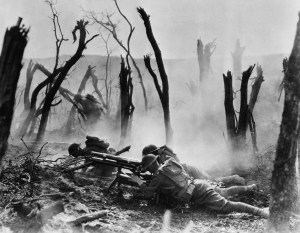
American soldiers of the 23rd Regiment, 2nd Division, firing a 37 mm machine gun in the Meuse-Argonne campaign.
(U.S. Army Signal Corps/The LIFE Picture Collection/Getty Images)

While Americans saw action only for the closing months of the war, 117,000 soldiers were killed and 202,000 were wounded. Nonetheless the Americans provided essential military and psychological support to the faltering Allies on the Western Front. Historian Geoffrey Wawro states categorically that the “Doughboys won the war by trapping the German army in France and Belgium and severing its lifeline [in the Meuse-Argonne campaign].”
About 53,000 Rhode Islanders enlisted during the war and 612 died. The First Battalion of the 103rd Field Artillery Regiment was composed almost entirely of Rhode Islanders and served gallantly in the war. The citizens of Rhode Island also helped the war effort by creating “war gardens,” volunteering with the Red cross, and fundraising. The Brown & Sharpe Manufacturing Company in Providence, a major manufacturer of machine tools, contributed significantly to the industrial war effort.

Historian Jackson Spielvogel calls World War I the “defining event of the 20th century.” The superiority of Europe was gone; the United States was ascendant. An unstable peace settled on Eurasia which would last only two decades. After its revolution in 1917, Russia now became the Union of Soviet Socialist Republics, with rising power and an ideology contrary to the democratic, capitalistic Western countries. Within many countries, government had projected itself into new areas of the economy and society. Many women had taken new jobs and had acquired the right to vote. Intellectually and psychologically, World War I was a jarring and disillusioning experience. With so much death and destruction, the faith in our leaders and in the idea of progress was shattered.

A retired Army officer, Fred Zilian (zilianblog.com; Twitter: @FredZilian) is an adjunct professor at Salve Regina University, an opinion contributor for The Hill, and a monthly columnist for The Newport Daily News.

Posted in Uncategorized | Tagged , , , , , | 3 Comments

Can I Really Be 70!?

(This essay was originally published by The Newport Daily News on October 11, 2018.)

Dear Readers, I am stunned to look at my calendar and realize I shall this month reach the distinguished age of 70. Tell me how this can be.

I have seen so many things: the sunrise over rice paddies in South Korea, horses running wild in the high desert in New Mexico, the majestic, soaring cathedral in Cologne, sting rays off the Grand Cayman Islands, Trafalgar Square in London, the Green Mountains of Vermont, the church where Martin Luther protested against the Roman Catholic Church, the chambers at Dachau, the statue of David in Florence, and the Swiss Alps.

I have ridden on the wonderful, winding Rhine River in Germany, Lake Winnipesauke, NH, the canals in Venice, the Caribbean, the battleship Iowa, and the canals of Amsterdam.

I have experienced so many thrills: the birth of three children and the pleasure of watching all three have their own children. I have wrestled with all my grandsons and bounced all my granddaughters on my knee. I have served our country at home and for seven years abroad—for six in Germany and for one in South Korea. Here at home I have lived with and have come to know the people of Virginia, Georgia, New York state, and Washington, DC. Because of my time abroad, I have been immersed in two other cultures and came to know them. This has given me great perspective on our American culture, the strong points but also its weak points. One can gain great insight in to one’s own country by living in another.

I have learned that in the grand choice we must all face between people and things, I have taken the former and it has served me well. In my experience a focus on things and stuff leads to the desire for more stuff, and more stuff. One can launch into infinite comparisons between one’s own stuff and the stuff of others. There is no future in this. Greg Mortenson in Three Cups of Tea was correct: human relationships are most important.

The ancient Greeks were correct in seeking balance. One of the two most frequent responses from their authoritative oracle at Delphi was meden agan: nothing too much. And then there are the immortal words of Miss Piggy: Never eat more than you can lift.
Speaking of eating, I have eaten eggs, grits, and biscuits in Georgia, ribs in St. Louis, kimchee in Korea, shrimp and grits in New Orleans, Schnitzel mit pommes frites und ein Bier in Germany, pasta in Positano, Italy, and Johnny Cakes and Macoun apples here in New England.

I thank the American citizen and system for providing not only my undergraduate education at West Point, but also my graduate education at Johns Hopkins University and the Naval War College. West Point changed me not only from a young citizen to a soldier but also from a boy to a man.

I thank my immediate and extended family—mostly deceased—and community in Hasbrouck Heights, NJ, for the support, nurture, and examples they provided me. I believe that solid families and communities are the incubators not only for men and women of character but also for good citizens—the lifeblood of a successful civilization. If America is to sustain itself it must restore more of our broken families and communities. As a country then, we shall have the foundation, character, and courage to make the right decisions about our future.

I thank my undergraduate students at Salve Regina University for their attention and eagerness to learn, for keeping me young, and for still laughing at my jokes.
I thank you, my readers, also for your attention, your faith, and your kind words about my essays these past seven years of writing for this newspaper. I hope it shall continue for another hundred.

As a citizen, I still believe in duty, honor, country and in America as an exceptional country. I agree with Senator John McCain in his final letter to us all: “Liberty, equal justice, and respect for the dignity of all people….” “We are citizens of the world’s greatest republic, a nation of ideals, not blood and soil.” “We have helped liberate more people from tyranny and poverty than ever before in history….”

He ended with words of inspiration: “Do not despair of our present difficulties. We believe always in the promise and greatness of America because nothing is inevitable here. Americans never quit, we never surrender, we never hide from history. We make history.”

Fred Zilian (zilianblog.com; Twitter: @FredZilian) is an adjunct professor at Salve Regina University, an opinion contributor for The Hill, and a monthly columnist for The Newport Daily News.

Posted in Uncategorized | Tagged , , , | 8 Comments

Real American Heroes and Fake Ones

(Note: This essay was originally published as “A Missed Opportunity to Celebrate True Heroes,” by The Hill on September 7, 2018. http://thehill.com/opinion/white-house/405404-a-missed-opportunity-to-celebrate-true-heroes )

In his reaction to the passing of John McCain, a true American hero, President Trump regrettably has missed a genuine opportunity to bring divided America together in mourning and reflection.

At a rally in Indiana on August 30, several days after McCain’s death, the president did not mention McCain. Rather he spoke again of his 2016 election win. He railed against the media, using again the anti-democratic phrase “enemy of the people.” Once again he stirred hatred and fear by labeling Hispanic gang members as sub-human, using the word “animals.” He invited his crowd to imagine “if Crooked Hillary Clinton had won.” He sowed division rather than unity.

Almost 2,450 years ago in ancient Greece, Athenian statesman Pericles did not pass up such an opportunity. To honor those fallen in battle during the first year of the Peloponnesian War, he gave one of the most famous speeches in Western history. Not only honoring the dead, he also reminded his fellow Athenians of their common democratic ideals and of their greatness. “Our constitution is called a democracy because power is in the hands not of a minority but of the whole people.” … “everyone is equal before the law.” What counts in public positions is not class, “but the actual ability which the man possesses.” “We are free and tolerant in our private lives, but in public affairs we keep to the law.” We respect especially those laws which protect the oppressed. “Taking everything together then, I declare that our city is an education to Greece….”

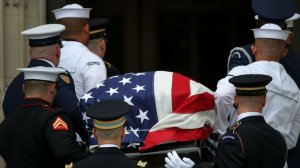
It is ironic that neither our president nor Vice President Mike Pence, who did attend the McCain funeral and spoke, took the occasion to remind us of our ideals and to inspire us. It was John McCain himself who did this eloquently in his final letter. “Liberty, equal justice, and respect for the dignity of all people….” “We are citizens of the world’s greatest republic, a nation of ideals, not blood and soil.” “We have helped liberate more people from tyranny and poverty than ever before in history….”


He ended with words of inspiration: “Do not despair of our present difficulties. We believe always in the promise and greatness of America because nothing is inevitable here. Americans never quit, we never surrender, we never hide from history. We make history.”

About twenty years ago, I attended a conference in California where we discussed the ideas of the famous 17th century philosopher-scientist Francis Bacon. I learned much about him, but the greatest insight I gleaned was during a coffee break. I was speaking with a woman from Canada, a professor, who said, “I don’t have any children, but if I did, I would move to the US.” Quite surprised, I ask: “Why?” She replied: “Because in the United States, you still believe in heroes.” Canadians, she explained, seemed bent on cutting down all their heroes, except for some star athletes.

Coming of age in the 1950s and early 60s and watching TV shows like “The Lone Ranger,” “Superman,” and “Gunsmoke,” my early baby-boomer generation believed in heroes. Men had their weaknesses; however, they sought to do right, to seek justice, to be driven by moral principles. They spoke a moral vocabulary. They possessed a moral compass. In that age, presidents didn’t lie, at least they did not lie for vanity or personal gain. If they did, we took it as an exception and continued our faith in them. They never made statements like President Bill Clinton, “That depends on what your definition of ‘is’ is.” They did not portray themselves as absolute monarchs like Richard Nixon did when he said: “Well, when the president does it, that means it is not illegal.” They, and other American heroes, did not seem obsessed with celebrity but rather with serving as exemplary citizens of our country. They had served honorably in World War II and Korea and had even led large invasion fleets to free captive continents from totalitarianism.

Heroes and stories of the heroic, real and mythical, are essential to the health and sustainability of a civilization. America’s culture wars are, in part, about our heroes—which ones are genuine, worthy of an honored place in America’s Story and worthy of holding up to our children as role models.

Because of his 60 years—five and one half as a POW—of honorable service to our country as a naval aviator and then senator, John McCain has earned the label of “American hero.” By not taking the high road—putting past differences aside and honoring McCain—President Trump has missed an easy opportunity to elevate himself and to elevate Americans together.

Fred Zilian is an adjunct professor of history and politics at Salve Regina University, Newport, RI. He is the author of “From Confrontation to Cooperation: The Takeover of the National People’s Army by the Bundeswehr.” Follow him on Twitter@Fred Zilian,

Posted in Uncategorized | Tagged , , , , , , , , , , , | 2 Comments

The Battle of Rhode Island (Part II)

(This essay was originally published as “Recounting the Battle of Rhode Island,” by the Newport Daily News on August 29, 2018.)

(Note: This is the second of two essays, celebrating the 240th anniversary of the battle.)

The American victory in the Battle of Saratoga (NY) in October, 1777, had a strategic impact on the Revolutionary War. It convinced the French to ally with us. In February, 1778, France signed a treaty of commerce and friendship and also a treaty of alliance with the fledgling United States. Great Britain now faced a much different threat. The US was hopeful and emboldened.

On July 29, the French fleet arrived off Pt. Judith. Under the command of Charles Henri Théodat, Comte d’Estaing, it consisted of 16 ships, with 12 ships of the line and about 4,000 army troops. The British naval forces were clearly overmatched so they took defensive measures. They withdrew their forces spread throughout the island to defensive positions near and in Newport. They also scuttled about 10 ships to prevent them from falling into French hands.

On August 8, d’Estaing moved the bulk of his fleet into Newport harbor. However, the next day British Admiral Howe and his fleet, a relief force, were spotted off Pt. Judith. On August 10, the fleets were maneuvering for position in the Atlantic south of the bay; however, Mother Nature stepped in. A tremendous hurricane arrived and raged for two days, disabling both fleets.

During this same time, the American forces, led by Maj Gen John Sullivan, had launched an offensive from Tiverton across Howland’s Ferry and landed unopposed in Portsmouth. They quickly occupied the fortifications which the British had evacuated, most prominently, Fort Butts, where the Portsmouth town wind turbine now stands. Gen Sullivan decided on a siege of Newport to try to strangle the British until the French fleet returned to the bay. American forces advanced in the east as far as the high ground east of Valley Rd. (Honeyman’s Hill), in the west as far as the high ground north of Miantonomi Ave.

Worried about the British relief force enroute, Adm d’Estaing informed Gen Sullivan that he was taking his fleet to Boston for repairs. The Americans were stunned and angry; Gen. Sullivan was indignant.

Thus began the unraveling of the allied offensive operation. To make matters worse, the terms of enlistment for several of the militia units were expiring. They wanted to get back to their farms and families. Lastly, sickness, especially dysentery, began to take its toll. On August 24, the siege ended and American forces began a retreat. British commander, Gen Robert Pigot, sensed an opportunity.

By August 29, the American force had declined to about 7,800 men; British-Hessian forces totaled about 6,000 soldiers and marines. The enemy line ran from Quaker Hill to Turkey Hill to Almy Hill. The forces on the western flank were mostly German regiments and they faced, among other units, the 1st RI Regiment, called the “Black Regiment” because of its many black and mixed-race soldiers.

Commanded on this day by Maj Samuel Ward, the regiment was situated behind a “thicket in the valley,” which gave them a strong defensive position. They also used the stone walls in this area as defensive positions from which to fire on the advancing troops. The Regiment had the primary responsibility for holding an important fortification on Durfee’s Hill, now called Lehigh Hill.

Disposition of British, French, and American Forces, Aquidneck Island, French Map, August 1778

(Library of Congress)

Three full assaults by Hessian forces failed to break the line. All the while Hessian cannon were firing on them from Turkey Hill. In his diary, one of the Hessian commanders, Captain Friedrich von der Malsburg, noted that during these assaults, “they found large bodies of troops behind the works and at its sides, chiefly wild looking men in their shirt sleeves, and among them many Negroes.”
In seven hours of combat that day, the American line held. This allowed for the successful retreat and evacuation of General Sullivan’s Army to Tiverton across the Sakonnet River. Regarding casualties, Gen Pigot’s official report stated combined British, Hessian, Loyalist casualties of 260 with 38 killed. Gen Sullivan reported casualties of 211, with 30 killed.

Tactically, the battle is considered a draw. Neither commander wanted a full-scale battle. British Gen Pigot was happy to get the American force off the island. He had no desire to risk his military force or Newport for a chance to gain a decisive victory. Gen Sullivan was happy to get his force off the island before the British reinforcements arrived.

Strategically, most historians would call the entire campaign a win for the British. They were not captured or pushed off the island. They remained another 14 months until they decided to end the occupation in October 1779.

Nonetheless, this was the first time that American and French forces had planned an allied military operation, one they would have executed, but for the hurricane. Finally, it was the largest battle of the war in New England and the last significant battle in the northern theater, one which unfortunately has never made the US history texts.

A monument to the Black Regiment now stands in Patriots’ Park, Portsmouth, and is dedicated to the “first black slaves and freemen who fought in the Battle of Rhode Island as members of the 1st Rhode Island Regiment.”

Fred Zilian (zilianblog.com; Twitter: @Fred Zilian) teaches history and politics at Salve Regina University, writes for The Hill and the History News Network, and is a monthly columnist.

Sources:

“The Battle of Rhode Island.” Rhode Island Society of the Sons of the American Revolution. http://rhodeislandsar.org/battleri.htm. Accessed April 14, 2019.

Crane, Elaine Foreman. A Dependent People, Newport, Rhode Island in the Revolutionary Era. New York: Fordham University Press, 1985.

Geake, Robert A. From Slaves to Soldiers, The 1st Rhode Island Regiment in the American Revolution. Yardley, PA: Westholme, 2016.

Greene, Lorenzo. “Some Observations on the Black Regiment of Rhode Island in the American Revolution”, The Journal of Negro History, Vol. 37, No. 2 (Apr., 1952), pp. 142-172

Johnson, Donald. “Occupied Newport: A Revolutionary City under British Rule”, Newport History, Vol 84, Summer 2015.

MacKenzie, Frederick. The Diary of Frederick MacKenzie, Giving a Daily Narrative of His Military Service as an Officer of the Regiment of Royal Welch Fusiliers During the Years 1775-1781 in Massachusetts, Rhode Island, and New York. Vol I & II. Cambridge, MA: Harvard University Press, 1930.

McBurney, Christian M. The Rhode Island Campaign: The First French and American Operation of the Revolutionary War. Yardley, PA: Westholme, 2011.

Schroder, Walter K. The Hessian Occupation Of Newport And Rhode Island,1776-1779. Westminister, MD: Heritage Books, 2005.

Stensrud, Rockwell. Newport, A Lively Experiment, 1639-1969. London: D Giles, 2015.

Youngken, Richard C. African Americans in Newport, An Introduction to the Heritage of African Americans in Newport, Rhode Island, 1700-1945. Rhode Island Historical Preservation & Heritage Commission, 1998.

Posted in Uncategorized | Tagged , , , , , | 1 Comment

The Battle of Rhode Island (Part I)

(This essay was originally published as “Recounting the Battle of Rhode Island” by the Newport Daily News on August 28, 2018.)

(Note: This is the first of two essays, celebrating the 240th anniversary of the battle.)

Beginning with the Sugar Act of 1764 to 1776, the British government tried in various ways to recoup from the American colonies expenses incurred from defending them during the Seven Years War (1756-1763).
Rhode Islanders became increasingly belligerent to what they viewed as unjustified British coercion. In July 1764, Newporters went to Fort George on Goat Island and began firing on the British schooner St. John, after the ship had seized a cargo of sugar from a New York merchant ship. Soon afterwards the HMS Maidstone appeared at Newport with a similar mission: confiscation and impressment of Americans into military service. Incensed Newporters stole one of its boats, dragged it to the Parade (Washington Square) and burned it.
In July 1769, Newporters stripped and burned the Liberty, an armed sloop which had been harassing merchant vessels on the Bay. On June 9, 1772, John Brown of Providence and 60 men seized the HMS Gaspee by force, brought its crew ashore, and set the ship ablaze. Historian Rockwell Stensrud states: “The total destruction of the HMS Gaspee … was a direct assault on the Royal Navy and thus an offensive action against the king and Great Britain itself.”
The so-called “shot heard round the world” came at Lexington on April 19, 1775. British regulars and American militia exchanged fire, and eight Americans lay dead. There was more fighting at Concord that morning, five miles away, before the British retreated to Boston. The war was on.

On May 4, 1776, the colony of Rhode Island severed its relation with the British Crown. The colony’s General Assembly listed the many grievances against Great Britain and its king and declared that all allegiance to the king by “his subjects, in this his colony and dominion of Rhode Island and Providence Plantations, BE, AND THE SAME IS HEREBY REPEALED.”

Though we celebrate this day as our Independence Day, actually it was not until July 19, that the RI General Assembly approved the Continental Congress’s resolution declaring full independence.

The British decided to seize and occupy Aquidneck Island and Narragansett Bay for several reasons. The British military viewed the bay and the island as a good base of operations in New England. From the bay British forces could launch operations to other parts of New England, as well as defend New York City merchant ships from revolutionary privateers operating from Boston and other ports. The fleet could spend the winter in a protected, deep-water port. At the same time, the Royal Navy could blockade Narragansett Bay and prevent pesky colonial privateers and commercial vessels from Providence, Bristol, Warren and other port towns from exiting the bay.

Politically, Newport was home to many Loyalists, Americans who remained loyal to the British Crown. Many Loyalist Newport merchants, for example, could be counted on to support British efforts so that the strained economic and social connections could be restored.

When the British force arrived offshore on December 7, 1776, Newport’s population had plummeted from a prewar high of about 9,000 to 5,000 or lower. The main cause of this was the fear of bombardment from Royal Navy warships and of British occupation. Later that day the armada dropped anchor west of Weaver’s Cove (near Melville, Portsmouth). The force consisted of seven ships of the line (the battleships of the day), four frigates (lighter warships), and seventy transports. Onboard were about 7,000 soldiers and about 1,500 civilians. The military forces consisted of both British soldiers and their German allies called Hessians (Germans), about equal in number, as well as some Loyalist units. Certainly a good number of Newporters welcomed the arrival and shared the reaction of Hessian officer C. Wende, who recorded in his regimental journal, “One can hardly imagine how majestic the arriving fleet looked.”

In January 1777, Americans began planning to attack Aquidneck Island to end the British occupation. They estimated that they would need at least 8,000 troops. Calls went out to the New England states to send units, which were slow in coming. In the early fall, Massachusetts and Connecticut promised more militia units, and planning for the operation increased. Major General Joseph Spencer was given command, and so the operation was soon called “Spencer’s Expedition.”

All forces were to rendezvous in Tiverton by October 1, 1777. Getting enough boats to transport the troops presented a substantial problem; however, by October, Nannaquaket Pond in Tiverton was filled with 130 boats. In place at Howland’s and Fogland Ferries were units from Rhode Island, Massachusetts, Connecticut, and New Hampshire. These 8,000 troops would face an estimated force of 3,600 British and Hessians.

By the middle of October, the force was ready; however, boat logistical problems arose. Also, over the next few days, British intelligence learned of the operation. Finally, on Oct 22, the weather turned bad; desertions increased.

By Oct 25, the force had diminished to 5,300, lessening the chances of success. The next day, Gen. Spencer cancelled the operation and released the remaining troops, causing great disappointment and recriminations.

Fred Zilian (zilianblog.com; Twitter: @Fred Zilian) teaches history and politics at Salve Regina University, writes for The Hill and the History News Network, and is a monthly columnist.

Sources:

“The Battle of Rhode Island.” Rhode Island Society of the Sons of the American Revolution. http://rhodeislandsar.org/battleri.htm. Accessed April 14, 2019.

Crane, Elaine Foreman. A Dependent People, Newport, Rhode Island in the Revolutionary Era. New York: Fordham University Press, 1985.

Geake, Robert A. From Slaves to Soldiers, The 1st Rhode Island Regiment in the American Revolution. Yardley, PA: Westholme, 2016.

Greene, Lorenzo. “Some Observations on the Black Regiment of Rhode Island in the American Revolution”, The Journal of Negro History, Vol. 37, No. 2 (Apr., 1952), pp. 142-172

Johnson, Donald. “Occupied Newport: A Revolutionary City under British Rule”, Newport History, Vol 84, Summer 2015.

MacKenzie, Frederick. The Diary of Frederick MacKenzie, Giving a Daily Narrative of His Military Service as an Officer of the Regiment of Royal Welch Fusiliers During the Years 1775-1781 in Massachusetts, Rhode Island, and New York. Vol I & II. Cambridge, MA: Harvard University Press, 1930.

McBurney, Christian M. The Rhode Island Campaign: The First French and American Operation of the Revolutionary War. Yardley, PA: Westholme, 2011.

Schroder, Walter K. The Hessian Occupation Of Newport And Rhode Island,1776-1779. Westminister, MD: Heritage Books, 2005.

Stensrud, Rockwell. Newport, A Lively Experiment, 1639-1969. London: D Giles, 2015.

Youngken, Richard C. African Americans in Newport, An Introduction to the Heritage of African Americans in Newport, Rhode Island, 1700-1945. Rhode Island Historical Preservation & Heritage Commission, 1998.

Posted in Uncategorized | Tagged , , , , , | Leave a comment