The Sleeping Serpent of Slavery

(This essay was originally published in the Newport Daily News on August 29, 2012.)

From our Declaration of Independence in 1776 to the start of the Civil War in 1861, slavery posed a fundamental contradiction to our American identity. How could the same country whose Declaration stated “all men are created equal” and which held itself on high as the exemplar of freedom allow slavery? Indeed, there were slave markets right in our nation’s capital.

Unable to resolve differences over slavery, our Founding Fathers avoided mentioning the word in our Constitution. It essentially recognized slavery as lawful by counting each slave as three-fifths a person for purposes of taxes and representation in Congress; however, it refers to them as “other persons,” or a “person held to service or labor.” Historian Barbara Fields has stated that “if there was a single event that caused the war, it was the establishment of the United States … with slavery still a part of its heritage.”

When in 1793 Eli Whitney invented the cotton gin, allowing the easy removal of cotton seeds, production of cotton and consequently the demand for slaves soared.

Slavery began in Rhode Island, as with the other American colonies, in the 17th century. In 1652, the colony passed the first abolition law in colonial America; however, the law was not really enforced. In the 18th century the colony’s economy became largely dependent on the trade triangle: rum produced in the colony would be exported to Africa for slaves, these slaves would be brought to the Caribbean for molasses and sugar, these commodities would come to the colony to produce the rum.

During the 18th century, Newport and Bristol became major slave markets in the American colonies. Between 1709 and 1807, Rhode Island merchants like John Brown and George DeWolf financed nearly 1000 slave voyages to Africa and carried over 100,000 slaves to the Western Hemisphere. By 1774, slaves made up 6.3% of the colony’s population, twice as high as any other New England colony. Anti-slavery laws were passed in 1774 and 1784; however, the transatlantic slave trade continued even after the United States banned it in 1807. By the mid-19th century, many Rhode Islanders were active in the abolitionist movement, particularly Quakers in Newport and in Providence such as Moses Brown.

Straining to maintain this so-called “peculiar institution,” so vital to their economy and way of life, southerners defended slavery vehemently, feeling themselves in mortal combat with their northern oppressors. By 1840 southerners maintained that slavery was “a great moral, social, and political blessing—a blessing to the slave, and a blessing to the master.” It civilized African savages and provided them social security for life in contrast with the sordid poverty of “free” labor in the North. Some southerners such as Edward Pollard and George Bickley of Virginia even envisioned the extension of the southern version of American liberty to the Caribbean and Central America. Slavery created a far superior society to the “vulgar, contemptible” Yankees. The famous South Carolina politician John C. Calhoun summed up the southern view by maintaining that slavery was a “positive good … the most safe and stable basis for free institutions in the world.”

A slave’s life was misery. One freed slave stated: “No day ever dawns for the slave, nor is it looked for. For the slave, it is all night.” Children were sent to the fields at twelve. Slaves worked from sunrise to sunset, and on moonlight night’s they would work longer. On the auction block, slaves were naked so that buyers could see how little they had been whipped. Historian James McPherson noted that the breakup of slave families was the “largest chink in the armor” of defenders of slavery. It was this theme which author Harriet Beecher Stowe dramatized in her highly influential bestseller, Uncle Tom’s Cabin, published in 1852. Slave marriage was not recognized as legal, so preachers changed the vows to “until death or distance do you part.”

 (USslave.blogspot.com)

A former slave stated: “If I thought I’d ever be a slave again, I’d just take a gun and end it all right away, because you’re nothin’ but a dog.”

The greatest African-American of the 19th century, Frederick Douglass, freed man, abolitionist, writer, and orator, stated: “In thinking of America, I sometimes find myself admiring her bright blue sky, her grand old woods, her fertile fields …, but my rapture is soon checked when I remember that all is cursed with the infernal spirit of slave-holding and wrong…. I am filled with unutterable loathing.”

Essayist John J. Chapman called slavery the “sleeping serpent” that lay coiled up under the table at the Constitutional Convention of 1787. In the 1850s it awoke, and in 1861 it envenomed our country.

Follow me on Twitter: @FredZilian

Posted in Uncategorized | Tagged , , , , , , , , , , , , , , | Leave a comment

Fifth Grade Separated by Two Generations

(The essay was originally published in the South Coast Insider as: “Fifth Grade Classrooms Gap, Separated by Two Generations,” August, 2012.)

I do not remember having a poetry recital in Ms. Macaluso’s 5th grade class in Hasbrouck Heights, New Jersey, to which my parents (and grandparents) were invited. Back in 1959 we certainly read poetry in English class—although I remember more clearly the long division arithmetic and, of course, my crush on the teacher—but the school never invited parents (let alone grandparents) to a planned event.

Not so in Portsmouth in June of last year. As our granddaughter, Mary Jane Milici, was completing 5th grade at Portsmouth Middle School, we attended what I thought would be a rather short “poetry recital.” Perhaps I was (again) not listening to my wife, Geri, closely enough, because what I experienced that day was much more than a recital. I had a classroom experience which in physical layout, in teaching format, and in technological sophistication, was dramatically different than what I experienced as a 5th grader, 52 years ago.

The first difference was that Mary Jane attended 5th grade not as member of a particular teacher’s class, but as part of Learning Center B4. I attended Euclid School and was in Ms. Macaluso’s class. She owned it. I do remember Mr. Tobin, the French teacher, instructing us once or twice per week. Aside from him, I remember all other instruction coming strictly from Ms. Macaluso.

Not so with Mary Jane and the other students. She was taught by a “team’ of teachers. Ms. Cindy Jilling served as her homeroom and science teacher. A native of Westerly, Cindy arrived in Portsmouth 36 years ago, started her teaching at Melville School, but has spent most of her 22-year teaching career at Portsmouth Middle School. In speaking to Cindy, I quickly realized there was no single principal teacher; there was a team of teachers teaching my granddaughter.

I made it a point to meet the other teachers. Lori Stone, the social studies teacher, is home grown, actually attended Portsmouth Middle School, and lives in Portsmouth. She has spent her entire 11-year career in Portsmouth, teaching Social Studies, English Language Arts, and Science.

A native of Worcester, Massachusetts, Amy Guertin was Mary Jane’s English Language Arts (ELA) teacher. Now living in Bristol, Amy has been teaching for eleven years, her subjects including ELA, Social Studies, and Science. Amy is the teacher who assigned the Self-Portrait Assignment to write an “I am” poem. This led to the poetry recital part of this experience.

The fourth member of the teaching team was Jeanne Kane, a case manager and special education teacher. A native of Meriden, Connecticut, she now lives in Newport and has been teaching for 24 years. She has taught a range of subjects over her career at several Newport County schools, including Coggeshall, Kennedy, Elmhurst, and now Portsmouth Middle. Karen Heller, the Math teacher, was the final member of the team.

In good old Ms. Macaluso’s class, we sat in individual desks (that still had inkwells) aligned in columns facing forward. Not so now. In fact, this was my first impression last June when I sat down at Mary Jane’s circular table and gazed at the other students and parents of that table. (A table normally had five-six students.) This was profoundly different than sitting at individual desks with our heads always facing the teacher. As an educator myself, I had two reactions. First, such a layout shifts the focus from the teacher to the other students at the table. Second, this should promote cooperation among the students, allowing students to teach students, but it also might increase student distraction and chatter.

My final and lasting impression was the level of technological sophistication in the classroom. I vaguely remember my teacher back in 1959 using an overhead projector. The technology was primitive and owned exclusively by the school—chalk, blackboard, and overhead projector. Not only is today’s technology owned also by the students, the students may indeed have greater facility with it than the teachers. Cindy Jilling admitted that many of her students “know more than I do” about today’s classroom technology, a comment that probably applies to many teachers at the Middle School. The teaching team indicated to me that each teacher now has a laptop that can be connected to an Elmo Projector, allowing the projection of such things as assignments, student work, and internet sites. Teachers also post homework assignments on their classroom webpages for students and parents. Finally, teacher grade books are now online, allowing parent access.  Amy Guertin indicated “there are no surprises when the quarter ends.

As I sat at the round table with Mary Jane, my wife, my daughter Nicole, and my son-in-law Marc, playing a dice game of PIG, and watching a student at the next table projecting his Power Point on planet Jupiter to a white board, I had a sense of true wonderment about the changes in the 5th grade learning experience over these five decades.

Posted in Uncategorized | Tagged , , , , | 2 Comments

It Is “All for the Union”: The Diary of Elisha Hunt Rhodes

(This essay was originally published in the Newport Daily News, July 26 & 27, 2012, as “R.I. Soldier Was Driven by Sense of Duty,” and “Faith in God, Union Kept Soldier Alive.”

Highlighted in Ken Burns’ acclaimed documentary, The Civil War, Elisha Hunt Rhodes is perhaps the most widely known Rhode Islander of the Civil War. Rhodes came to Burns’ attention through the publication of his Civil War diary, “All for the Union,” in 1985 by his great-grandson, Robert Hunt Rhodes. The first entry was written in May 1861, shortly after the war began, and the diary closes with an entry dated July 28, 1865.

            As a member of the 2nd Rhode Island Volunteer Regiment, he fought in all the major battles waged by the Army of the Potomac, from First Bull Run in 1861 to Appomattox in 1865. Hailing from the village of Pawtuxet, Cranston, he entered military service as a private and left it four years later as a colonel. Written in plain, direct, and unvarnished style, his diary is a bounty of insights into Army life, his spirit of service, his battle experiences, and his religious faith and drive to see the war to its conclusion.

http://www.pbs.org/civilwar/war/biographies/rhodes.html

            Rhodes’ diary portrays the challenges and small pleasures of Army life away from the battlefield. In departing Rhode Island on June 19, 1861, he states: “My knapsack was heavy; in fact it was so heavy that I could hardly stagger under the load.” In July, he is short of food, so he and a friend catch a rooster and cook it. “As I had no salt I could only add hard bread….” They try to eat him, but “he was tough, and we had to give it up.” In camp in Washington, DC, he writes in August: “Camp life is dull, but I suppose that it is part of a soldier’s duty, and it will be lively enough before we reach home again.” In January, 1862, he complains: “Mud, mud. … Will the mud never dry up so that the Army can move? I hope so, for I am tired and weary of mud and routine work. I want to see service and have the war over so that I can go home.” On March 21 he reflects: “I have now been in service ten months and feel like a veteran. Sleeping on the ground is fun, and a bed of pine boughs better than one of feathers. At the end of that month he notes: “I am well and contented as usual. Camp life agrees with me.” A few weeks later he writes: “Cooking coffee and soup in the same tin cup is not my forte, but I have to do it or starve.”(15 April 62) While he had been initially somewhat bored at times, by April 23, 1862, he could say: “We never get lonesome now, for something exciting is going on all the time.”

Rhodes’ diary reveals a young man who sincerely wishes to perform his duty for his country. On guard duty early in his service, he accepts the tedious requirements of guard duty though Confederate forces are not near. “I do not complain of this for I want to know the whole duty of a soldier.” (11 July 61) With his regiment ready for action, his commander orders him to remain in camp, an order Rhodes cannot accept. “I objected to this plan and finally told my Captain that if he left me in camp I would run away and join the Regiment on the road as soon as it became dark.”  His commander relents and allows him to go. Rhodes experiences periods of homesickness, but seeing the war through is more important. “I want to see service and have the war over so that I can go home.” (31 Jan 62) Assigned to division headquarters for a period, Rhodes notes: “but I want to be with the boys in the next campaign and do my part as a soldier. I have no fear of the future. If I die upon the battlefield I hope to receive the reward of the righteous and feel resigned to God’s will.” (6 March 62) On June 26 he complains about some of the work given to him during a night of battle, but he then states: “I did not like the work, but it was duty, and I try to do my duty always.” On Independence Day, 1862, he writes: “Soldiering is not fun, but duty keeps us in the ranks. Well, the war must end some time, and the Union will be restored.”

Rhodes sees his first combat action at the Battle of Bull Run/Manassas on July 21, 1861. He writes of the Confederates opening fire. “I remember that my first sensation was one of astonishment at the peculiar whir of the bullets, and that the Regiment immediately laid down without waiting for orders.” In the afternoon, it appears the Union forces have won but the enemy renews the fight. The “woods and roads were soon filled with fleeing men.” Eventually as the Union forces retreated, “a panic seemed to seize upon every one.” … “Of the horrors of that night, I can give you no adequate idea. I suffered untold horrors from thirst and fatigue but struggled on, clinging to my gun and cartridge box. Many times I sat down in the mud determined to go no further, and willing to die to end my misery.”  By a year later Rhodes had seen action with the 2nd RI Regiment in such major battles as Yorktown (April-May, 1862), Williamsburg (May & July, 1862), Seven Pines (May-June 1862),  and Malvern Hill (July, 1862). Of the Battle of Malvern Hill, he writes: “O the horrors of this day’s work, but at last we have stopped the Rebel advance, and instead of following us they are fleeing to Richmond.” (1 July 62) “Rest is what we want now, and I hope we shall get it. I could sleep for a week.” (4 July 62)

Through the war, Rhodes manages to keep his faith in God and in the Union cause. Early in his service on the first Sunday away from home, he notes that the day is not “much like a Sunday in Rhode Island, but yet we have tried to keep the day holy and recognize the fact that God is still our Lord.” (24 June 61) The next day in seeing President Lincoln for the first time, he writes: “He looks like a good honest man, and I trust that with God’s help he can bring our country safely out of its peril.” Months after his first combat, he notes “Army life is not so disagreeable as I imagined it would be, and I trust that I am prepared to do my whole duty unto death if it is required. I trust that I shall be able to live, or die if need be, like a Christian soldier.” (12 October 61) In March of the following year, he pens: “I have no fear of the future. If I die upon the battlefield I hope to receive the reward of the righteous and feel resigned to God’s will.” (6 March 62) On March 21, his twentieth birthday, he reflects: “The past year has been an eventful one to me, and I thank God for all his mercies to me. I trust my life in the future may be spent in his service.” With action soon coming at Yorktown the following month, he notes: “I am cheerful and in good spirits, trusting that God will bring us in safety to victory.” (6 April 62) After the Battle of Fair Oaks, he writes: “The old Second has again been in battle, and although many have been killed and wounded I, by the goodness of God, escaped unhurt.” (26 June 62)

http://www.librarything.com/author/rhodeselishahunt

            By July 1862, 150 years ago, Elisha Hunt Rhodes was a veteran of numerous engagements and battles. He had been recommended for promotion and was about to become a second lieutenant. His diary shows that through it all he had kept his faith in his god, his country, his regiment and himself. In his entry for June 4, 1862, as he was completing one year of service, he uses the phrase he will use many times in his diary: “We can see the Rebel guns, and the shells fly over our camp. They sound like a steam whistle. We have no tents, and our blankets are wet most of the time. But it is all for the Union.” (italics added)

See the next essay in the series: “Elisha Hunt Rhodes, as Officer, Sees Action at Antietam and Fredericksburg.”

Posted in Uncategorized | Tagged , , , , , , , , | Leave a comment

The Civil War’s Most Accomplished Newporter

(This essay was originally published on June 27, 2012, in the Newport Daily News as “Newport’s Gen. Stevens exemplified courage.”)

The most famous Newporter of the Civil War was of Newport but not from Newport. Isaac Ingalls Stevens was born and raised in Andover, Massachusetts. His close connection to Newport stemmed from his military assignment to Fort Adams, his marriage to Newporter Margaret Lyman Hazard, and his burial in Island Cemetery in Newport.

In 1839 Stevens graduated from West Point at the head of his class and was commissioned as a second lieutenant in the Corps of Engineers. He was ordered to Newport to continue building Fort Adams, begun twenty years earlier and nearing completion. He reached the city in July 1839, and boarded at Ms. Castoff’s boarding house at Spring and Ann Streets.

While stationed here, he met Margaret Hazard, the daughter of Benjamin Hazard, a lawyer and member of the state legislature for 31 years.

Margaret Lyman Hazard Stevens

(www.findagrave.com)

       They were married September 8, 1841, and eventually had five children together. The first child, Hazard, was born in the Wanton Lyman Hazard House on June 9, 1842. During the Revolutionary War, it was the home of John G. Wanton, a wealthy merchant and son of the colonial governor, Gideon Wanton. Today it stands as Newport’s oldest surviving house. (To visit the house, see www.newporthistorytours.org, “Colonial Site Tour.”)

While slight of frame, Stevens’ remarkable intellect and leadership ability are shown by his record of military service and his numerous achievements outside of the Army. He rose to be the adjutant of the Corps of Engineers during the Mexican-American War, 1846-1848, where he saw action at Vera Cruz, Cerro Gordo, Contreras, Churubusco, Chapultepec, and Mexico City, in the last battle sustaining a severe wound. From 1841-1849, he oversaw the fortifications of the New England Coast. From 1849-1852 he headed the coast survey office in Washington, D.C. In 1852 he resigned from the army and in 1853 became the governor and superintendent of Indian affairs of the new Washington Territory in the northwest. On the way to the Territory, he surveyed a railroad route across the northern part of the country. In both 1857 and 1858 he was elected as the Territory’s delegate to the U.S. Congress.

There was no question of his sympathies once the Civil War threatened the Union. In his biography written by his son, Hazard wrote: “Governor Stevens was preeminently a national man in all his ideas and sympathies. His Revolutionary ancestry, his West Point training, his participation in large national interests … strengthened his love for and pride in the great Republic, and made sectionalism or disunion utterly abhorrent to him. Like Webster, he regarded the Union as the palladium of national liberty, life, and power, and its preservation the highest patriotic duty.”

In his letter to Secretary of War Simon Cameron dated May 22, 1861, Stevens stated: “Sir, – I have the honor to offer my services in the great contest now taking place for the maintenance of the Union in whatever military position the government may see fit to employ them.”

With Stevens’ strong roots in our state, Governor William Sprague offered him command of a Rhode Island regiment; however, just before Stevens received this offer, Secretary Cameron offered him command of the 79th New York Regiment known as the Highlanders, and he accepted the appointment.

On September 28, 1861, he became a brigadier general and led his troops during the Port Royal Expedition. Now a division commander, he saw action June 16, 1862, at the Battle of Secessionville/First Battle of James Island. The Union troops were defeated in this single attempt to capture by land the city of Charleston, South Carolina.


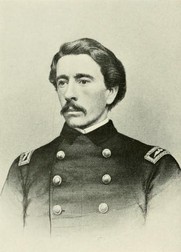
 General Stevens during the Civil War

(Library of Congress)

        Stevens and his division were transferred to Virginia and became part of the Union Army of Virginia under Major General John Pope. August 28-30, 1862, Stevens’ division fought in the Second Battle of Bull Run, in which Confederate General Robert E. Lee defeated General Pope.

        On the very next day, General Stevens engaged the forces of Confederate General Thomas J. “Stonewall” Jackson in the Battle of Chantilly/Ox Hill, as Jackson attempted to deny the line of retreat of the Union Army. Though outnumbered, Stevens’ forces attacked across an open field and achieved initial success. During the Confederate counterattack, Stevens attempted to rally the 79th Highlanders, his former regiment. Five color bearers had fallen. Stevens himself raised the regimental colors as a wounded bearer shouted, “For God’s sake, don’t take the colors, general. They’ll shoot you if you do.” Ignoring this plea, Stevens cried: “Highlanders, my Highlanders, follow your general!” The regiment charged, and the Confederate counterattack was halted. Stevens lay dead, a bullet through his temple, the colors lying on his head and shoulders.

        In March 1863 General Stevens was awarded posthumously the rank of major general. He is buried in Island Cemetery, Newport.

Gravestone, Isaac Ingalls Stevens, Island Cemetery, Newport

(Russ Dodge, http://www.findagrave.com)

Posted in Uncategorized | Tagged , , , , , , | Leave a comment

Rhode Island Joins March to War

(This essay was originally published in the Newport Daily News, May 26, 2012)

After the South’s bombardment of Fort Sumter, on April 12, 1861, President Lincoln issued a call to arms on April 15 and established Rhode Island’s quota at 780 men. Governor William Sprague called the General Assembly into special session on April 17, and both Houses quickly passed unanimously a resolution to meet the quota. Various state banks came forward and offered loans to meet the financial requirements. Finally, acts reviving the charters of the Providence Horse Guards, the Narragansett Guards, the City Guards of Providence, and the Wickford Pioneers were approved.

         During the period April 18-24, Rhode Island sent its first units off to war. On April 18, the Providence Marine Corps Artillery left Providence. Following this unit were two detachments composing the First Regiment, Rhode Island Detached Militia, commanded by Colonel Ambrose E. Burnside.  On April 20, the first contingent, 530 men, under the command of Burnside departed on the Steamer Empire State. These men came from the ten companies making up the regiment, six from Providence and one each from Pawtucket, Woonsocket, Westerly, and our own Newport. As the ship passed Newport Harbor, salutes were fired from the city and Fort Adams to honor the departure.  The second contingent of 510 men, under the command of Colonel Joseph T. Pitman, departed Providence by steamer on April 24. As they marched to the Fox Point pier, they sang their regimental song:

“The gallant young men of Rhode Island
Are marching in haste to the wars:
Full girded for strife, they are hazarding life
In defense of our banner and stars.”


Second Detachment of the First RI Regiment departing Providence, April 24, 1861

        Burnside eventually became the most renowned Rhode Island Civil War hero. Born in Indiana, he graduated West Point, served in the Mexican War (1846-48), married Mary Fisher from Providence, and invented and manufactured in Bristol a breech-loading rifle. Shortly after Fort Sumter, Governor Sprague asked him to lead the First Rhode Island Regiment. He gave his name to the style whiskers which he wore.

        Burnside reported to the governor that during the final marches to the nation’s  capital: “Nothing whatever occurred to detract from the good reputation of the State, whose patriotism had called into active service the fine body of men whom I esteem it an honor to lead.”

        On April 29, the First Detachment welcomed their fellow soldiers from the Second Detachment and escorted them to the Patent Office grounds where they had temporary quarters. That same day the entire regiment marched to the White House and was there welcomed by President Lincoln, Lieutenant General Winfield Scott, the Army Commander in Chief, Secretary of State Seward and Secretary of War Cameron.

            On May 2 the entire regiment was paraded with Governor Sprague, President Lincoln, and many spectators observing. It was then marched to the Capitol where the regiment was mustered into service for the United States for a period of three months. Each soldier recited the following oath of allegiance:

 “I ___________, do solemnly swear, that I will bear true allegiance to the United States of America and that I will serve honestly and faithfully against all their enemies or opposers whatsoever, and observe and obey the orders of the President of the United States, and the orders of the officers appointed over me, according to the rules and regulations for the government of the armies of the United States.”

Colonel Burnside reported that “eleven hundred voices rose in one volume upon the air.”

            In his first official report to Governor Sprague on May 23, Burnside closed by saying, “I cheerfully bear testimony to the general good conduct and character of the men composing this Regiment. It is with the greatest satisfaction, that I can commend them to the favor and generosity of the people of the State whose honor they are engaged in upholding, and whose good name they are determined to maintain.”

            It would be this good name that would be put to the test when the First Rhode Island Regiment took part in its first combat at the First Battle of Bull Run in July, 1861.

            For more information, please visit the state’s Civil War Sesquicentennial Commemoration Commission website: www.rhodeislandcivilwar150.org.

Posted in Uncategorized | Tagged , , , , , , , , | Leave a comment

The American Civil War: Beginning to the Battle of Shiloh

(This essay, entitled “Freedom, Unity Born in Conflict,” was published in the Newport Daily News on April 25, 2012)

One hundred and fifty years ago, Americans fought, wounded, and killed each other in astounding numbers. The American Civil War began on April 12, 1861, when Confederate forces began shelling Fort Sumter in Charleston harbor, South Carolina. Although fighting continued until the end of May, 1865, the war was essentially over when General Robert E. Lee surrendered to General Ulysses S. Grant at Appomattox Court House, Virginia, on April 9.

          After Abraham Lincoln won the national election in November, the Confederate States of America began its formation when South Carolina seceded from the Union on December 20, 1860. By April, 1862, it had grown to eleven states. The United States had 34 states and about 31 million people when the Civil War began. It ended the war with 36 states after West Virginia and Nevada earned statehood during the war.

          The war took the life of the president who, in most surveys, is rated our greatest president, Abraham Lincoln. In accepting the Republican nomination for the Senate in 1858, he stated, “A house divided against itself cannot stand. I believe this government cannot endure, permanently half slave and half free. … It will become all one thing, or all the other.” The bloody conflict ended slavery and mended the political division among us. At the outset of the war, people referred to the country as “the United States are,” while afterward people said “the United States is.” At first the conflict was about the existence of the Union and about states’ rights, but it eventually rose to a higher plane. The subtext of slavery surfaced and recast the war into one fought about a new birth of freedom for our country and about dictating that the Southern way of life based on slavery must be gone with the wind.

          The Civil War is a cornerstone in America’s national identity. Civil War writer Shelby Foote stated that any understanding of our nation must be based on an understanding of the Civil War. “The Civil War defined us as what we are and opened us to what we became ….” It was an “enormous catastrophe” and the “crossroads of our being.” Civil War historian James McPherson has stated that: “From the war sprang the great flood that caused the stream of American history to surge into a new channel ….”

          The average Civil War soldier was 25 years old, five feet eight inches tall, and weighed 143 pounds. Though the minimum legal age for enlistment was 18, an estimated 100,000 soldiers in the Union Army were under 15, some drummer boys being as young as nine.

          The war claimed the lives of over 600,000 Americans, about 2% of the population. Over 2.2 million men served under arms in the Union military and perhaps 1.5 million served in the Confederate military. One in 65 died in combat, one in 13 died of disease, one in 10 was wounded. The last Civil War veteran died in 1959.

          By March, 150 years ago, a number of key events had taken place since the surrender of Fort Sumter to the Confederacy in April 1861. Virginia, Arkansas, Tennessee, and North Carolina had joined the Confederate States of America, bringing its total to eleven. In July the First Battle of Bull Run (Manassas to the Confederates) took place, ending in a rout of the Union Army. The Union navy had begun its blockade of the South. Finally, in March, the first naval engagement between ironclad ships took place. The Union Monitor fought the Confederate Merrimac (C.S.S. Virginia) to a draw, but only after the Merrimac had sunk two wooden Union warships.

          By this month 150 years ago, both sides still hoped for a war limited in scale and duration. This lasted until April 6-7 when in Tennessee about 65,000 Union troops led by Major General Ulysses S. Grant fought some 45,000 southern troops, led by General Albert Sidney Johnston near a church called Shiloh. Attempting to finish off the Union forces, the Confederates launched a dozen attacks at the weakening Union center at a place which came to be known as the Hornet’s Nest. But the Union line held, and when reinforcements arrived the next day, the Southern forces retreated.

       The losses were shocking and unprecedented: 3477 deaths and 24,000 total casualties (killed, wounded, captured, fallen ill, or missing), more casualties than in all previous American wars combined. After the Battle of Shiloh, both sides realized in Foote’s words that they had “a very bloody affair on their hands.” Shiloh is a Hebrew word meaning ironically “place of peace.”

Posted in Uncategorized | Tagged , , , , , , , , , , , , , , , | Leave a comment

The Causes of Peace

The terms war and peace can relate to many dimensions of society. This essay examines very briefly the causes of peace in the international state system: war and peace within states (intrastate conflict) and between states (interstate conflict).

Political scientists normally do not ask the question what causes peace. They normally address the issue from the other end: What causes war? If we can learn more about this, then we are more apt to begin to answer the question about the causes of peace.

Traditional theory of international relations gives various explanations or theories about war and peace. The most famous is balance of power theory and what political scientists call political realism. In this theory of realism:

  • World politics is a world of anarchy. There is no world government which has sovereignty.
  • Because of this, states–the most important actors–must look after themselves.
  • The interests of the state, rather than moral principles, always come first. Survival is the most important self-interest.
  • They do this mainly by seeking power, by accumulating more power than other states.
  • In behaving like this, they normally follow the rule: the end justifies the means.

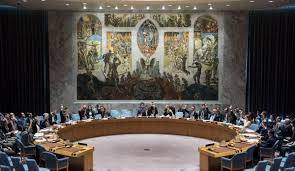
UN Security Council

This theory suggests that for war to break out, there must be an imbalance of power in the international system. A state accrues too much power, e.g., France under Napoleon in the early 19th C, or has too little power, e.g., Kuwait in 1990, when Iraq attacked and occupied it.

Then for peace to “break out,” the theory suggests that there must either be a state with overwhelming power, like Rome in the 2nd century or the U.S. in the 1990s, or a system of states where power among the states is relatively balanced, like the Cold War period 1947-1991, between the US-led NATO alliance and the USSR-led Warsaw Pact.

Achieving balance and stability is critical. In his book, The Peloponnesian War, Donald Kagan discusses the Thirty Years Peace, between Athens and Sparta in the 5th century BCE. He addresses three different types of peace treaties.

  1. Some end in one side being totally destroyed, e.g., Carthage in the Punic Wars, (and perhaps the native Americans in the war for the American West).
  2. Other treaties inflict harsh terms on a defeated enemy but do not extinguish it, e.g., Prussia’s defeat of France in 1871, the Allies defeat of Germany in World War I. The loser, in this case, may seek revenge. After the punitive Versailles Treaty the Allies forced Germany to sign after WW I, Hitler referred to this “dictated peace” often and used it to stir the emotions of the German people.
  3. The third type ends a long and costly conflict in which the sides have recognized the great costs of the war and in which there is no genuine victor, for example, the Peace of Westphalia in 1648 ending the Thirty Years War or the Congress of Vienna ending the Napoleonic Wars in 1815. This last type seeks to reestablish an enduring order and stability. While there were many wars and revolutions after 1815, there was no general war involving all the major European powers until World War I in 1914.

Recent scholarship on war and peace gives grounds for optimism. In his book , The Better Angels of Our Nature: Why Violence Has Declined, Steven Pinker presents such data. Interstate wars have declined. The last one was the US-Iraq War in 2003. Moreover, since World War II, the deadliness of wars has also declined. Pinker points out that in 1950, the average conflict (of any kind) killed 30,000 people. In 2007, it killed less than 1000. Also, intrastate conflict or civil wars and other conflicts have also declined. The annual rate of battle deaths has dropped from almost 300 per 100,000 of world population during WW II to fewer than one in the 21st century. And we have not seen an increase in civilian deaths with this drop in battle deaths. The ratio has remained the same:  about 50-50.

What are the causes of this drop? Pinker offers several reasons or theories. First, he says that war no longer pays. The costs outweigh the perceived benefits. Second, while there is no sovereign world organization or uniform set of international laws, happily we have a more regulated international system. The United Nations is a bigger player than in the 20th century and has sent peacekeeping missions to many areas. Third, we have witnessed in the past 60 years an increase in trade and prosperity. Today more wealth comes from trade than conquest. Lastly, there has been a “growing repugnance” to and rejection of “institutionalized violence.” Perhaps the human qualities of self-control, reason, and empathy are winning out over greed, revenge and the lust for power.

In an online article in Current Anthropology on October 13, 2017, Dean Falk and Charles Hildebolt challenge Pincker’s conclusions. In their study which cut across cultures and species and compared annual war deaths for 11 chimpanzee communities, 24 hunter-gathering communities, and countries that fought in WWI and WWII, they found that  overall battle-deaths in modern organized societies is exponentially higher than in hunter-gatherer societies of the past 200 years. They also found that humans have evolved to be more violent than chimpanzees. Pincker disputes these findings.

Regrettably, we need look no further than the news to realize that violence still certainly persists. The newest country in our international system, South Sudan, gained independence in July 2011 after five decades of ethnic conflict and 2 million deaths. However, eventually there came troubling reports of renewed ethnic conflict. A mere three hundred yards from the UN compound in South Sudan, the corpses began. Hundreds, perhaps thousands, died in ethnic conflict between the Nuer and Murle tribes. Syria’s civil war continues with other regional and major powers fighting proxy war there. ISIS, essentially defeated in the Middle East, is morphing and continuing its violence in other regions of the world. We all watch the stand-off between North Korea and the United States with anxiety.

Picasso’s Guernica

What can you and I do? How can you and I “wage peace?” Let me offer several ways.

  1. Develop more empathy. Learn another person’s language but also learn about her/his history and culture. Try to put yourself in the other person’s shoes and see the world as that person sees it. If you already know another language, learn still another.
  2. Listen to each other more; respect each other more. Look for and build on our common interests. War is possible but so is peace. You may have seen the Hollywood movie “War Horse.” In the scene on the Western Front, British and German soldiers stop fighting for a few minutes to free the war horse from the barbed wire between the trench lines in No Man’s Land. A British and a German soldier jointly free him from the wire and flip a coin to see who will take the horse. In this case the life of this remarkable horse that had made it through the night in No Man’s land served to give the enemies a common purpose.
  3. Study and learn the essentials of Power and Influence in this world. Examine and learn about power and influence between individuals, groups, companies, states, and other international actors. Your goals for peace and stability probably cannot be achieved by kindness alone. Learn to operate in this world of power and influence while compromising your own principles as little as possible. To help you understand blunt, hard-nosed, Machiavellian power politics, watch the movie: “Elizabeth.”
  4. For peace to prevail, compromise among competing groups is necessary. In your group, distinguish the essential and vital from the not-so-essential. Be ready to compromise. To help you understand the negative consequences of the persistent striving to dominate and be Number 1, watch the movie: “A Beautiful Mind.”
  5. If we wish for a better world, you and I must strive to make the various episodes of life end well—with goodness and justice winning over malice and evil.
  6. Lastly, we must all enhance our inner capacities for peace and reconciliation. Challenge yourself to enhance the “better angels” of your nature.

As one of my heroes, Abe Lincoln, said famously in his first inaugural address: “I am loathe to close.  We are not enemies, but friends.  We must not be enemies… The mystic chords of memory, stretching from every battlefield, and patriot grave, to every living heart and hearthstone, all over this broad land, will yet swell the chorus of the Union, when again touched, as surely they will be, by the better angels of our nature.” (Please see Part II.)

(Note: See President John F. Kennedy’s “Peace Speech” in June 1963:

https://www.jfklibrary.org/Asset-Viewer/BWC7I4C9QUmLG9J6I8oy8w.aspx)

Bibliography:

Brodie, Bernard. War and Politics. NY: MacMillan, 1975.

Claude, Inis L. Power and International Relations. NY: Random House, 1966.

von Clausewitz, Carl. On War. Translated and edited by Michael Howard
and Peter Paret. Princeton, NJ: Princeton University Press, 1976.

Kagan, Donald. On the Origins of War and the Preservation of Peace. NY:
Doubleday, 1995.

________ . The Peloponnesian War. NY: Viking, 2003.

Mearsheimer, John J. The Great Delusion: Liberal Dreams and International
Realities. New Haven: Yale University Press, 2018.

________ . The Tragedy of Great Power Politics. NY: W.W. Norton, 2001.

Morgenthau, Hans J. Politics Among Nations: The Struggle for Power and Peace.
NY: Alfred A. Knopf, 1973.

Stoessinger, John G. Why Nations Go to War. NY: St. Martin’s Press, 1974.

Sun Tzu. The Art of War. Translated by Samuel B. Griffith. London:
Oxford University Press, 1963.

Waltz, Kenneth N. Theory of International Politics. NY: Random House, 1979.

Posted in Uncategorized | Tagged , , , , , , , , , , , , , , , , , , | Leave a comment

Letter from Abe Lincoln to President Obama, April 12, 2011

 ( This essay was published in the Newport Daily News, April 16, 2011, as “What Would Lincoln Think of U.S. Today?”)

With the 150th anniversary of the bombardment of Ft. Sumter, on April 12, 1861, launching the Civil War, what might Abe Lincoln say today to our current president?

 Dear Mr. President,

        Though your allegiance is to the other political party, I cast aside partisanship on such a momentous anniversary. First, let me render my highest praise and heartiest congratulations to you on your election to the highest political office in the land. For a man of your parentage to achieve such a station glorifies both you as well as the constitution and character of our country. With my Emancipation Proclamation of 1863, I am happy to have played a small part in launching the ship of freedom for the Negro race.

        Second, I am elated that our beloved country, this great experiment in self-government, continues to thrive 235 years after its birth. My faith in the common people is vindicated. I have always believed that if they retain their virtue and vigilance, no administration, however weak or corrupt, can do too much damage to our government in the space of four years.

        I must say that I am not surprised that the United States can claim today to be the leader of the free world. I could anticipate this; in my era I could see the vast potential of our country to expand economically, industrially, and geographically to the shores of the Pacific.

        On the other hand, I am surprised by the extent to which the many minorities of our Union have achieved such a notable level of social justice, by the complexities of the international system today, and by the astounding advances in technology which seem to be transforming the lives of Americans so profoundly.

        May I offer some humble advice? I must first register my serious concern at the size and role of government, both federal and state, and how it has assumed so many roles in our society, roles in my era filled by other institutions such as family and church, or simply left to individual initiative and responsibility. This to me is the most striking and potentially harmful feature of government in this present era. I have always firmly believed it is the role of government to set the conditions for men to lift themselves. As I said in my July 4, 1861, message to Congress:  The war on the Union side was “a struggle for maintaining in the world, that form, and substance of government, whose leading object is to elevate the condition of men …to afford all an unfettered start, and a fair chance, in the race of life.”  I fear that these well-intentioned, social welfare programs of today breed too much dependence and dampen individual responsibility and initiative, rather than magnifying them.

        Looking beyond our shores, I am heavy with doubt about the multiple military conflicts in which our republic is engaged. In the shadow it casts upon the international stage, let the United States be more the exemplar rather than the crusader. Avoid a malady of ancient Rome, which succumbed to the tendency of seeing threats everywhere. As its borders expanded, it saw malicious threats multiply. 

        Finally, look first to secure and strengthen the Union. While our country continues to be blessed with many natural, financial, and human resources, these resources must be husbanded. They are not limitless. In waging now more than two wars with the current budgetary problems not only at the federal but state and local levels, we may be driving the country to the breaking point. Let every segment of American society shoulder a share of the burden in solving our fiscal problems. As we claim today to teach others abroad how to be citizens of a state, let us renew our own efforts at home to bind together a house too divided.

        Remember the Aesop’s fable about the father who could not keep his sons from quarreling. He gave a bundle of sticks to each son and told each to break it. None could. Then he untied the bundle and gave a stick to each son. Each son broke the single stick easily. While we are unified, no enemy can do us mortal harm.

        I am reminded of my words early in my political career: “If destruction be our lot, we must ourselves be its author and finisher. As a nation of freemen we must live through all time, or die by suicide.”

Yours, very sincerely,

A. Lincoln

Fred Zilian is an admirer and impersonator of Abe Lincoln. He is also an educator at Portsmouth Abbey School, Portsmouth, RI.

Posted in Uncategorized | Tagged , , , , , , | 3 Comments

Western Gifts to Arabs

(Published in the Newport Daily News on March 14, 2011, as “Democracy is West’s Gift Back to the Arabs”)

As the Arabs for centuries kept alive and eventually passed back to the West the learning of the ancient Greeks, the West has now offered the Arabs the ancient Greek ideals of freedom and democracy, galvanizing and actuating them to overthrow their tyrants.
     In the Western tradition, it was the ancient Greeks—especially the Athenians—who raised the ideal of freedom with all its risks to a highest principle. Tired of tyranny, the Athenian people in 508 BCE arose to throw off the yoke of oppression. Under the leadership of Cleisthenes and eventually Pericles, the Athenians established the world’s first democracy.
     After the Western Roman Empire declined and fell in the 5th century CE, remarkably and tragically most of the learning of the ancient Greeks was lost to the West. After Muhammad’s death in 632, Arabs–impassioned by Allah’s revelations to Muhammad—launched an expansion which eventually brought them into contact with the wisdom of the ancient Greeks. It was the Arabs—coming across the great works of Ptolemy, Plato, Galen, Hippocrates, Euclid, Archimedes, and especially Aristotle—who kept the lamp of Greek learning alive in those centuries of Western history we have come to consider as dark with brutality, superstition, and intellectual stagnation.
     How fitting then that the West has repaid the favor by providing the Arab world with its example of freedom and democracy. Educated and enabled by the gadgets of the technological revolution of the last two decades, the younger Arab generations have been sparked by the self-immolation of one of their own—26-year-old Tunisian Mohamed Bouazizi, denied the freedom to sell fruits and vegetables. Even as US forces invaded Iraq in 2003 carrying the ideal of freedom in their rucksacks, most of us knew if the “Arab Street” was going to rise up and reject the tyranny of Ben Ali in Tunisia, Mubarak in Egypt, and now Qaddafi in Libya, it would have to be self-initiated and not imposed from without by Western forces wielding guns and missiles.
     In recent years the question, much-debated in high academic and policy circles, has been whether Islam and democracy are compatible. Some have argued no; others like Daniel Pipes of the Middle East Institute have argued it is not Islam that is incompatible with democracy. Rather it is Islamism or political-militant Islam a la al-Qaeda or the Taliban. “…the Islamist movement which today dominates Muslim intellectual life pulls in precisely the opposite direction from democracy.”
    

What will emerge in the Arab world in the next decade will be an Arab synthesis of Western democracy and Arab-Islam. With Arab-Islam’s different views of the place of women, the relationship of mosque and state, and the authority of the tribal leader, this democratizing process will be much more of a challenge than the people of Eastern Europe faced after they toppled their Communist regimes in the revolutions of late 1980s and early 90s. The East Germans, for example, were simply incorporated in October 1990 into the existing democracy of the Western Germans.
     Arab tradition and culture is much more rooted in the subordination of women, the integration of religion into the life of the state, and deference and docility to the tribal leader. Therefore, the process now begun in the Arab world will be much bloodier, volatile, fitful, and extended. Plato, one of the ancient Greeks that the Arabs helped to keep alive, suggested democracy’s messiness: “Democracy is a charming form of government, full of variety and disorder, and dispensing a sort of equality to equals and unequal alike.” Happily for Western political leaders, they should confront less than they have in the past the dilemma of dealing with ossified autocrats who deny the very rights and freedoms which allowed these leaders to assume power in their own countries.
     The ancient Athenians were willing to take the risks which freedom posed. In so taking, they eventually created the political system of direct democracy in which the Athenian citizens actually took turns in running the government of Athens. Three or four times each month all adult, male Athenians assembled to debate and vote on issues as simple as the price of olives and as momentous as a declaration of war. The Arabs (and perhaps the Persians of Iran), who have risen up against their tyrants as the ancient Athenians did, have decided to risk it.
     The future complexion of these new regimes is not clear. What is clear is that the long era of acquiescence to the Arab tyrant is over.

Posted in Uncategorized | Tagged , , , , , , , , , , , , , , , | 4 Comments

United Germany at 20

By Fred Zilian

(Published in the Newport Daily News, October 10, 2010, as “Unified Germany at 20 Has Much to Celebrate”)

This October Germany is not only celebrating the 200th anniversary of its world famous Oktoberfest, but more significantly on October 3 it celebrated the 20th anniversary of its unification. This one, accomplished peacefully unlike its first unification in 1871, added 16 million people from the previous East Germany to West Germany, creating the most populous country in Europe, now with over 82 million. Not only Germany, but also Europe and America can be proud and thankful.

          On the political level, the Federal Republic of Germany has now proven itself over sixty years to be a stable, resilient democracy, consigning to history its authoritarian and totalitarian past up to 1945. In its twenty years since the Unification it has peacefully and democratically installed several governments of various political hues. In 2005 Angela Merkel became its first female chief executive (chancellor) and the first from the “new federal states,” as the former East Germany is called. Though accused by its NATO allies of foot-dragging at times, it has moved from a country militarily hand-cuffed—restricted by its Constitution, its national culture, and its past—to a more confident, “normal” country that is prepared to assert itself and even send its soldiers abroad. In 1999 it committed its military forces to combat for the first time since WW II as part of a NATO force to protect Kosovo from Yugoslavia. Beyond the Balkans it has also sent military forces to the Middle East, Africa, and now Afghanistan. It currently has 4670 soldiers in that region as part of NATO’s force. When I was stationed there as a young officer in the early 1970s, I can recall my surprise at the universal lack of patriotism and flag waving. Showing that it has exorcised at least some of the hyper-national devils from its Nazi period, German flags flew plentifully and vibrantly for the World Cup it hosted in 2006.

          Economically, Germany has the fifth largest economy in the world and the largest in Europe. For decades Germany has been the economic engine of Europe, so featured on the front page of a recent edition of the influential British magazine The Economist. Driven by Germany’s 2.2% growth—its best quarterly performance since Unification—the 16-nation eurozone of the European Union with a growth of 1% outpaced both US (.4%) and Japan (.1%) in April-June of this year.

          The social and economic integration of eastern Germany into the Federal Republic has had its successes as well as its shortcomings. In July, 1991, shortly after Unification, the unemployment rate in the east (12%) was double that of the west. Regrettably, the figures remain about the same today, with some areas of the east having a rate approaching 20%. Since Unification, the east has lost one-tenth of its population and still needs much aid from the western states, totaling $12 billion in 2008 for example. On the other hand, former east Germans now earn on average 83% of the equivalent salary in the west, compared to only 53% in 1991. GDP per capita has risen in the east from 40% of the west’s in 1991 to nearly 70% in 2008. Life expectancy in the east has risen by six years, and its infrastructure has enjoyed a substantial makeover, making westerners jealous.

          On the social level, the difficulty in integrating easterners and westerners—the Ossis and Wessis—persists. This so-called “wall of the mind,” present 20 years ago, has proven quite tenacious. The resentments and prejudices continue. One politician described it as like an “arrogant rich uncle [the West] versus the resentful poor nephew [the East].” A poll in 2008 found that 64% of the easterners feel they are treated like second class citizens, with about one in six agreeing with the statement: “It would have been better if the Wall had never fallen.” Still, in a poll this past year, 91% of easterners and 85% of westerners said that unification was the right choice, and another survey showed that 91% of easterners support democracy though half are not happy about the way it sometimes works.

As I stood in Bonn’s central market place on Unification Day twenty years ago, oompah music playing, balloons rising, flocks of pigeons darting, the crowd swaying, I was hopeful that the Germans would succeed in their unification. Today the Germans can be proud of their achievements, and Americans can be proud of the role they played in ending the Cold War and supporting the Unification. Shortly after Unification, I spoke to a former East German sergeant who indicated how it might have been had the Soviets won the Cold War. He told me that “Germany would have been one big concentration camp.”

An educator at Portsmouth Abbey School, Portsmouth, RI, Fred Zilian, Ph.D., spent six years in Germany as an Army officer.

Posted in Uncategorized | Tagged , , , , , , , | Leave a comment