The American Civil War: Beginning to the Battle of Shiloh

(This essay, entitled “Freedom, Unity Born in Conflict,” was published in the Newport Daily News on April 25, 2012)

One hundred and fifty years ago, Americans fought, wounded, and killed each other in astounding numbers. The American Civil War began on April 12, 1861, when Confederate forces began shelling Fort Sumter in Charleston harbor, South Carolina. Although fighting continued until the end of May, 1865, the war was essentially over when General Robert E. Lee surrendered to General Ulysses S. Grant at Appomattox Court House, Virginia, on April 9.

          After Abraham Lincoln won the national election in November, the Confederate States of America began its formation when South Carolina seceded from the Union on December 20, 1860. By April, 1862, it had grown to eleven states. The United States had 34 states and about 31 million people when the Civil War began. It ended the war with 36 states after West Virginia and Nevada earned statehood during the war.

          The war took the life of the president who, in most surveys, is rated our greatest president, Abraham Lincoln. In accepting the Republican nomination for the Senate in 1858, he stated, “A house divided against itself cannot stand. I believe this government cannot endure, permanently half slave and half free. … It will become all one thing, or all the other.” The bloody conflict ended slavery and mended the political division among us. At the outset of the war, people referred to the country as “the United States are,” while afterward people said “the United States is.” At first the conflict was about the existence of the Union and about states’ rights, but it eventually rose to a higher plane. The subtext of slavery surfaced and recast the war into one fought about a new birth of freedom for our country and about dictating that the Southern way of life based on slavery must be gone with the wind.

          The Civil War is a cornerstone in America’s national identity. Civil War writer Shelby Foote stated that any understanding of our nation must be based on an understanding of the Civil War. “The Civil War defined us as what we are and opened us to what we became ….” It was an “enormous catastrophe” and the “crossroads of our being.” Civil War historian James McPherson has stated that: “From the war sprang the great flood that caused the stream of American history to surge into a new channel ….”

          The average Civil War soldier was 25 years old, five feet eight inches tall, and weighed 143 pounds. Though the minimum legal age for enlistment was 18, an estimated 100,000 soldiers in the Union Army were under 15, some drummer boys being as young as nine.

          The war claimed the lives of over 600,000 Americans, about 2% of the population. Over 2.2 million men served under arms in the Union military and perhaps 1.5 million served in the Confederate military. One in 65 died in combat, one in 13 died of disease, one in 10 was wounded. The last Civil War veteran died in 1959.

          By March, 150 years ago, a number of key events had taken place since the surrender of Fort Sumter to the Confederacy in April 1861. Virginia, Arkansas, Tennessee, and North Carolina had joined the Confederate States of America, bringing its total to eleven. In July the First Battle of Bull Run (Manassas to the Confederates) took place, ending in a rout of the Union Army. The Union navy had begun its blockade of the South. Finally, in March, the first naval engagement between ironclad ships took place. The Union Monitor fought the Confederate Merrimac (C.S.S. Virginia) to a draw, but only after the Merrimac had sunk two wooden Union warships.

          By this month 150 years ago, both sides still hoped for a war limited in scale and duration. This lasted until April 6-7 when in Tennessee about 65,000 Union troops led by Major General Ulysses S. Grant fought some 45,000 southern troops, led by General Albert Sidney Johnston near a church called Shiloh. Attempting to finish off the Union forces, the Confederates launched a dozen attacks at the weakening Union center at a place which came to be known as the Hornet’s Nest. But the Union line held, and when reinforcements arrived the next day, the Southern forces retreated.

       The losses were shocking and unprecedented: 3477 deaths and 24,000 total casualties (killed, wounded, captured, fallen ill, or missing), more casualties than in all previous American wars combined. After the Battle of Shiloh, both sides realized in Foote’s words that they had “a very bloody affair on their hands.” Shiloh is a Hebrew word meaning ironically “place of peace.”

Posted in Uncategorized | Tagged , , , , , , , , , , , , , , , | Leave a comment

The Causes of Peace

The terms war and peace can relate to many dimensions of society. This essay examines very briefly the causes of peace in the international state system: war and peace within states (intrastate conflict) and between states (interstate conflict).

Political scientists normally do not ask the question what causes peace. They normally address the issue from the other end: What causes war? If we can learn more about this, then we are more apt to begin to answer the question about the causes of peace.

Traditional theory of international relations gives various explanations or theories about war and peace. The most famous is balance of power theory and what political scientists call political realism. In this theory of realism:

  • World politics is a world of anarchy. There is no world government which has sovereignty.
  • Because of this, states–the most important actors–must look after themselves.
  • The interests of the state, rather than moral principles, always come first. Survival is the most important self-interest.
  • They do this mainly by seeking power, by accumulating more power than other states.
  • In behaving like this, they normally follow the rule: the end justifies the means.
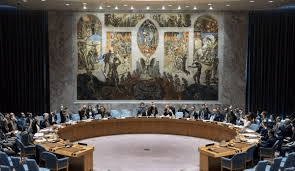
UN Security Council

This theory suggests that for war to break out, there must be an imbalance of power in the international system. A state accrues too much power, e.g., France under Napoleon in the early 19th C, or has too little power, e.g., Kuwait in 1990, when Iraq attacked and occupied it.

Then for peace to “break out,” the theory suggests that there must either be a state with overwhelming power, like Rome in the 2nd century or the U.S. in the 1990s, or a system of states where power among the states is relatively balanced, like the Cold War period 1947-1991, between the US-led NATO alliance and the USSR-led Warsaw Pact.

Achieving balance and stability is critical. In his book, The Peloponnesian War, Donald Kagan discusses the Thirty Years Peace, between Athens and Sparta in the 5th century BCE. He addresses three different types of peace treaties.

  1. Some end in one side being totally destroyed, e.g., Carthage in the Punic Wars, (and perhaps the native Americans in the war for the American West).
  2. Other treaties inflict harsh terms on a defeated enemy but do not extinguish it, e.g., Prussia’s defeat of France in 1871, the Allies defeat of Germany in World War I. The loser, in this case, may seek revenge. After the punitive Versailles Treaty the Allies forced Germany to sign after WW I, Hitler referred to this “dictated peace” often and used it to stir the emotions of the German people.
  3. The third type ends a long and costly conflict in which the sides have recognized the great costs of the war and in which there is no genuine victor, for example, the Peace of Westphalia in 1648 ending the Thirty Years War or the Congress of Vienna ending the Napoleonic Wars in 1815. This last type seeks to reestablish an enduring order and stability. While there were many wars and revolutions after 1815, there was no general war involving all the major European powers until World War I in 1914.

Recent scholarship on war and peace gives grounds for optimism. In his book , The Better Angels of Our Nature: Why Violence Has Declined, Steven Pinker presents such data. Interstate wars have declined. The last one was the US-Iraq War in 2003. Moreover, since World War II, the deadliness of wars has also declined. Pinker points out that in 1950, the average conflict (of any kind) killed 30,000 people. In 2007, it killed less than 1000. Also, intrastate conflict or civil wars and other conflicts have also declined. The annual rate of battle deaths has dropped from almost 300 per 100,000 of world population during WW II to fewer than one in the 21st century. And we have not seen an increase in civilian deaths with this drop in battle deaths. The ratio has remained the same:  about 50-50.

What are the causes of this drop? Pinker offers several reasons or theories. First, he says that war no longer pays. The costs outweigh the perceived benefits. Second, while there is no sovereign world organization or uniform set of international laws, happily we have a more regulated international system. The United Nations is a bigger player than in the 20th century and has sent peacekeeping missions to many areas. Third, we have witnessed in the past 60 years an increase in trade and prosperity. Today more wealth comes from trade than conquest. Lastly, there has been a “growing repugnance” to and rejection of “institutionalized violence.” Perhaps the human qualities of self-control, reason, and empathy are winning out over greed, revenge and the lust for power.

In an online article in Current Anthropology on October 13, 2017, Dean Falk and Charles Hildebolt challenge Pincker’s conclusions. In their study which cut across cultures and species and compared annual war deaths for 11 chimpanzee communities, 24 hunter-gathering communities, and countries that fought in WWI and WWII, they found that  overall battle-deaths in modern organized societies is exponentially higher than in hunter-gatherer societies of the past 200 years. They also found that humans have evolved to be more violent than chimpanzees. Pincker disputes these findings.

Regrettably, we need look no further than the news to realize that violence still certainly persists. The newest country in our international system, South Sudan, gained independence in July 2011 after five decades of ethnic conflict and 2 million deaths. However, eventually there came troubling reports of renewed ethnic conflict. A mere three hundred yards from the UN compound in South Sudan, the corpses began. Hundreds, perhaps thousands, died in ethnic conflict between the Nuer and Murle tribes. Syria’s civil war continues with other regional and major powers fighting proxy war there. ISIS, essentially defeated in the Middle East, is morphing and continuing its violence in other regions of the world. We all watch the stand-off between North Korea and the United States with anxiety.

Picasso’s Guernica

What can you and I do? How can you and I “wage peace?” Let me offer several ways.

  1. Develop more empathy. Learn another person’s language but also learn about her/his history and culture. Try to put yourself in the other person’s shoes and see the world as that person sees it. If you already know another language, learn still another.
  2. Listen to each other more; respect each other more. Look for and build on our common interests. War is possible but so is peace. You may have seen the Hollywood movie “War Horse.” In the scene on the Western Front, British and German soldiers stop fighting for a few minutes to free the war horse from the barbed wire between the trench lines in No Man’s Land. A British and a German soldier jointly free him from the wire and flip a coin to see who will take the horse. In this case the life of this remarkable horse that had made it through the night in No Man’s land served to give the enemies a common purpose.
  3. Study and learn the essentials of Power and Influence in this world. Examine and learn about power and influence between individuals, groups, companies, states, and other international actors. Your goals for peace and stability probably cannot be achieved by kindness alone. Learn to operate in this world of power and influence while compromising your own principles as little as possible. To help you understand blunt, hard-nosed, Machiavellian power politics, watch the movie: “Elizabeth.”
  4. For peace to prevail, compromise among competing groups is necessary. In your group, distinguish the essential and vital from the not-so-essential. Be ready to compromise. To help you understand the negative consequences of the persistent striving to dominate and be Number 1, watch the movie: “A Beautiful Mind.”
  5. If we wish for a better world, you and I must strive to make the various episodes of life end well—with goodness and justice winning over malice and evil.
  6. Lastly, we must all enhance our inner capacities for peace and reconciliation. Challenge yourself to enhance the “better angels” of your nature.

As one of my heroes, Abe Lincoln, said famously in his first inaugural address: “I am loathe to close.  We are not enemies, but friends.  We must not be enemies… The mystic chords of memory, stretching from every battlefield, and patriot grave, to every living heart and hearthstone, all over this broad land, will yet swell the chorus of the Union, when again touched, as surely they will be, by the better angels of our nature.” (Please see Part II.)

(Note: See President John F. Kennedy’s “Peace Speech” in June 1963:

https://www.jfklibrary.org/Asset-Viewer/BWC7I4C9QUmLG9J6I8oy8w.aspx)

Bibliography:

Brodie, Bernard. War and Politics. NY: MacMillan, 1975.

Claude, Inis L. Power and International Relations. NY: Random House, 1966.

von Clausewitz, Carl. On War. Translated and edited by Michael Howard
and Peter Paret. Princeton, NJ: Princeton University Press, 1976.

Kagan, Donald. On the Origins of War and the Preservation of Peace. NY:
Doubleday, 1995.

________ . The Peloponnesian War. NY: Viking, 2003.

Mearsheimer, John J. The Great Delusion: Liberal Dreams and International
Realities. New Haven: Yale University Press, 2018.

________ . The Tragedy of Great Power Politics. NY: W.W. Norton, 2001.

Morgenthau, Hans J. Politics Among Nations: The Struggle for Power and Peace.
NY: Alfred A. Knopf, 1973.

Stoessinger, John G. Why Nations Go to War. NY: St. Martin’s Press, 1974.

Sun Tzu. The Art of War. Translated by Samuel B. Griffith. London:
Oxford University Press, 1963.

Waltz, Kenneth N. Theory of International Politics. NY: Random House, 1979.

Posted in Uncategorized | Tagged , , , , , , , , , , , , , , , , , , | Leave a comment

Letter from Abe Lincoln to President Obama, April 12, 2011

 ( This essay was published in the Newport Daily News, April 16, 2011, as “What Would Lincoln Think of U.S. Today?”)

With the 150th anniversary of the bombardment of Ft. Sumter, on April 12, 1861, launching the Civil War, what might Abe Lincoln say today to our current president?

 Dear Mr. President,

        Though your allegiance is to the other political party, I cast aside partisanship on such a momentous anniversary. First, let me render my highest praise and heartiest congratulations to you on your election to the highest political office in the land. For a man of your parentage to achieve such a station glorifies both you as well as the constitution and character of our country. With my Emancipation Proclamation of 1863, I am happy to have played a small part in launching the ship of freedom for the Negro race.

        Second, I am elated that our beloved country, this great experiment in self-government, continues to thrive 235 years after its birth. My faith in the common people is vindicated. I have always believed that if they retain their virtue and vigilance, no administration, however weak or corrupt, can do too much damage to our government in the space of four years.

        I must say that I am not surprised that the United States can claim today to be the leader of the free world. I could anticipate this; in my era I could see the vast potential of our country to expand economically, industrially, and geographically to the shores of the Pacific.

        On the other hand, I am surprised by the extent to which the many minorities of our Union have achieved such a notable level of social justice, by the complexities of the international system today, and by the astounding advances in technology which seem to be transforming the lives of Americans so profoundly.

        May I offer some humble advice? I must first register my serious concern at the size and role of government, both federal and state, and how it has assumed so many roles in our society, roles in my era filled by other institutions such as family and church, or simply left to individual initiative and responsibility. This to me is the most striking and potentially harmful feature of government in this present era. I have always firmly believed it is the role of government to set the conditions for men to lift themselves. As I said in my July 4, 1861, message to Congress:  The war on the Union side was “a struggle for maintaining in the world, that form, and substance of government, whose leading object is to elevate the condition of men …to afford all an unfettered start, and a fair chance, in the race of life.”  I fear that these well-intentioned, social welfare programs of today breed too much dependence and dampen individual responsibility and initiative, rather than magnifying them.

        Looking beyond our shores, I am heavy with doubt about the multiple military conflicts in which our republic is engaged. In the shadow it casts upon the international stage, let the United States be more the exemplar rather than the crusader. Avoid a malady of ancient Rome, which succumbed to the tendency of seeing threats everywhere. As its borders expanded, it saw malicious threats multiply. 

        Finally, look first to secure and strengthen the Union. While our country continues to be blessed with many natural, financial, and human resources, these resources must be husbanded. They are not limitless. In waging now more than two wars with the current budgetary problems not only at the federal but state and local levels, we may be driving the country to the breaking point. Let every segment of American society shoulder a share of the burden in solving our fiscal problems. As we claim today to teach others abroad how to be citizens of a state, let us renew our own efforts at home to bind together a house too divided.

        Remember the Aesop’s fable about the father who could not keep his sons from quarreling. He gave a bundle of sticks to each son and told each to break it. None could. Then he untied the bundle and gave a stick to each son. Each son broke the single stick easily. While we are unified, no enemy can do us mortal harm.

        I am reminded of my words early in my political career: “If destruction be our lot, we must ourselves be its author and finisher. As a nation of freemen we must live through all time, or die by suicide.”

Yours, very sincerely,

A. Lincoln

Fred Zilian is an admirer and impersonator of Abe Lincoln. He is also an educator at Portsmouth Abbey School, Portsmouth, RI.

Posted in Uncategorized | Tagged , , , , , , | 3 Comments

Western Gifts to Arabs

(Published in the Newport Daily News on March 14, 2011, as “Democracy is West’s Gift Back to the Arabs”)

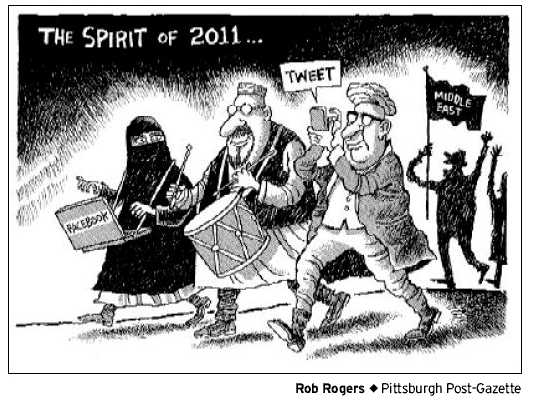
As the Arabs for centuries kept alive and eventually passed back to the West the learning of the ancient Greeks, the West has now offered the Arabs the ancient Greek ideals of freedom and democracy, galvanizing and actuating them to overthrow their tyrants.
     In the Western tradition, it was the ancient Greeks—especially the Athenians—who raised the ideal of freedom with all its risks to a highest principle. Tired of tyranny, the Athenian people in 508 BCE arose to throw off the yoke of oppression. Under the leadership of Cleisthenes and eventually Pericles, the Athenians established the world’s first democracy.
     After the Western Roman Empire declined and fell in the 5th century CE, remarkably and tragically most of the learning of the ancient Greeks was lost to the West. After Muhammad’s death in 632, Arabs–impassioned by Allah’s revelations to Muhammad—launched an expansion which eventually brought them into contact with the wisdom of the ancient Greeks. It was the Arabs—coming across the great works of Ptolemy, Plato, Galen, Hippocrates, Euclid, Archimedes, and especially Aristotle—who kept the lamp of Greek learning alive in those centuries of Western history we have come to consider as dark with brutality, superstition, and intellectual stagnation.
     How fitting then that the West has repaid the favor by providing the Arab world with its example of freedom and democracy. Educated and enabled by the gadgets of the technological revolution of the last two decades, the younger Arab generations have been sparked by the self-immolation of one of their own—26-year-old Tunisian Mohamed Bouazizi, denied the freedom to sell fruits and vegetables. Even as US forces invaded Iraq in 2003 carrying the ideal of freedom in their rucksacks, most of us knew if the “Arab Street” was going to rise up and reject the tyranny of Ben Ali in Tunisia, Mubarak in Egypt, and now Qaddafi in Libya, it would have to be self-initiated and not imposed from without by Western forces wielding guns and missiles.
     In recent years the question, much-debated in high academic and policy circles, has been whether Islam and democracy are compatible. Some have argued no; others like Daniel Pipes of the Middle East Institute have argued it is not Islam that is incompatible with democracy. Rather it is Islamism or political-militant Islam a la al-Qaeda or the Taliban. “…the Islamist movement which today dominates Muslim intellectual life pulls in precisely the opposite direction from democracy.”
    

What will emerge in the Arab world in the next decade will be an Arab synthesis of Western democracy and Arab-Islam. With Arab-Islam’s different views of the place of women, the relationship of mosque and state, and the authority of the tribal leader, this democratizing process will be much more of a challenge than the people of Eastern Europe faced after they toppled their Communist regimes in the revolutions of late 1980s and early 90s. The East Germans, for example, were simply incorporated in October 1990 into the existing democracy of the Western Germans.
     Arab tradition and culture is much more rooted in the subordination of women, the integration of religion into the life of the state, and deference and docility to the tribal leader. Therefore, the process now begun in the Arab world will be much bloodier, volatile, fitful, and extended. Plato, one of the ancient Greeks that the Arabs helped to keep alive, suggested democracy’s messiness: “Democracy is a charming form of government, full of variety and disorder, and dispensing a sort of equality to equals and unequal alike.” Happily for Western political leaders, they should confront less than they have in the past the dilemma of dealing with ossified autocrats who deny the very rights and freedoms which allowed these leaders to assume power in their own countries.
     The ancient Athenians were willing to take the risks which freedom posed. In so taking, they eventually created the political system of direct democracy in which the Athenian citizens actually took turns in running the government of Athens. Three or four times each month all adult, male Athenians assembled to debate and vote on issues as simple as the price of olives and as momentous as a declaration of war. The Arabs (and perhaps the Persians of Iran), who have risen up against their tyrants as the ancient Athenians did, have decided to risk it.
     The future complexion of these new regimes is not clear. What is clear is that the long era of acquiescence to the Arab tyrant is over.

Posted in Uncategorized | Tagged , , , , , , , , , , , , , , , | 4 Comments

United Germany at 20

By Fred Zilian

(Published in the Newport Daily News, October 10, 2010, as “Unified Germany at 20 Has Much to Celebrate”)

This October Germany is not only celebrating the 200th anniversary of its world famous Oktoberfest, but more significantly on October 3 it celebrated the 20th anniversary of its unification. This one, accomplished peacefully unlike its first unification in 1871, added 16 million people from the previous East Germany to West Germany, creating the most populous country in Europe, now with over 82 million. Not only Germany, but also Europe and America can be proud and thankful.

          On the political level, the Federal Republic of Germany has now proven itself over sixty years to be a stable, resilient democracy, consigning to history its authoritarian and totalitarian past up to 1945. In its twenty years since the Unification it has peacefully and democratically installed several governments of various political hues. In 2005 Angela Merkel became its first female chief executive (chancellor) and the first from the “new federal states,” as the former East Germany is called. Though accused by its NATO allies of foot-dragging at times, it has moved from a country militarily hand-cuffed—restricted by its Constitution, its national culture, and its past—to a more confident, “normal” country that is prepared to assert itself and even send its soldiers abroad. In 1999 it committed its military forces to combat for the first time since WW II as part of a NATO force to protect Kosovo from Yugoslavia. Beyond the Balkans it has also sent military forces to the Middle East, Africa, and now Afghanistan. It currently has 4670 soldiers in that region as part of NATO’s force. When I was stationed there as a young officer in the early 1970s, I can recall my surprise at the universal lack of patriotism and flag waving. Showing that it has exorcised at least some of the hyper-national devils from its Nazi period, German flags flew plentifully and vibrantly for the World Cup it hosted in 2006.

          Economically, Germany has the fifth largest economy in the world and the largest in Europe. For decades Germany has been the economic engine of Europe, so featured on the front page of a recent edition of the influential British magazine The Economist. Driven by Germany’s 2.2% growth—its best quarterly performance since Unification—the 16-nation eurozone of the European Union with a growth of 1% outpaced both US (.4%) and Japan (.1%) in April-June of this year.

          The social and economic integration of eastern Germany into the Federal Republic has had its successes as well as its shortcomings. In July, 1991, shortly after Unification, the unemployment rate in the east (12%) was double that of the west. Regrettably, the figures remain about the same today, with some areas of the east having a rate approaching 20%. Since Unification, the east has lost one-tenth of its population and still needs much aid from the western states, totaling $12 billion in 2008 for example. On the other hand, former east Germans now earn on average 83% of the equivalent salary in the west, compared to only 53% in 1991. GDP per capita has risen in the east from 40% of the west’s in 1991 to nearly 70% in 2008. Life expectancy in the east has risen by six years, and its infrastructure has enjoyed a substantial makeover, making westerners jealous.

          On the social level, the difficulty in integrating easterners and westerners—the Ossis and Wessis—persists. This so-called “wall of the mind,” present 20 years ago, has proven quite tenacious. The resentments and prejudices continue. One politician described it as like an “arrogant rich uncle [the West] versus the resentful poor nephew [the East].” A poll in 2008 found that 64% of the easterners feel they are treated like second class citizens, with about one in six agreeing with the statement: “It would have been better if the Wall had never fallen.” Still, in a poll this past year, 91% of easterners and 85% of westerners said that unification was the right choice, and another survey showed that 91% of easterners support democracy though half are not happy about the way it sometimes works.

As I stood in Bonn’s central market place on Unification Day twenty years ago, oompah music playing, balloons rising, flocks of pigeons darting, the crowd swaying, I was hopeful that the Germans would succeed in their unification. Today the Germans can be proud of their achievements, and Americans can be proud of the role they played in ending the Cold War and supporting the Unification. Shortly after Unification, I spoke to a former East German sergeant who indicated how it might have been had the Soviets won the Cold War. He told me that “Germany would have been one big concentration camp.”

An educator at Portsmouth Abbey School, Portsmouth, RI, Fred Zilian, Ph.D., spent six years in Germany as an Army officer.

Posted in Uncategorized | Tagged , , , , , , , | Leave a comment

America and China’s Rise

Hello, Cyberworld,

I am happy to be up and running with my first blog post. As Rick said in Casablanca: I think this is the beginning of a beautiful friendship.

I would like to provide my latest essay on the United States and the rise of China.

 America: The Middle Kingdom

(Published in the Newport Daily News, February 16, 2011, as “China’s Rise Is Wake-Up Call for United States”)

For an American patriot, recent news on the rise of China can be quite grim. On many fronts China seems to be forging ahead while the U.S. limps.

        On the economic front China maintained over the period 1989-2010 an average quarterly growth in GDP of 9.3 %, growth which it seems likely to sustain for at least the near term. After negative growth rates during the Great Recession of 2008, the US has managed a GDP growth rate of less than 3%. Eighteen months into “the recovery” unemployment is at 9% and the federal deficit for last year was $1.3 trillion. China’s export-driven economy has boosted its foreign reserves to $2.6 trillion. It is using this and its other sources of wealth to build a network of new airports, a new system of high-speed trains, and a state of the art electric car industry. The U.S. continues to spend billions each month in Iraq and Afghanistan. While China’s President Hu had conciliatory remarks throughout his recent visit, the US has been unable to convince China to let its currency rise in value against the dollar, something which would help redress the large US trade imbalance.

        On the international political-military level, China is showing a more assertive foreign policy. It failed to support South Korea when North Korea sank one of its ships, killing 46, even after an international panel concluded a North Korean submarine had attacked it. The Pentagon has indicated that China has “the most active land-based ballistic and cruise missile program in the world.” It is developing the world’s first anti-ship ballistic missile system, and has enlarged its submarine fleet. Richard Armitage, the former deputy secretary of state, has said, “The smiling diplomacy is over.” 

        The gloominess is not just restricted to these traditional spheres of hard power; it shows also in the social and cultural spheres. Hou Yifan, a young Chinese girl of 16, has become the new women’s world chess champion, the youngest person ever to win a championship. Hitting us literally in our own homes, Chinese-American Amy Chua, in her new book, The Battle Hymn of the Tiger Mom, asserts that the Chinese way of raising children is the best—emphasizing excellence, hard work, high standards, less independent decision-making and less concern for the child’s self-esteem compared to the American approach.

        In 1405 Chinese Emperor Yongle launched a series of maritime expeditions. Under Admiral Zhenghe a fleet of Chinese ships was dispatched into the Indian Ocean to explore, to acquire knowledge, and to show China’s wealth and power, similar to Theodore Roosevelt’s launching of America’s Great White Fleet in 1907. The first voyage included 62 ships and some 28,000 sailors, and eventually 300 ships participated in seven of these voyages. Some of these Junk ships were larger than any ships the world had seen. One account claims at least one expedition even reached North America in 1421.

        Historians offer different explanations as to why the voyages ended after three decades. One holds that a majority of the Chinese elites and Yongle’s son and successor, Hongxi, did not believe the voyages justified the effort and cost. China was the Middle Kingdom—between heaven and earth—and therefore the outside world did not have anything to offer of genuine significance. The Confucian court scholars said that China should end the voyages, destroy records of them, and return to traditional agriculture.

        If there is any silver lining in these trends that mark the rise of China it is that they may collectively shake us in our collective complacency about our centrality in the world system, a mentality which has been called the “omphalos syndrome,” from the Greek word for navel. The omphalos stone was a monument in a number of ancient cities and supposedly marked the center of the world.     China’s rise should give us pause to reconsider our national priorities and where we are spending our enormous yet limited resources. Especially, it should help us to be more open to how others think and order their societies. In the process of considering ourselves less a Middle Kingdom, we may learn another way of thinking about ourselves and our relation to the world.

Fred Zilian teaches Western Civilization and World History at Portsmouth Abbey School, Portsmouth, RI.

Posted in Uncategorized | Tagged , , , , , , , , | 26 Comments