The Year There Was No Summer–200th Anniversary

(An abridged version of this essay was published as “The Year Without a Summer” by the Newport Daily News on June 21, 2016.)

In recent decades we have become accustomed to hear how an event in a far-off place may affect us in Rhode Island—politically, economically, demographically, security-wise, and also environmentally. This was not the case two hundred years ago. However two centuries ago this summer, a volcanic event halfway round the world had a dramatic impact on weather in the United States. It became known by such names as the “Year There Was No Summer,” and “Eighteen Hundred and Froze to Death.” Happily southern Rhode Island was spared its worst effects.

On April 5, 1815, British forces at a fort in Jakarta, Indonesia, heard what appeared to be cannon fire. It was actually the beginnings of the volcanic eruption of Mount Tambora on the island of Sumbawa about 750 miles away. The full eruption came on April 10, killing some 60,000 people with many others dying later from disease and famine. The ash cloud spread across the globe carrying an estimated 140 billion tons of volcanic matter, sulfur particles and sulfur-dioxide gas, substantially decreasing the amount of solar radiation reaching the earth. When the gas reached the stratosphere, it mixed with hydroxide gas and created a massive cloud, which the jet stream transported around the globe.

That spring and summer were both unseasonably cold and wet. Napoleon and his forces at Waterloo in mid-June struggled with weeks of rain, their cannon sinking into the mud.

Napoleon at Waterloo, Hulton Archive, Getty Images, 6-13-16

Napoleon at Waterloo

(Getty Images)

The following year, 1816, proved to be Great Britain’s coldest year ever recorded, causing bread riots, famine, and disease. In France the starving rural peasants swarmed southward for survival. Lord Byron’s social group, on holiday at a lake in Switzerland, were trapped indoors by the heavy rains, thunder, lightning, and cooler temperatures. Mary Shelley, a 19-year old member of the group, conceived and wrote her classic horror novel, Frankenstein. Jane Austen, declining in health in England, described the summer of 1816 as one in which “the gloom, darkness and rain was an extraordinary and dismal affair ….”

Frankenstein, doctormacro.com, 6-13-16

(www.doctormacro.com)

In North America, frosts occurred throughout the spring. On June 6-7 it snowed in New England with freezing temperatures continuing afterward. There was snow also in upstate New York, and sheep began dying for lack of forage. The uncanny weather continued all summer with drought and high winds, causing streams to dry up and wild fires to increase. August felt like October with low temperatures and frost killing crops from Maine to South Carolina, causing many farms throughout New England to fail.

Happily Aquidneck Island and southern Rhode Island appear to have been spared the worst effects of the bad weather. The local newspapers reported the severe weather from other parts of the country, but not much about ill weather here.

In mid-summer, reports about the weather were optimistic. On July 27 the Newport Mercury (precursor to the Daily News) reported: “Fears have been entertained that the coldness and backwardness of the season would produce an alarming scarcity. But these fears we believe were premature.” … “In the Southern States it is stated there is an unusual plentitude of wheat; so that notwithstanding the gloomy appearances, which have passed before us, we may now anticipate the blessing of Providence, in a sufficient supply of the fruits of the earth.”

On August 10, it gave an August 5 report from Albany, NY: “We are much gratified to hear from various parts of the country … the crops of grain are more promising than was expected.” It went on to predict sufficient harvests to supply the people.

However, by September, the tone of the reports had changed. On September 11, the RI Republican newspaper (printed in Newport) gave an August 20 report from the Norfolk Herald [VA]: “The cool (we may say cold) and dry weather … will have a serious effect upon the crops of every description; in the upper country we fear the effects will be most severely felt.”

On September 28, the Mercury gave a report from the Richmond Enquirer [VA]: “the communications on the subject of the crops from all parts of the State, are more than gloomy, and the mischief occasioned by the drought has been increased by the torrents of rain.” A writer in that paper called for action from the U.S. Congress.

On October 12, the RI Republican gave an October 5 report from Windsor, Vermont. Referring to the weather, it stated: “Never perhaps in this vicinity appeared more gloomy and cheerless …. It is extremely cold for the time of year, and the drought was never before so severe.”

The diary of Thomas B. Hazard (“Nailer Tom”) of Kingstown, RI, also suggests that southern RI was not hit as hard as the rest of New England. He reported snow and rain on May 14, rain September 11-16, and heavy frost on September 28. On June 21 and September 21, the first day of summer and of fall, he reports only commonplace activities and uneventful weather. Both days were clear. On June 21 he bought 7 lbs of Bass for 28 cents, worked in his shop, and dined with Reynolds Barber. On September 2, his son Benjamin killed four lambs and a yearling ram and Hazard, with his daughter Hannah, visited John Congdon.

In a letter to a former colleague, 73-year old Thomas Jefferson in Virginia summarized the year: “We have had the most extraordinary year of drought and cold ever known in the history of America.”

(The author would like to thank Bert Lippincott of the Newport Historical Society for his help with this essay.)

Fred Zilian (www.zilianblog.com) teaches history and politics at Salve Regina University.


Posted in Uncategorized | Tagged , , , , , , , , , , , , , , , , | Leave a comment

Colony of Rhode Island Is First to Sever Allegiance to Great Britain

(This essay was originally published as “First in Independence,” on May 4, 2016, in the Newport Daily News.)

Two hundred and forty years ago today, the colony of Rhode Island became the first of the thirteen colonies to sever its relationship with Great Britain. Newport, a political and economic center of the colony, played an important role in the resistance leading up to the break.

There were two underlying causes for the action: first, the increasingly coercive actions of the British; and second, the rising resistance to these actions by Rhode Islanders.

While Great Britain was victorious in the Seven Years War (1757-1763), giving it dominance in North America over France, the costs were heavy. Great Britain believed it was fully justified in requiring the American colonies to pay their share of the war costs and also for the subsequent stationing of British troops.

It decided first to enforce more strictly the Acts of Trade and Navigation, challenging the colony’s long history of evasion and smuggling. Second, beginning in 1764, the British Parliament repeatedly imposed new taxes on the colonies. The Sugar Act (1764) increased the duty on molasses and sugar which Rhode Island merchants used to produce rum, a product traded in Africa for slaves. The following year it passed the Stamp Act, the first direct tax on all colonists. Further taxes followed with legislation such as the Townshend Acts (1767) and the Tea Act (1773).

Rhode Islanders saw such acts as violations of the rights and liberties granted by the hallowed Charter of 1663, issued to Rhode Island by King Charles II. They held firmly to the belief that only their colonial General Assembly could tax them directly, not the British Parliament, in which they were not represented.

The final aspect of British coercion was the stationing of British troops throughout the colonies, supposedly to protect the colonists from possible French incursions, and the increasing presence of the Royal Navy. In the case of Rhode Island, this meant the heightened presence of the British Navy in Narragansett Bay, which led to the confiscation of the colony’s trading vessels and also the impressment of colonists into service for the Royal Navy.

From 1764 to 1776, Rhode Islanders became increasingly belligerent in their reactions to what they viewed as unjustified British coercion. In July 1764, Newporters went to Fort George on Goat Island and began firing on the British schooner St. John, after the ship had seized a cargo of sugar from a New York merchant ship.  Soon afterwards the HMS Maidstone appeared at Newport with a similar mission: confiscation and impressment. Incensed Newporters stole one of its boats, dragged it to the Parade (Washington Square) and burned it.

In August 1765, anger was building toward those Newporters, called “Tories” or “loyalists,” who supported cooperation with the British.  Martin Howard led a group of prominent loyalists, named the “Newport Junto,” and called opponents of British rule “licentious, sordid, and incompetent.” Led by Samuel Vernon and William Ellery, a large group of men created three effigies of loyalists, dragged the effigies through the streets of Newport, hung and later burned them. The following day hundreds of men carrying axes and clubs ransacked the homes of the three loyalists who fled the town.

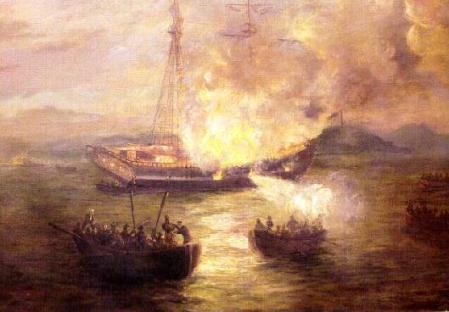
In the space of three years, Rhode Islanders escalated their resistance by burning two British naval ships. In July 1769, Newporters stripped and burned the Liberty, an armed sloop which had been harassing merchant vessels on the Bay. On June 9, 1772, John Brown of Providence and 60 men seized the HMS Gaspee by force, brought its crew ashore, and set the ship ablaze. Coming three years before the Lexington and Concord, this can be viewed as the first battle of the revolution. Historian Rockwell Stensrud states: “The total destruction of the HMS Gaspee … was a direct assault on the Royal Navy and thus an offensive action against the king and Great Britain itself.”

Burning of Gaspee, gaspee.com

Burning of the Gaspee

(gaspee.com)

The immediate cause of RI’s severance was the British Navy’s acts of coercion on the colony 1774-1776. In November 1774, the Rose, a British frigate with 24 guns captained by James Wallace, arrived at Newport. It continued the patrolling of the Bay and the halting of merchant ships. Fearful of a bombardment, Newporters fled the town bringing the economy to a standstill.

In March 1775, the citizens of Providence had their own “Tea Party,” burning some 300 pounds of tea. On April 22, 1775, three days after Lexington and Concord, the RI General Assembly voted to raise an army of 1500 men.

In July 1775, British ships opened fire on the town, repeating these attacks over the next several months. The Newport Mercury reported: “a great many inhabitants moved part of or all their effects out and many families … left town. The carts, chaises, riding chairs and trucks, were so numerous that the streets and roads were almost blocked up with them.”

By late summer 1775, the situation in Newport worsened. The 14-gun sloop Swan joined the Rose. With more sailors to feed, Captain Wallace sent sailors on foraging missions to Aquidneck Island, stealing crops and animals.

map_Blaskowitz, 1777

Newport, 1777

In December, Wallace announced that his Christmas present to Newport was going to be its destruction. The Mercury reported Wallace as stating that inhabitants “should be burnt in their houses if they did not instantly turn out.”

On February 20, 1776, Ezra Stiles, Congregational minister, wrote in his diary: “All marketing from Narrag. & the northward cut off at Newport by the Fleet …. The Town with perhaps a Third of its Inhabitants yet behind suffering greatly for Wood & Provision ….  All Business stagnated.”

Finally, on May 4, 1776, the colony’s General Assembly, impatient with the Continental Congress’ lack of action, took the initiative. After listing the many grievances against Great Britain and its king, it declared that all allegiance to the king by “his subjects, in this his colony and dominion of Rhode Island and Providence Plantations, BE, AND THE SAME IS HEREBY REPEALED.” This was essentially Rhode Island’s declaration of independence.

Follow me on Twitter: @FredZilian

Fred Zilian teaches history and politics at Salve Regina University.

Posted in Uncategorized | Tagged , , , , , , , , , , , , , , , | Leave a comment

The Colonial Portsmouth Schoolhouse

(This essay was originally published as “Schoolhouse has survived centuries of change,” by the Newport Daily News on April 5, 2016.)

Believing in “how excellent an ornament learning is to mankind,” the Town of Portsmouth three hundred years ago authorized the building of two schools, the Southermost School and the Northermost School. The Southermost with its original frame posts still stands today at the corner of East Main and Union Streets. The Portsmouth Historical Society claims that it is the oldest schoolhouse in Rhode Island.

Southernmost School

Southermost School today

(portsmouthhistorical.org)

Founded in 1638, Portsmouth in 1716 had existed for 78 years when the town took the action. Its records show that in that year the Town authorized the building of the two schools, the first schools to be built by the town. Portsmouth at the time probably had close to 700 people, as the census of 1708 indicated a population of 628.

The land for the Southermost was donated by William Sanford, presumably a descendant of John Sanford, one of the original 23 signers of the Portsmouth Compact in 1638. It was to be built near what is today 102 Union Street. The Town authorized the sum of 20 pounds for the project; however, the final cost was 23 pounds.

Six years later in 1725, the schools were actually built. The original bill indicates that it was built by Adam Lawton and a “negro.” The building has simple post and beam construction and contained a cellar, chimney, and fireplace.

Sketch, School, frank-coelho-1940-1.jpg-300x220

Rendering of Southermost School in 18th century

(portsmouthhistorical.org)

James Preston was hired as the first schoolmaster, and the town allowed him and his family to live in the school’s cellar. Schoolmasters during the colonial period throughout New England were generally men. The curriculum was probably designed to teach the students how to write and also to read, if their parents had not taught them. The texts used were probably the hornbook, primer, psalter, and ultimately the Bible. (The hornbook was not an actual book, but a sheet of paper with written material on it, mounted on a board with a handle. It had a piece of transparent material over the sheet.)

On display in an exhibit at the Portsmouth Free Public Library on early education in Portsmouth is a “200 Year Old List of Rules and Punishments Posted at the Southermost School.” The list brings us back to an age when corporal punishment was the norm. It includes:

  • Climbing for every foot over 3 ft up a tree  – 1 lash
  • Wearing long fingernails – 2 lashes
  • For not saying yes or no sir or yes or no marm – 2 lashes

The list gives us insight into views on gender and the apparent unruliness of boys to girls:

  • Boys and girls playing together  – 1 lash
  • Girls going to boys play place – 2 lashes
  • Boys going to girls play place – 3 lashes
  • Misbehaving to girls – 10 lashes

Fighting and unruliness were clearly disapproved.

  • Quarreling at school – 3 lashes
  • Fighting at school – 5 lashes

Misusing the gift of language was also.

  • Giving each other ill names – 3 lashes
  • Telling lies – 7 lashes
  • Telling tales out of school – 8 lashes

The school may have fallen into disuse as records show that at a town meeting in 1746, the widow Sarah Strange, who had been living there, was ordered to leave so that the school could be renovated and once again used as a school.

In 1863, it was bought at auction by the Almy family, moved to Lakeside Farm on Union Street, and used as a storage and harness shed. In 1952 the Hall family gave the school to the Portsmouth Historical Society (founded in 1939), and it was moved to its current location. Inside the school are various artifacts, including original student desks and examples of the primers, copy books, and textbooks from the colonial period.

For more info, see the website of the Portsmouth Historical Society at: portsmouthhistorical.org. The Society’s building at East Main Rd. and Union St. is open to the public on Sundays, 2-4 pm.

(The author would like to thank Jim Garman for his help in writing this essay.)

Fred Zilian lives in Portsmouth and teaches history and politics at Salve Regina University.

Posted in Uncategorized | Tagged , , , , | Leave a comment

Despite Roger Williams’ Efforts, Providence Burns in 1676

(This essay was originally published as “Despite Roger Williams’ Efforts, Providence Burns Down,” in the Providence Journal on March 29, 2016.)

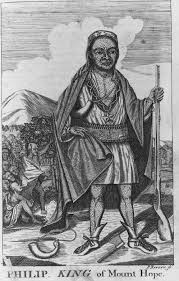
Three hundred and forty years ago today Divine Providence did not smile kindly on the burgeoning town of Providence in the colony of Rhode Island. On March 29, 1676, Native Americans attacked and set it ablaze, one of many New England towns which met this fate during King Philip’s War, 1675-78. This war, named after the leader of the Wampanoag, Metacomet (with the European name of Philip), devastated both the English settlers and the Native Americans. About one-third of the towns of New England towns (Connecticut to Maine) were destroyed. Historian Nathaniel Philbrick estimates that per capita the war was twice as bloody as the Civil War and seven times as deadly as the Revolutionary War.

Metacomet

There were several underlying causes to the conflict. First, the pressure of demographics from the wave of migration to America. The Spanish,  French, Dutch, and English were establishing settlements from Florida to Maine. The Mayflower Pilgrims landed at Plymouth Rock in 1620. While these first settlers in New England sought to maintain peaceful relations with native peoples, later groups came with various motives and did not necessarily share the same view. Over the succeeding decades, pressure on the land and the Native Americans increased. By 1676, it is estimated that the European population of New England was about 70,000.

Second, differing conceptions of agreements and of the relationship between humans and the land. The English came from a capitalistic society based on the right to own private property and on the rule of written law and contracts. Native Americans did not put much stock in written contracts and did not commonly accept that human beings could “own” land. Misunderstandings and encroachments followed.

Third, power politics. Many different Native American tribes occupied New England, the largest being the Wampanoag, Nipmuck, Narragansett, Mohegan, and Pequot. They could be friendly but also bitter enemies. European settlers entered this political environment, and complicated it. As misunderstandings and incidents multiplied, so did mistrust.

Fourth, the death in 1661 of Massasoit, the leader of the Wampanoag and friend of the settlers, followed by the death of his eldest son, Wamsutta, in 1662. This brought Metacomet to the leadership of the Wampanoag tribe. Unlike his father, he did not strive for peaceful relations with the settlers; rather he became more and more irritated by their increasing numbers and their ways.

The immediate cause for the war came in June 1675 when three Wampanoag were brought to trial for the death of a Christianized Indian, John Sassamon. He had earlier informed the English that Metacomet was building a Native American alliance to wage war against the English. The three men were found guilty and were hanged on June 8, 1675, at Plymouth. On June 20, a band of Pokanoket-Wampanoag attacked the Plymouth Colony settlement at Swansea, burning it and killing several people.

The spring of 1676 brought calamity to English settlements from the Connecticut River to Maine. After successful attacks on English militia and their Native American allies on the Blackstone River and then at Rehoboth, the Native Americans approached Providence on March 29. Its approximate 500 residents had already departed for the protection of Aquidneck Island. Roger Williams, the town’s founder and now seventy-seven years old, and about 30 men remained. The natives set the town ablaze.

 Providence Burns, 2

Rendering of Providence burning

In a letter to his brother in Newport, Williams described the scene. After accosting a group of the attackers, he asked them why they were burning and killing. “This house of mine now burning … hath lodged kindly some thousands of you these ten years.” They mentioned the support that Rhode Island had given to colonies assaulting them.

“I told them they … had forgot they were mankind and ran about the country like wolves tearing and devouring the innocent and peaceable…. They confessed they were in a strange way.”  After arguing with them more, Williams eventually offered to serve as peacemaker. The natives declined, indicating that after they settled more scores with Plymouth Colony over the next month, they might return. “We parted and they were so civil that they called after me and bid me not go near the burned houses….”

Fred Zilian teaches history and politics at Salve Regina University.

Sources:

Lepore, Jill. The Name of War: King Philip’s War and the Origins of American Identity. NY: Vantage Books, 1999.

Philbrick, Nathaniel. Mayflower. NY: Penguin Group/Viking, 2006.

Warren, James A. God, War, and Providence: The Epic Struggle of Roger Williams and the Narragansett Indians Against the Puritans of New England. NY: Scribner, 2018.

Posted in Uncategorized | Tagged , , , , , , | 3 Comments

The Humanities Keep Us Human

(Note: This essay was originally published in Education Week on January 6, 2015.)

President Obama’s announcement in the fall 2014 of an additional $28 million to bolster STEM teachers was great news and reminded me of my passion for science during those heady days of the Kennedy “Camelot” when the president announced the goal of reaching the moon. In a speech before a special joint session of Congress on May 25, 1961, he said: “I believe that this nation should commit itself to achieving the goal, before this decade is out, of landing a man on the Moon and returning him safely to the Earth. No single space project…will be more exciting, or more impressive to mankind, or more important…and none will be so difficult or expensive to accomplish.”

During those days, the Cold War—the state of tension between the U.S. and the Soviet Union—was in full swing. Several years before in 1957, the Soviets had leapt out in front us in the space race with the launching of Sputnik. There were fears of a “missile gap” by which the Soviets, leading the U.S. in missile technology, could intimidate, coerce, and—at worse—attack us with nuclear missiles, and we could not defend ourselves. Fallout shelters were all the rage.

Though the STEM acronym did not exist at the time, I was STEM through and through: Sputnik, Telstar, missiles, spaceships, those great missile-like fins on the ‘57 Chevy and the ‘59 Cadillac, and atom-smashing accelerators. Hollywood gave us all those great, corny, “B” science fiction movies. I was all in.

The president’s Educate to Innovate program is now five-years old. When Obama launched it on November 23, 2009, he described it as “a nationwide effort to help reach the goal this administration has set: moving to the top in science and math education in the next decade.” The White House has portrayed it as “an all-hands-on-deck campaign to help more girls and boys be inspired to excel in science, technology, engineering , and math (STEM) subjects.” The program has sought a synergistic effort, using the combined forces of government, education leaders, foundations, companies, non-profits, and scientific and technology professionals. Its major components have included such initiatives as the 100kin10 (seeking to prepare 100,000 excellent STEM teachers over the next decade), Change the Equation (a coalition of CEOs committed to expanding STEM programs to more than 1 million students by 2016), and Discovery Communications (launching a new show next year to inspire students in STEM fields, highlighting “All –American makers”).  Even though I chose not to become a scientist, I am all for this.

However, caution is needed here, a caution against imbalance. In our rush to emphasize the empirical sciences, we must be careful not to reduce too much the resources devoted to the Humanities, the mix of subjects normally including the language arts, history, philosophy, religion, and the visual and performing arts. (STEM in recent years has, in some circles, morphed to STEAM, integrating the visual and performing arts.) Science and technology have given us wondrous benefits and conveniences. I can imagine the relief in back pain when 5,500 years ago we invented the wheel. I relish the ability to communicate with ease with my friends in Germany or Skype with my grandchildren far away. Nonetheless, we should not place STEM on a pedestal too high. It brought us the wheel, the polio vaccine, and the Internet; it also brought us napalm, cluster bombs, and the atomic bomb.

STEM can give us the “what and why” of the physical universe, but not the “ought.” Beyond the molecules, fractions, and scientific laws that govern the physical universe, the Humanities, collectively, teach us about “human-ness” and our relationships with each other. They help us connect with each other, understand each other, and cooperate rather than conflict with each other. As the world gets smaller and as we are forced to share more of its fewer resources, it is the Humanities along with the social sciences that will help us cooperate, coexist, continue, and even flourish rather than cancel each other.

Artwork, Humanities Keep Us Human, 1-7-15

We need the language arts. When I decided in 10th grade to study German, little did I know that almost thirty years later, I would be using German to interview former communists of the East German army about German Unification (1990). As anyone who understands a foreign language appreciates, actually living in another language—rather than relying on translations–gives one a much richer and comprehensive understanding of that people, a larger and more nuanced window into the world of that society.

We need English and literature so that we can see and employ the beauty and utility of the spoken, recited, sung, and written word. We cannot think without words. The more sophisticated our vocabulary; the more sophisticated and subtle our thoughts, especially important as we increasingly rely on clipped and mangled English in the digital world. Also through reading about other humans, we can learn more of ourselves. Finally, in my first career as a professional Army officer, during the challenging times I faced, it was not the First Law of Thermodynamics or Newton’s Second Law of Motion that sustained me. It was Shakespeare, Beethoven, and Frost.

We need history. The historical method teaches us how to weigh carefully the credibility and reliability of the sources from which we derive our information and hence our picture of reality. Though I strongly disliked all the “curricular requirements” faceless, unnamed but clearly highly-credentialed educators from the College Board heaped on me as an AP history teacher, I appreciated how these forced me to teach my students such essentials as the difficulties of pursuing knowledge and causality in history compared to the STEM subjects. Crucial is also the skill of patiently and thoroughly asking questions—before the first word of the document is read—about the creator of the document (or visual).

We need philosophy and ethics. More here than in the other Humanities, especially for students who prefer rationality and linearity, is where we can learn to deal with ambiguity and irrationality, where we can grapple with essential questions which have no right answers. In my “War & Morality” course, we deal with such questions as: When is it right to use violence against other human beings? Who is to judge whether there is “just cause” to begin a war? How many alternatives must a state attempt before it is using violence truly as a “last resort”?  My students role-play a post-World War II commission, examining whether the British-American fire-bombing of Dresden in February 1945 was a war crime. We end the course with the political, military, legal, and finally ethical implications of using drones in warfare. Moreover, in a world where so much emphasis is placed on “metrics” to measure, these subjects can force us to deal with factors that resist quantitative measurement: trust in Ferguson, Missouri; mistrust with Iran; the fundamentalism and hatred of ISIS.

And finally, there is religion. Whether one is a believer or non-believer, understanding the history of the world’s major religions, their role in societies, and their influence in shaping our world today is crucial to any educated person and engaged citizen. Religion also can give us words and ideas for our celebrations as well as for our commemorations and memorials.

After a Western Civilization lesson on the rise of Christianity in the Roman Empire, one of my Chinese remained after class. She was curious about Jesus Christ and the broader subject of religion and society. I asked her about religion in China. She indicated that she was never really taught religion, and followed by saying that if there was any “religion” in Chinese education, it would be “science.”

In ancient Greece even wealthy, aristocratic non-Greeks would journey to the famous Oracle at Delphi to seek guidance on their most pressing questions. One of the most common responses the oracle gave was: Meden Agan (Moderation in all things.) STEM must be complemented with an ample ration of the Humanities rather than displace it. Giving too much emphasis to STEM may cause us to lose too much of our HUMAN-ness.

(A retired Army officer, Fred Zilian teaches history and political science at Salve Regina University, RI.)


Posted in Uncategorized | Tagged , , , , | 7 Comments

Mother Nature Does No Favors

(This essay was originally published as “Policies Must Respect, Protect Mother Nature,” on January 29, 2016, in the Newport Daily News.)

The storms and low temperatures of the past few weeks remind us of the power and beauty of Mother Nature, something to be admired, respected, and protected.

On the larger weather front, both the National Oceanic and Atmospheric Administration (NOAA) and NASA jointly announced that 2015 was the warmest year since systematic record-keeping began in 1880. The average global temperature was 1.62 degrees (F) above the 20th century average. Beyond this, scientists in the United Kingdom announced that the average global temperature for the first time had reached one degree Celsius (1.8 degree F) above pre-industrial levels.

This was no surprise to Denny Ingram, a Newport lobsterman for 30 years, who was recently quoted speaking about the changes in weather, “It seems to be accelerating over the last 10 years. December now seems like October. Everything is a little out of whack.”

The key driver of the recent climate change, especially for the last 50 years, has been the concentration of carbon dioxide in the atmosphere. In March of last year, for the first time in human history, the concentration reached 400 parts per million, according to the NOAA. As scientists Andrew Dessler and Edward Parson have indicated, the increase in concentration matches the fossil-fuel sources in quantity, isotopic mix, and timing.

In all the arguments I have heard from those skeptical of the human role in this or its seriousness, I have never heard any address this rise in carbon dioxide and its proven connection to global warming. The amounts of it that we have pumped into the air are staggering. The journal, Nature Climate Change, reported that in 2010, we pumped over 38 billion tons of carbon dioxide into the air from the burning of fossil fuels, about a billion tons more than in 2009. According to the Global Carbon Project report of September 2014, written by scientists, the figure had grown close to 40 billion tons in 2013, up from just over 39 billion in 2012. Skeptics cannot explain what Mother Nature does with all this so that we can continue business as usual. But of course Mother Nature follows physics and does favors for no one.

Rhode Island is especially vulnerable to sea level rise, an important consequence of temperature rise. As recently reported by Rep. Lauren Carson, head of a state legislative commission studying the economic impact of this rise, 21 of the state’s 39 municipalities have historic property within the Narragansett Bay’s flood plain. Newport is exceptionally vulnerable. Melissa Barker, Newport’s geographic information systems coordinator, indicated that 600 Newport businesses, 23 percent of all its roads, and nearly 1000 historic structures, are located within the flood plain. Barker also reported that the NOAA has predicted that sea level in Newport will rise one foot by 2035, and two feet by 2050.

Consumers are benefitting from the international oil glut. Its price has tumbled from $105 per barrel to less than $30 in one and a half years. A few weeks ago, I was certainly happy to see gasoline dip below $2.00/gallon in Providence, soon reaching that level here on Aquidneck Island. The time is propitious then for actions to adapt to and to mitigate climate change.

Some proposals:

  • At the national level, it is time to place a price on carbon emissions, either through a tax or a cap and trade system, the latter which China plans to institute.
  • Second, at the state level, levy a “climate-change tax” on gasoline and diesel rather than the proposed truck toll.

With the funds generated from these two sources:

  • Build new infrastructure to adapt to sea level rise.
  • To prepare for more extreme weather, bury as many utilities as possible.
  • Subsidize technology companies researching renewables.
  • Enact tax incentives for businesses which switch to renewables and are striving to reduce their carbon footprint.
  • Prepare education modules for our public schools to teach our children about sustainable living.
  • Fix the state’s crumbling infrastructure.

It is time to get serious about mitigating our carbon footprint and about adapting to the effects of our fossil-fueled lifestyle.

Fred Zilian (www.zilianblog.com) teaches environmental politics at Salve Regina University.

Posted in Uncategorized | Tagged , , , , , , , , | 3 Comments

Marcus Aurelius and His Meditations

While many Roman emperors are infamous for their tyranny and debauchery, Marcus Aurelius is famous for his statesmanship, generalship, and intellect. He reigned as emperor, 161-180 CE, and is considered the last of what are called “the good emperors.” Edward Gibbon in his book, The Decline and Fall of the Roman Empire (1776) describes this period, 96-180 CE, glowingly: “If a man were called to fix the period in history of the world during which the condition of the human race was most happy and prosperous, he would, without hesitation, name [this period].”

Brown Model UN, 11-2012 012(Statue of Marcus Aurelius at Brown University, Providence, RI)

The five emperors who reigned during this period are described as “good” by historians because they generally respected the members of the Senate, ended arbitrary executions, acted in accordance with the public welfare, enlarged and protected the empire, and did their best to keep a general peace.

The ancient Greek Plato, in his most famous political work, The Republic, examines two critical questions: How does a society produce good men? How does a society produce a good state? No admirer of democracy and no believer in the political sense of the common people (demos), Plato concludes it is best to find, educate, and train the best men of a society, making them eventually philosopher-kings. It is to these men that the power to rule should be given. Some historians consider Marcus Aurelius to be history’s closest approximation to this ideal “philosopher-king.”

Not only a successful politician, administrator, and general, he was also a thinker and writer. We are lucky to have his philosophical system available to us in his writings, collectively called Meditations. In it he covers a wide range of subjects, sometimes becoming overly vague and abstruse. However, his main focus is clear: the ethical system of a good person; how a person should live his life—a good life.

Marcus Aurelius was schooled in and became the last great proponent of the philosophical system called Stoicism. Founded by Zeno of Citium on the island of Cyprus in the 3rd century BCE, Stoicism, as practiced by Aurelius, includes the following fundamental principles for living a truly “good life.”

About the world we live in:

  • The Universe has unity. All is inter-connected.
  • The patterns which govern the Universe and human lives continue as always.

About humans:

  • Man possesses a divine element.
  • Man is a social being.
  • Man is distinguished from other animals by his reason.
  • Man is simply a speck in the vast universe; his life is a mere drop in the bucket.
  • All life is fleeting.

About how humans ought to act:

  • Live in accord with “Universal Nature.”
  • Pursue the quest for truth, justice, and moral rectitude through right actions.
  • Perform one’s duty and purpose which Nature has given you.
  • As social beings, be kind and generous to one another.
  • Maintain the “governing self” within, free from all negativism and distraction.
  • Avoid regret about the past and worry about the future; concentrate on the present.
  • Persevere through pain.

Follow me on Twitter: @FredZilian

Writer and educator, Fred Zilian teaches history and politics at Salve Regina University, Newport, RI.


Posted in Uncategorized | Tagged , , , , , , , | 7 Comments

A Tribute to Martin Luther King: Move over Lone Ranger

About twenty years ago, I attended a conference in California where we discussed the ideas of the famous 17th philosopher-scientist Francis Bacon. I learned much about him, but the greatest insight I gleaned was during a coffee break. I was speaking with a woman from Canada, a professor, who said, “I don’t have any children, but if I did, I would move to the US.” Quite surprised, I ask: “Why?” She replied: “Because in the United States, you still believe in heroes.” Canadians, she explained, seemed bent on cutting down all their heroes, except for some star athletes.

Coming of age in the 1950s and early 1960s, my generation believed in heroes. We watched shows like “The Lone Ranger,” “Superman,” and “Gunsmoke.” Men had their weaknesses; however, they sought to do right, to seek justice, to be driven by moral principles. They spoke a moral vocabulary. They possessed a moral compass. In that age, presidents didn’t lie, at least we did not think they did. They never made statements like President Bill Clinton, “That depends on what your definition of ‘is’ is.” They had been war heroes who led large invasion fleets to free captive continents from totalitarianism.

One need not be African-American, or even American, to see Martin Luther King, Jr. as a genuine, true-blue, hero. Consider his accomplishments. In 1955, at the age of 26, he earned a Ph.D. from Boston University. He also led the Montgomery bus boycott opposing laws which forced blacks to ride at the back of buses or give up their seats for whites on crowded buses.

At age 29, he published his first book. In 1957 King helped found the Southern Christian Leadership Conference, an organization of black churches and ministers that aimed to challenge racial segregation.

In the 50s and 60s, he organized and led numerous protests against racist laws which sought to keep the races segregated and hinder the progress of African-Americans, activities that led to jail on numerous occasions.

Throughout 1966 and 1967, King increasingly turned the focus of his civil rights activism throughout the country to economic issues. He began to argue for redistribution of the nation’s economic wealth to overcome entrenched black poverty. In 1967 he began planning a Poor People’s Campaign to pressure national lawmakers to address the issue of economic justice.

In the spring of 1968, this focus on economic rights took King to Memphis, Tennessee, to support striking black garbage workers. He was assassinated in there by a sniper on April 4. News of the assassination resulted in an outpouring of shock and anger throughout the nation and the world, prompting riots in more than 100 United States cities.

His most famous speech is the “I Have a Dream Speech.” King and other black leaders organized the 1963 March on Washington, a massive protest in Washington, D.C., for jobs and civil rights. On August 28, 1963, King delivered this stirring address to an audience of more than 200,000 civil rights supporters. His “I Have a Dream” speech expressed the hopes of the civil rights movement in oratory as moving as any in American history:

“I have a dream that one day this nation will rise up and live out the true meaning of its creed: ‘We hold these truths to be self-evident, that all men are created equal.’… I have a dream that my four little children will one day live in a nation where they will not be judged by the color of their skin but by the content of their character.”

To me his most poignant speech is not this one but rather the speech he gave on April 3, the night before he was shot.

“Like anybody I would like to live a long life. Longevity has its place. But I’m not concerned about that now. I just want to do God’s will. And he’s allowed me to go up to the mountain. And I’ve looked over and I’ve seen the Promised Land. I may not get there with you. I want you to know tonight that we as a people will get to the Promised Land. So I’m happy tonight. I’m not worried about anything. I’m not fearing any man. Mine eyes have seen the glory of the coming of the Lord.”

We can draw many things from the life of Martin Luther King. One reminder this holiday brings to me is to envision—as he did— a world of better social justice, better opportunities and freedoms for people who, for one reason or another, have been left behind in the march of history.

I am reminded of a book, popular a few decades ago entitled, “The Education of a WASP.” (WASP: white-Anglo-Saxon Protestant) Towards the end the author, Lois Stalvey, dreams of a world shorn of color boundaries. Perhaps some day in the future we shall not talk of black, white, brown, and yellow. Perhaps one day, she says, we shall all be one beautiful creamy color. I have seen this happen in my own extended family, which now includes African-Americans.

So today, I have asked my own pantheon of heroes—the Lone Ranger, Superman, Mahatma Gandhi, Socrates, Mother Teresa and Abe Lincoln, among others—to move over and make room for Martin Luther King.

Fred Zilian teaches history and politics at Salve Regina University, Newport, RI.


Posted in Uncategorized | Tagged , , , , , , | 6 Comments

The Causes of Peace, Part VII: Guernica and the Horror of War on Innocents

The horror that war brings to non-combatants or “innocents” can help to restrain the initiation of war and to curb its most destructive tendencies once it has begun. The bombing of the city of Guernica, Spain, in 1937, showed the world the horror of aerial bombing on innocents, a new feature of warfare in the 20th century.

This bombing took place in the initial year of the Spanish Civil War (July 1936 to April 1939). The war began after a declaration of opposition by a group of conservative generals against the government of the Second Spanish Republic.  The rebel coup was supported by a number of conservative groups including the Spanish Confederation of the Autonomous Right , monarchists, and fascists, eventually led by General Francisco Franco and a number of army generals.

Following the partially successful coup, Spain was left militarily and politically divided.  General Franco began a protracted war with the established government, as loyalist supporters of the centre-left Republican Government fought the rebel forces for control of the country. The conservative generals received the support of Nazi Germany and the Kingdom of Italy, as well as neighboring Portugal. The Republican government was supported by the Soviet Union and Mexico.

Although the US never formally took sides, American civilians eventually volunteered. Volunteers from the U.S. made up the Abraham Lincoln Brigade and served in what were called the International Brigades. They fought for Spanish Republican forces against Franco and the Spanish Nationalists.

Revolution in Military Affairs

While the airplane had been used in WWI, it had been used mainly for reconnaissance, that is, for gathering intelligence on enemy positions. There were no genuine bombers in WWI. During the interwar period, this changed. Technologies were developed to make planes bigger and capable of dropping bomb loads, eventually heavy bomb loads. We would see these bombers wreak their havoc in WW II; the Spanish Civil War was a sort of preamble to that conflict.

Guernica

Guernica, a town in the Basque country of Spain, had a population of around five thousand. It was of great symbolic importance to the Basque people and the center of their cultural tradition. The raid took place on a Monday, ordinarily a market day in Guernica. Generally speaking, a market day would have attracted people from the surrounding areas to town to conduct business.

Bombing

The bombing of Guernica on April 26, 1937, was an aerial attack causing widespread destruction and civilian deaths. German and Italian planes of  the German LuftwaffeCondor Legion” and the Italian Fascist Aviazione Legionaria conducted the raid. There were five waves in the first attack which began at 4:30 pm and lasted until about 6:00 pm. Thirty minutes later three bomber squadrons of Ju-52 Junkers attacked.  At the same time, and continuing for around fifteen minutes after the bombing wave, German attack planes strafed the roads leading out of town, adding to civilian casualties.

The number of victims of the attack is disputed. The Basque government reported 1,654 people killed, but modern speculations suggests between 200 to 400 civilians died. The bombing has often been considered one of the first raids in the history of modern military aviation on a defenseless civilian population, and denounced as a terrorist act, although the capital (Madrid) had been bombed many times previously.

This aerial attack came to have such great significance because it was the first time in history that a town was destroyed by aerial bombing.

Guernica, 2

Just War Principles

The Western military tradition includes what is called the Just War Tradition or Just War principles. One fundamental principle is that military action should not kill innocent civilians or non-combatants, people not directly or indirectly involved in the war. A second principle that applies is that of discrimination: The attacking state must discriminate between soldiers or combatants and those that are not combatants. Applying these principles to what we know about Guernica, it is clear that the Nationalist rebels led by Franco and their international supporters, the German and Italian aviation units, were not justified in conducting these bombing raids on the town of Guernica.

Legacy

Guernica quickly became a world-renowned symbol of civilian suffering resulting from war and inspired Pablo Picasso to adapt one of his existing paintings into Guernica, the image that adorns the banner of this website. The painting went on to become a symbol of Basque nationalism during the Spanish transition to democracy. Today it is located in a museum in Madrid. A tapestry copy of Picasso’s Guernica is displayed on the wall of the United Nations building in New York City, at the entrance to the Security Council room, placed there as a reminder of the horrors of war. On April 26, 2007, Dr. Akiba, Mayor of Hiroshima and President of Mayors for Peace, compared the experience of Guernica to Hiroshima.

Human beings have often sought to give concrete form to our powerful collective longing for peace. After World War I, that longing led to the League of Nations and numerous rules and taboos designed to govern warfare itself. Of these, the most important was the proscription against attacking and killing civilian non-combatants even in times of war. However, the second half of the twentieth century has seen most of those taboos broken. Guernica was the point of departure of aerial bombing on innocents, and Hiroshima is the ultimate symbol. We must find ways to communicate to future generations, especially political leaders who have the power to initiate war, the history of horror that began with Guernica.

Posted in Uncategorized | Tagged , , , , , , , , , , , , , | 1 Comment

American Exceptionalism on Climate Change

(Note: This essay was originally published as “Fred Zilian: Obama Leads on Climate, but Will U.S. Follow?” by the Providence Journal on December 17, 2015, and as “U.S. Out of Step in Fight Against Climate Change,” by the Newport Daily News on December 22, 2015.)

On December 12, after over 20 years of largely futile attempts to reach a meaningful agreement on climate change, the international community succeeded at the COP (Conference of Parties) 21 meeting in France in taking its first genuine step toward curbing greenhouse gas emissions. The United States was once again exceptional in its leadership and vision; however, this positive exceptionalism may transform into a negative exceptionalism, given our domestic politics and public complacency.

A near universal international action, 195 states approved the agreement. While there is no legal requirement to cut emissions in the agreement, 186 states have already submitted plans for cutting carbon emissions through 2025 or 2030. There is, however, a legal requirement for states to strengthen progressively their measures on climate change. Beginning in 2020, states will convene every five years, and beginning in 2023, the pressure of world opinion will increase as states reconvene to report publicly their progress in decreasing emissions.

UN General Secretary Ban, Ki-Moon called it “a truly historic moment” and “a truly universal agreement.” President Barak Obama indicated that the agreement “sends a powerful signal that the world is fully committed to a low-carbon future.” German environmental scientist Hans Joachim Schellnhuber asserted: “This is a turning point in the human enterprise, where the great transformation towards sustainability begins.” On the Eiffel Tower the words “FOR THE PLANET” stood aglow.

Here in Rhode Island, Governor Raimondo jumped on the bandwagon by signing an executive order on December 8, committing the state’s government to be 100% powered by clean energy sources by 2025, an ambitious goal.

The agreement has come none too soon, as CO₂ in the atmosphere has reached levels unprecedented in human history. The global average temperature has risen about .8° Celsius (1.45° F) in the past century. The ten hottest years on record, dating back to 1880, have taken place since 1998. Last year was the hottest on record, and 2015 looks to beat that record. CO₂ levels in the oceans are increasing, boosting acidity, and sea ice is decreasing. Nearly all the world’s 144 glaciers monitored since 1900 have retreated. And in my garden, I find myself in mid-December weeding and admiring my Gazania flowers—uncanny for this time of year.

President Obama and his administration have shown exceptional leadership and management leading up to and at the conference. Last year the president enacted stronger regulations to cut greenhouse gas emissions from coal plants. In November 2014, he and Mr. Xi Jinping, the leader of China, announced jointly plans to slash these emissions. While it is unclear how much of a role the president and Secretary of State John Kerry played, the agreement is not a treaty and therefore will not require approval of the US Senate, as required by our Constitution—very smart politically.

Nonetheless, Congress must still approve any new appropriations to enact the agreement, and this is where the US may again prove exceptional—divided against itself and out of step with most other countries. Shortly after the conference had begun and after President Obama had pledged to be a leader in the global response to climate change, the Republican-dominated Congress passed two resolutions essentially denying this. Also, after the December 12 agreement, Republican leader Mitch McConnell stated: “Before his international partners pop the champagne, they should remember that this is an unattainable deal based on a domestic energy plan that is likely illegal … that Congress has already voted to reject.”

Moreover, Americans are out of step with most of the international community on climate change. Recent polling data (AP NORC Center for Public Affairs Research) indicates that fewer than one in four Americans are extremely or very worried about climate change. In Pew Research Center surveys conducted in 2013, 40 percent of Americans said that global climate change was a major threat to their country, compared to more than 50 percent of Canadians, Australians, French and Germans; more than 60 percent of Italians and Spaniards; and more than 70 percent of Japanese.

The words of Winston Churchill and Charles De Gaulle seem apt: “England is an island, France the edge of a continent, America another world.”

Fred Zilian (www.zilianblog.com) teaches environmental politics at Salve Regina University, Newport, RI.


Posted in Uncategorized | Tagged , , , , , , | 4 Comments