Anne Hutchinson, Part II: Founding Mother of Religious Tolerance

(Note: This is Part II of a three part essay on Anne Hutchinson. It was originally published as “Hutchinson followed her ideals on diversity” in the Newport Daily News on December 28, 2017.)

Three hundred eighty years ago, the Great and General Court of Massachusetts Bay Colony convicted Anne Hutchinson of heresy and banished her from the colony. More than just a founding mother of Portsmouth, she can be considered a founding mother of religious tolerance in America.

It was a cold November 7, 1637, when she was called before the General Court of Massachusetts, a group of 40 black-clad men at the meeting house in Cambridge, led by Governor John Winthrop. Hutchinson was 46 years old, pregnant, of average height, the mother of 12, and the grandmother of one. She was forced to stand while the men sat on benches.

She remained strong and steadfast during the two-day ordeal, fortified by her sure knowledge of divine succor. Before her husband, their eleven children, and she had departed England in 1634, she had had a vision of the adversity to come. She would find herself in the role of Daniel of the Old Testament. Daniel, a Jew, was serving in the administration of the Babylonian empire of King Darius. The other high administrators were jealous of his favored relationship with the king, and so they reported that Daniel had broken the law by praying to his Jewish god, Yahweh, rather than to him and the Babylonian gods. The king was forced to have Daniel thrown into a lions’ den; however, Daniel remained unharmed. King Darius was so stunned that he ordered Daniel released and also converted to Judaism.

“It was revealed to me,” Anne recalled, “that [some] should plot against me, and I should meet with affliction. But the Lord bid me not fear.” God said to her: “I am the same God that delivered Daniel out of the lions’ den. I will also deliver thee.”
The General Court combined the powers which our Constitution, 150 years later, divided into three branches: the executive, the legislative, and the judicial. As Eve LaPlante points out, “This court’s vast power over the populace limited people’s freedom to a degree that is unimaginable today. People were banned … from wearing any fur, lace, or colorful cloth, and all citizens, whether or not they were church members, were required to attend Sunday services.”

Throughout the two-day trial, the governor and other magistrates questioned her on her authority to conduct religious meetings, called “conventicles,” which had grown in size from a few women to 80 or so women and men. The magistrates and she both rooted their arguments in holy scripture, the ultimate source of knowledge and truth in that day. Religion infused each day of their lives, not just Sundays, and was the prism through which they interpreted reality.
The magistrates questioned her further about her reported criticism of the colony’s ministers, her denial of the importance of performing good works as a sign of salvation, and her claims of divinely-inspired prophecy, a gift which Puritans reserved solely for ministers.

Hutchinson skillfully parried these accusations with quotes from scripture. She argued that testimony given by some magistrates was based on private conversations. Women had no public role in Puritan society. She argued then that she could not be charged and condemned for private opinions and actions.

On the second day of trial, Hutchinson—emboldened by her performance on the first day and convinced of her divine support—could not resist speaking in a manner that would lead to her conviction: she began to preach to the court. In doing so in this public proceeding, she played into the hands of her enemies. Literary scholar Lad Tobin described her speech as a “final act of defiance.”

After being asked to explain how she knew she had received divine revelation, she answered: “By the voice of his own spirit to my soul.” She claimed: “… the Lord showed me what he would do for me and the rest of his servants!” … “And therefore I desire you ,…, to consider and look what you do. You have power over my body, but the Lord Jesus hath power over my body and soul.” She claimed direct connection with God, and this was heresy. She then prophesied the doom of the colony. “I know that for this you go about to do to me, God will ruin you and your posterity, and this whole state!”

With such forceful and heretical statements from Hutchinson, Winthrop had what he needed to convict her. Pointing at her, he exclaimed, “This has been the ground of all these tumults and troubles. This is the thing that has been the root of all the mischief.”

In the end, Hutchinson was charged with heresy for her claims of divine revelation and with sedition for her criticisms of the colony’s ministers. Winthrop concluded: “Mistress Hutchinson, the sentence of the court you hear is that you are banished from our jurisdiction as being a woman not fit for our society ….”

(See Part III.)
Fred Zilian (zilianblog.com; Twitter: @Fred Zilian) is a writer, educator, and monthly columnist.

Sources:
Conley, Patrick T. Rhode Island’s Founders (Charleston, SC: History Press, 2012).
LaPlante, Eve. American Jezebel (NY: Harper Collins, 2004).
Stensrud, Rockwell. Newport: A Lively Experiment, 1639-1969 (London: D Giles, 2015).
Winship, Michael. The Times and Trials of Anne Hutchinson: Puritans Divided. (Lawrence: University of Kansas Press, 2005).

Posted in Uncategorized | Tagged , , , , , , | 3 Comments

Anne Hutchinson: Founding Mother of Religious Tolerance

Three hundred eighty years ago, the General Court of Massachusetts Bay Colony convicted Anne Hutchinson of heresy and banished her from the colony. More than just a founding mother of Portsmouth, RI, she can be considered a founding mother of religious tolerance in America.

Born Anne Marbury on July 17, 1591, in Alford, England, Anne Hutchinson was raised with no formal schooling, as was common for the times. However, she was well-educated by her father Francis Marbury, a clergyman, schoolmaster, and Puritan reformer. Her father instilled in her an ability to think critically, an uncommon confidence in her own goodness, a strong religious faith, and a desire to demonstrate that faith to others.

In 1634, Anne, her husband William, and their 11 children crossed the Atlantic to the new colony. A female colonist wrote of the wilderness they found: “the air is sharp, the rocks many, the trees innumerable, the grass little, the winter cold, the summer hot, the gnats in summer biting, the wolves at midnight howling.”

Only four years earlier, a group of Puritans formed the Massachusetts Bay Colony under a royal charter. The Puritans had been harassed and even imprisoned in England for their religious beliefs, specifically the desire to “purify” the Church of England by removing all practices and rituals of the Roman Catholic Church. In the New World, they were free to create a “true” society and state. Theirs would be a “city upon a hill,” as John Winthrop, the first governor, stated in a speech, a near theocracy in which religious and political leadership was closely intertwined.

It is difficult for us today in the increasingly secular Western world to grasp how religion pervaded life for these Puritans in the 1630s. Europe was in the midst of the Thirty Years War, the last of Europe’s religious wars, which saw most of Europe riven by political-religious violence. In daily life the average colonist was constantly concerned with her/his soul and salvation. The devil’s temptations and the potential for sin were ubiquitous.
Winthrop, as the leader and governor of this burgeoning colony, saw himself as the Moses of a new Exodus, establishing a New Jerusalem and initiating essentially a Second Protestant Reformation. To be sure, he would be ever vigilant for anything or anyone who might threaten this vision.

It is also difficult today, with the many advances in women’s civil and political rights over the past century, to comprehend how unusual Anne Hutchinson stood in her day. She was well known among the colonists for her services as a competent nurse and midwife. Primed by her father for spiritual instruction, with a gifted mind and strong will, she began a year after her arrival to hold weekly meetings with women in which she discussed the weekly sermons given by the colony’s ministers. Beyond the sermons she also incorporated discussions of scripture and theology. This occurred at a time when women could not vote, teach outside the home, or hold public office.

Initially a handful of women came to the meetings, then scores. Eventually she crossed a red line: she invited men into her circle. Her commentary on the ministers’ sermons became longer and more critical, and she began discussing scripture and theology more generally. She emphasized especially that a soul’s salvation depended on a “covenant of grace” rather than a “covenant of works.” Salvation was a gift and not an objective goal one could win with right actions.

Anne Hutchinson proved to be too great a threat to Winthrop and the other political and religious leaders of the colony. Some viewed her as a witch; others saw her as possessed by the devil. Winthrop called her an “instrument of Satan,” an “American Jezebel,” and suspected her of aiming to establish a “community of women” to nurture “abominable wickedness.”

It was a cold November day when she was called before the General Court of Massachusetts, a group of 40 black-clad men at the meeting house in Cambridge, led by Winthrop. Hutchinson was 46 years old, pregnant, of average height, the mother of 12, and grandmother of one. With a white coif covering her head and a white linen smock and neckerchief, the rest of her clothing was black. She was forced to stand while the men sat on benches.

“Anne Hutchinson is present,” announced a male voice. Winthrop began: “Mistress Hutchinson, you are called here as one of those that have troubled the peace of the commonwealth and the churched here.” “You are known to be a woman that hath had a great share in the promoting and divulging of those opinions that are the cause of this trouble ….”

Ending his opening remarks, he stated: “If you be in an erroneous way we may reduce you.” … “If you be obstinate in your course then the court may take such course that you may trouble us no further.”

Hutchinson, probably the first female defendant in the New World, stood steadfast after he finished and replied: “I am called here to answer before you, but I hear no things laid to my charge.”

(See Part II.)

Fred Zilian (zilianblog.com; Twitter: @Fred Zilian) is a writer, educator, and monthly columnist.

Sources:
Conley, Patrick T. Rhode Island’s Founders (Charleston, SC: History Press, 2012).
LaPlante, Eve. American Jezebel (NY: Harper Collins, 2004).
Stensrud, Rockwell. Newport: A Lively Experiment, 1639-1969 (London: D Giles, 2015).
Winship, Michael. The Times and Trials of Anne Hutchinson: Puritans Divided. (Lawrence: University of Kansas Press, 2005).

Posted in Uncategorized | Tagged , , , , , , | 1 Comment

Building American Civicism

(A version of this essay was published as “What It Means to Be a Good Citizen in the Age of Colin Kaepernick” by TheHill.com, on 11-17-17.)

GQ’s recent selection of Colin Kaepernick as a “man of the year,” specifically “citizen of the year,” and recent Veteran’s Day ceremonies have served to re-invigorate the debate over the requirements of a good American citizen. But the debate is misguided. Rather than debating whether Kaepernick is a good or rotten citizen and whether NFL owners should fire similarly protesting players, we should be debating how to fortify not only American patriotism but also American civicism.

Kaepernick and I have a number of similarities. We both share diverse ancestries. He was born to a Caucasian mother and an African-American father. Only recently through DNA analysis, I have discovered I am not only Italian and German, but also African and British. Despite being separated by two generations, Kaepernick’s life in high school and beyond has had similarities to mine. In high school we both played the same three sports and in football were both quarterbacks. We both played intercollegiate football, although he had a bit more success. I played only freshman year. When I arrived at the U.S. Military Academy, there were 17 other freshmen who also wanted to quarterback Army in vanquishing Navy on national TV.

Thereafter our paths diverged; however, we both became staunch patriots. I chose a 21-year career in the Army; he chose a different, less conventional, patriotic path. In August 2016, he challenged a conventional ritual of patriotism by sitting during the national anthem at pre-season games, eventually switching to kneeling.

We can now see his actions came at considerable personal expense. He argued: “There is police brutality — people of color have been targeted by police.” He criticized the inadequate training police receive. He asserted he was not “going to show pride in a flag for a country that oppresses black people and people of color.”

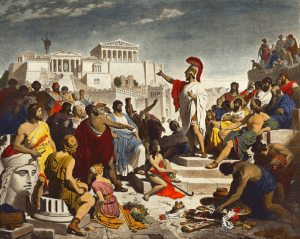
Historians normally date the birth of the modern concept of citizenship from the period of the French Revolution and Napoleonic France (1789-1815); however, it has roots in the ancient world. In the Western tradition, the roots of citizenship and the good citizen reach back to ancient Athens and Republican Rome. The word “citizen” stems from the Latin word “civis,” meaning citizen. Citizens had both rights from and duties to the political body — the city-state. When the state — facing an emergency — summoned the citizen to military duty, the citizen had to respond, putting his allegiance to the state above allegiance to family, clan, tribe or political faction.

Aristotle maintained that a human being could reach his full potential only through the city-state. To Pericles, living life aloof from the affairs of state was stupidity. The Greeks called such a person an “idiotes.”

Pericles’ Funeral Oration (Perikles hält die Leichenrede) by Philipp Foltz (1852)

In addition to words for citizen (civis) and citizenship (civitas), the Romans also had the word civilitas, which meant civility/politeness, but could also refer, as Mary Beard states in her book, SPQR,” to the connectedness between Roman citizens: “we are all citizens together.” When I, as an individual citizen, thinking of the idea of my country, show devotion and loyalty to it by reciting the pledge of allegiance or standing for the national anthem, I am showing patriotism. When I do this relating more to my fellow citizens, I show not only patriotism but also civicism, a word only rarely seen in our political discussions.

We would be greatly aided in fortifying both patriotism and civicism with a different president. President Trump has yet to show genuine leadership in uniting us in our common civic project. Were it possible with a wave of the wand, we should all increase our opportunities to get to know each other: eat, listen to music, and dance together. As the Germans do, we should consider state subsidization of admission for the common person to the theater and to sporting events, so that people from all levels of American society could sit near each other and enjoy these events. These could have salutary results. We might not only get to know one another, but also fall in love and have children. Over generations, this would go a long way in fighting prejudice. It is very difficult, I can say from experience, to hate one’s grandchild.

The greatest step to fortify civicism would be to institute a program of national service, with the requirement for at least one year of some type of service to the country. In addition to the option of military service, there could be many options outside the military. The needs of our society are great: the sick, the elderly, the homeless, the addicted, and the ravaged by domestic abuse, PTSD or natural disaster. If accomplished between the ages of 18-25, these young cohorts would not only fill important needs, but also gain another year of experience to know themselves and decide on their futures, and to experience places and people in different corners of America.

We would have fewer college students repeat the words that one of mine recently said as he shrugged: “Yes, I went to college because it was what you do after high school.” The program could help us build walkways to each other and break down walls of prejudice. Finally, it could fight our society’s deification of individualism and also the multiple tribalisms, which have grown over the past four decades from the internet, the iphone, and the excesses of American culture.

In his inaugural speech, President John F. Kennedy inspired my generation to: “Ask not what your country can do for you; ask what you can do for your country.” A program of national service would institutionalize this service to country, and it would fortify our civicism, something we shall need to confront the many challenges of the 21st century, including a rising China and a Russia bent on our self-destruction.

Fred Zilian teaches history and politics at Salve Regina University, in Newport, Rhode Island. Follow him on Twitter at @FredZilian.

Posted in Uncategorized | Tagged , , , , , , , , , , , , | 4 Comments

A “Chinese Century” of Leadership in Clean Energy?

(This essay was originally published as “We are paving the way for Chinese dominance in clean energy,” by The Hill [online] on November 12, 2017.)

For early baby-boomers, the federal government’s release on November 3 of the comprehensive science report on climate contained few surprises. It simply confirmed what we have been experiencing for six decades. The central question is whether the U.S. will surrender to Chinese leadership in this key strategic area of clean energy systems while we plod along relying heavily on carbon-based, dirty fuels.

The National Oceanic and Atmospheric Administration oversaw the report, with input from 12 other federal agencies. Some highlights: Over the past 115 years the average global temperature has increased 1.8 degrees Fahrenheit. Global temperature has set highs for the last three years, and six of the last 17 years are the warmest on record. “The frequency and intensity of extreme high temperature events are virtually certain to increase in the future as global temperature increases.” Humans are the dominant cause of the global temperature rise. Finally, we are experiencing the warmest period in the history of civilization.

Being attentive to the natural world since the mid-1950s, I am confident in making some observations about climate change, at least for the Mid-Atlantic and southern New England regions. First, the robins once departed in October and did not return until late February. Today I am not sure they ever really depart. Second, by mid-October, my garden was once dead. This year I am still weeding, and my gazanias, dahlias, geraniums, and petunias are still blooming. Third, I feel quite badly for the ladybugs who do not know whether to fly or to go into their winter suspension. Overall, it is simply uncanny how much winter has shortened. Back in the 1950s, I reached for my jacket by the end of September; by this time in November, I certainly needed an overcoat.

We can thank Washington politics for the release of the report evidently without any significant sanitizing by the Trump administration appointees who doubt the role of carbon dioxide and of humans in climate change. President Trump has described climate change as a “canard.” In August, President Trump rescinded an earlier executive order that urged federal agencies to consider climate change and sea-level rise when rebuilding infrastructure. His EPA administrator Scott Pruitt has said that carbon dioxide is not a primary contributor to warming. Energy Secretary Rick Perry maintains that the science is still out on whether humans cause climate change. It appears that the Trump administration was fixed on tax reform and did not wish to expend political capital in fighting over the report.

Regrettably, it is doubtful that the report will have any impact on the policies of this anti-climate administration. Unfazed, Raj Shah, a White House spokesman said in a business-as-usual statement: “The climate has changed and is always changing.” With such a Lazy Grasshopper attitude, this suggests that the U.S. will cede the technological high ground to China which will then dominate clean energy technology with its attendant political dividends.

China is already dominant in many low-carbon energy technologies. It produces two-thirds of the world’s solar panels and nearly half of the wind turbines. On a lake created by the collapse of abandoned coal mines in Luilong, China has built the world’s largest floating solar project. China is now leading the construction of the Quaid-e-Azam solar park in Pakistan, one of the world’s largest. China is also rapidly expanding its fleet of nuclear reactors and leads the world by far in hydroelectric power.

The country’s “Made in China 2025” program calls for heavy spending on clean-energy research and development, as a way to bolster the economy. State-owned banks are pouring tens of billions of dollars each year into technologies like solar and wind.
China’s “One Belt, One Road” plan is essentially a $1 trillion global campaign to generate economic and diplomatic ties through infrastructure building. It envisions the bankrolling of clean-energy projects across Asia, including the Mideast, East Africa, and Eastern Europe.

There is a famous line from Giuseppe Lampedusa’s 19th century, Italian novel, The Leopard, that goes: “If we want things to stay as they are, things will have to change.” If we wish to remain a superpower, we must become one in clean energy technologies, the Big Thing of the 21st century. With over 85% of the global market, China already dominates the rare earth minerals industry, of strategic importance to the US. On our current course, we should not be surprised when China also becomes the economic-technological hegemon in clean energy technologies.

Fred Zilian (zilianblog.com; Twitter: @FredZilian) teaches global environmental politics at Salve Regina University, RI.

Posted in Uncategorized | Tagged , , , , , , , , , , , | 2 Comments

Martin Luther: Courageous Challenger of the Church

(Originally published by the Newport Daily News on October 31, 2017.)

Five hundred years ago, Martin Luther initiated the Protestant Reformation with his 95 Theses, challenging the pope’s authority and denouncing the sale of indulgences by the Roman Catholic Church. Facilitated by the printing press, the Reformation spread throughout Christendom, creating a definitive schism which persists today, something which would have shocked Luther. He was hoping to reform the Catholic Church from within, not begin a political-social-religious revolution.

Luther was not the first individual to challenge the pope and Catholic Church doctrine during this time period. In the late 14th century, Oxford scholar John Wycliffe criticized the material wealth of the church and sought greater emphasis on scripture, drawing the church’s condemnation. In the 15th century, Jan Hus in the city of Prague of the Czech Republic also emphasized scripture over church hierarchy. He was arrested, charged with heresy, and burned at the stake in 1415.

Martin Luther began his religious vocation as a young man of 21. Caught in a terrible thunderstorm, he prayed to St. Anne that if he was saved, he would become a monk. Having lived through the storm, he fulfilled his vow by joining the monastic order of Augustinian Hermits in the German city of Erfurt. He pursued his quest for salvation relentlessly but found that no matter how devout and pious he acted, he still felt sinful.
Then came the revelation. Reading Paul’s letter to the Roman Christians, Luther seized on another path to salvation besides good works and Catholic ritual: simply having faith in God’s promises, specifically belief in Jesus Christ as savior—justification by faith alone. Because he had achieved this epiphany through studying the Bible, he believed that scripture and not the pope or any of the Church leadership was the true path to religious understanding. Justification by faith and the Bible as sole authority would become the two fundamental pillars of the Protestant Reformation.

The spark that ignited Luther and the Reformation in 1517 was the Catholic Church’s sale of indulgences, supposedly allowing one’s soul to transit purgatory more quickly. Johann Tetzel, a Dominican monk, was the pope’s representative in Germany. Pope Leo X needed funds to continue the construction of St. Peter’s Basilica in Rome. Tetzel’s slogan was: “As soon as the coin in the coffer rings, the soul from purgatory springs.”

Martin Luther by Lucas Cranach the Elder, c. 1543

Luther was sickened and angered at this commercialization of salvation. He prepared his “Disputation on the Power of Indulgences,” known as the Ninety-Five Theses. According to tradition, he nailed these to the door of All Saints’ Church in Wittenberg, Saxony, October 31, 1517. They denounced indulgences as a means of salvation.

The Church ordered Luther to retract his statements, but he refused, repeatedly making statements denying the papal foundations of the church and claiming faith in Christ as the foundation.

In January 1521, a papal decree declared him a heretic and excommunicated him. Several months later in April, he appeared before the Imperial Diet (assembly) of the Holy Roman Empire, led by the Emperor Charles V. Luther stood brave and steadfast against the charges and made his famous reply:

Unless I am convicted by Scripture and plain reason—I do not accept the authority of popes and councils, for they have contradicted each other—my conscience is captive to the Word of God. I cannot recant and I will not recant anything, for to go against conscience is neither right nor safe. Here I stand, I cannot do otherwise. God help me. Amen.

The printing press, invented in the mid-15th century, greatly facilitated the propagation of Luther’s ideas. His Theses were quickly translated from Latin into German. Now many common Germans, sharing his resentments toward an apparently corrupt Catholic Church, joined the movement. Over the next 130 years, Western Europe was riven by religious, political, and social turmoil, conflict, and war, ending in 1648 with the conclusion of the Thirty Years War, the last of Europe’s religious wars.
On January 16 each year, Americans honor the memory of Martin Luther King, Jr., so named by his father, a Baptist minister in Atlanta, who became interested in Luther during a trip to Europe.

It was on a research trip to Germany in 1991, shortly after German Unification, that I was able to spend several hours in Wittenberg in the former East Germany. I was thrilled to visit All Saints’ Church and Luther’s home. Naturally, I followed my sightseeing by eating a good bratwurst, German roll, und ein Bier.

This year the Germans have been celebrating the anniversary with over 1,000 events in 100 different locations. Minnesota may be the center of celebration in America. Lutheran Pastor Nancy Monke of Underwood, Minn., said: “The whole idea of individual freedom, that you can protest the church or any authority, really took off from him.”

Fred Zilian (zilianblog.com; Twitter:@FredZilian) is a writer, educator, and monthly columnist.

Posted in Uncategorized | Tagged , | 5 Comments

Part X: Judging the Unconventional Patriotic Citizen

(A version of this essay was originally published as  “How Should We Judge Unconventional Patriotic Citizens Like Snowden and Kaepernick?”  by the History News Network-online on October 15, 2017.)

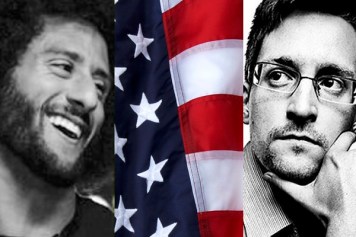
This is the tenth essay in a series devoted to examining citizenship and the American citizen, the rights, duties, and norms of which have become ever more contentious since the divisive Sixties. They have become especially relevant in recent years with the actions of Edward Snowden and Colin Kaepernick, and with the election of Donald Trump and his proposed policies on immigration reform and his accusatory statements against those who will not stand for the national anthem.

Along with organized and informal groups of protesting citizens such as those of the Sixties, we have seen in the last five years individual citizens, empowered by technology and social media, roil the American political and social landscape with their individual actions. These techno-powered, defiant citizens are simply carrying on the traditions established and legitimized by the angry, defiant protestors and counterculture groups of the Sixties, only now they are in some cases acting alone. Also, they can gather more information, disseminate it, and garner support more quickly than the protestors of the Sixties.

In 2013, Edward Snowden, an intelligence contractor for the U.S. government and former CIA employee, copied and leaked thousands of classified documents to several British and American journalists, revealing the National Security Agency’s massive, warrantless surveillance and data collection programs. He has been called numerous things: a whistleblower, a traitor, and a patriot. Snowden’s actions broke federal law; he faces charges on theft and two counts under the 1917 Espionage Act.

Colin Kaepernick, the biracial, back-up quarterback for the San Francisco 49ers, challenged a common ritual of patriotism by sitting during the national anthem at pre-season NFL games in August, 2016, eventually switching to kneeling. His actions did not break any law. There is no law requiring that a citizen stand for the national anthem.

However, all expectations of a good citizen in a state or civilization cannot be, and should not be, codified. Good civilizations also have unwritten citizen’s norms and codes of ethics. These help to identify and bind the citizenry. The ancient Romans had a word for this, civilitas, which Mary Beard in her book SPQR defines as: “we’re all citizens together.” The best, if uncommon, word we have for this is civicism: civic spirit.

Empowered by the internet and social media, such actions by these unconventional presumably patriotic citizens would appear to have become fixtures in American society. What follows is a five-point framework for evaluating such actions, a framework rooted in the principles of the Just War tradition, reaching back to Hugo Grotius of the 17th century.

I. Noble Aim: Was the citizen’s aim noble or did the citizen perform the action simply for personal gain, for example, for such things as financial gain, fame, or celebrity? If so, this could disqualify the citizen as a patriot.
II. The Clarity and Achievability of the Citizen’s Goal(s): Did the citizen have a clearly stated goal(s)? Would a reasonable person say that the citizen had a good chance of succeeding in achieving it? Without a clearly stated goal, the citizen cannot be focused on achieving some good. If the chances of success are minimal, the citizen can not only be wasting his/her time, but also cause needless conflict, instability, or even chaos.
III. The Suitability of the Means Chosen to Obtain the Goal: Was the means chosen to achieve the goal suitable? Was it discriminatory and focused or was it broad-brushed and heavy-handed causing unnecessary collateral damage?
IV. Proportionality of Action: Did the potential good outweigh the potential bad caused by the action? Was it designed to effect the greatest good while causing the least harm? Before the fact, this question can be hard to answer. In hindsight, of course, the benefits and harm of an action are still challenging but easier to judge.
V. Acceptance of Consequences: Was the citizen prepared to accept the consequences of the actions or, conversely, did the citizen want—so to speak—to have his/her cake and eat it too?

Two prefatory comments: If one wishes to hold the unconventional patriot to a very high standard, his/her actions should meet all five criteria. Second, even if one agrees with these criteria, objective, unbiased information relating to them may be hard to obtain.

Let us consider how the actions of Snowden and Kaepernick stack up against these criteria.

I. Noble Aim: Both individuals appear to have acted with good intentions and for selfless and noble aims. Snowden’s intention was to reveal the global, illegal surveillance programs, many run by the National Security Agency with the cooperation of telecommunications companies and European governments. Impliedwas his desire to stop the illegal surveillance and to improve the privacy of the individual citizen, a right he called “the fountainhead of all our rights.” In June 2013, he stated: “I’m just another guy who sits there day to day in the office, watches what’s happening and goes, ‘This is something that’s not our place to decide, the public needs to decide ….” His authority for making such a decision on the public’s “need to know” can be questioned.
Kaepernick’s intention was to bring attention to and protest police brutality, specifically, that directed at people of color. Of course, implied was his desire for this somehow to change. It does not appear that either took their actions for personal gain. No evidence exist that would suggest they were pursuing fortune, fame or celebrity. Of course, sometime—even for the citizen him/herself—it is hard to be sure of one’s motives.

II. The Clarity and Achievability of the Citizen’s Goal(s):
In the case of Snowden, his short-term goal was reasonably clear and achievable. He wished to reveal the surveillance programs and he did that through a number of international journalists, Glenn Greenwald, Laura Poitras, and Ewen MacAskill. His revelations were eventually printed in high profile newspapers, such as The Guardian and The Washington Post. The larger goal of at least curbing the programs, he argues, was also achieved. In September 2016 he was asked about this and he said: “Do I think things are fixed? No. Can any single individual fix the world? No that’s too much. Have things improved. Yes.” He cited important changes in American and European laws, and that some internet companies have made changes, pushing back against government pressure. People are certainly more aware of the issue. “Things have gotten better,” he said. Snowden’s website currently lists numerous achievements to date, including many investigations into illegal surveillance, greater transparency, legislative reforms, lawsuits, and a more informed public debate.

A U.S. appeals court in 2015 ruled that the bulk data collection of American phone records revealed by Snowden was illegal. Congress then replaced that program with another which keeps the bulk data under the control of the phone companies.
In the case of Kaepernick, a positive goal was implied rather than clearly stated. His statements about his actions were stated in negative terms: “There is police brutality—people of color have been targeted by police.” He criticized the inadequate training police receive and asserted he was not “going to show pride in a flag for a country that oppresses black people and people of color.” By not engaging in a fundamental civic ritual, he presumably was acting for the positive goal of police reform: to end or at least to curb racism, the achievability of which can be questioned with his type of action. He has succeeded in provoking President Trump to weigh in and further elevate the issue. On September 22, Trump publicly urged owners to fire or suspend protesting players and fans to stage boycotts of the NFL.

Kaepernick himself appears content with his achievements. In March 2018, ESPN’s Adam Schefter wrote that “Kaepernick no longer wants his method of protest to detract from the positive change he believes has been created” and that “the amount of national discussion on social inequality…affirmed the message he was trying to deliver.” Kaepernick remains unemployed as a football player. Reportedly he is staying in shape in case a call comes and also running civil rights education events for disadvantaged youth.

III. The Suitability of the Means Chosen to Obtain the Goal:
Snowden did choose means that were suitable. He wanted revelation to the public and so he used highly-reputable newspapers in the U.S., the U.K., and Germany. However, Snowden’s actions get a poor grade for discrimination. Rather than releasing carefully-selected NSA documents, he revealed “thousands.” His website indicates he reached a point where he “realized that the wrongdoing he witnessed was something that should be determined by the public.” Even if one agrees with this, the necessity of the magnitude of the release can be questioned.

Also, in the case of Kaepernick, one can challenge the means he chose. Certainly he can be admired for his courage and clearly he reached a wide audience, but other than interviews on his actions, it appears he never followed with other, more substantive actions to fight racially motivated police brutality, e.g., publishing a thoughtful letter or essay explaining his actions fully and what specific things he would like to see happen to address the problem. He did address the short training period for many police; however, we might expect a better “game plan” from an NFL quarterback.

IV. Proportionality of Action:
In the case of Snowden, the private citizen is now informed about the enormous and illegal NSA surveillance programs. However, he has clearly embarrassed the U.S. government. His critics have also asserted that his actions have made it more difficult to gather necessary intelligence on terrorists and other foreign threats. They speak of the extensive damage done to national security. Given the classified nature of the details, this aspect is had to judge.

In the case of Kaepernick, one can say that he performed a service by elevating the issue to the national level, while producing little substantive damage to anything. He broke no laws; he simply broke a norm of conventional patriotism. The conformist, conventional patriot might argue that he has sown unnecessary division within the country.

V. Acceptance of Consequences:
Snowden has paid a heavy price for his actions. Fleeing from his native country, he traveled to Hong Kong and hoped to reach Latin America via Moscow. However, his passport was “annulled,” and he was left stranded in Russia. His website states that he is currently at an “undisclosed, secure location,” presumably in Russia. Unless pardoned, something rejected by the Obama administration and unlikely by the Trump administration, he faces charges on two counts under the 1917 Espionage Act, an act does not allow for a “public interest” or “whistle blower” defense. Snowden has stated he would consider a prison term as part of a plea bargain.

To date, Kaepernick remains unemployed as a quarterback. His supporters assert collusion among the generally conservative and conventionally patriotic NFL owners who may say publicly that they support his right to protest but privately shun him primarily because of his actions and the trend he began.

Summation
Overall, in using this framework to judge the actions of these two unconventional patriotic citizens, we can say that both were motivated by noble aims and good intentions. Snowden’s goals were clear and he has achieved much at great personal expense, assuming one highly values the individual right of privacy. The means he chose to reach his goals were suitable, and he has stood stoical with the consequences of his actions. Nonetheless, he gets a poor grade on discrimination, as he released so many documents with sensitive material.
Kaepernick gets weak grades for his goals and the means he chose to achieve them. However, he broke no laws and has forced us to think about racism within our society, especially in the ranks of our police. He has remained open and upright in his unemployed status.

Follow me on Twitter: @FredZilian

Fred Zilian has taught Western Civilization, World History, and War & Morality for the past 25 years at the high school and college levels. He currently teaches history and politics at Salve Regina University, RI.

Posted in Uncategorized | Tagged , , , , , , , , | 1 Comment

Part IX: Citizenship in the Age of Donald Trump

(A version of this essay was originally published as “What Makes a Good Citizen?” in the Newport Daily News on September 30, 2017, and as “What Citizenship Means Keeps Changing,” on October 8, 2017, by the History News Network-online)

This is the ninth essay in a series devoted to examining citizenship and the American citizen, the rights, duties, and norms of which have become ever more contentious since the divisive Sixties. They have become especially relevant in recent years with the actions of Edward Snowden and Colin Kaepernick, and with the election of Donald Trump and his proposed policies on immigration reform and his accusatory statements against those who do not stand for the national anthem.

As a human body is only as healthy as its individual cells, so a civilization or modern state is only as healthy as its individual citizens. As a healthy human body is sustained by new, healthy cells, so a modern state needs continuous rejuvenation with new, healthy, good citizens to sustain itself, especially in times of stress.

President Obama and Citizenship
In his farewell speech on January 11, 2017, President Barack Obama made frequent reference to the ideas of citizen and citizenship in our democracy. Early in his speech he stated: “For 240 years, our nation’s call to citizenship has given work and purpose to each new generation.” In stressing the domestic as well as international roles of the citizen, he said: “So, just as we, as citizens, must remain vigilant against external aggression, we must guard against a weakening of the values that make us who we are.” In calling us to our duty as citizens, he stated: “But remember, none of this happens on its own. All of this depends on our participation; on each of us accepting the responsibility of citizenship, regardless of which way the pendulum of power happens to be swinging.” He lauded the role of citizen in saying: “Because for all our outward differences, we, in fact, all share the same proud title, the most important office in a democracy: Citizen.” (He emphasized the word by saying it twice amidst applause.) Toward the end of his speech, he stressed his own intentions as a citizen: “My fellow Americans, it has been the honor of my life to serve you. I won’t stop. In fact, I will be right there with you, as a citizen, for all my remaining days.”

Trump Assumes the Presidency
A few days later, Donald Trump assumed the office of presidency, with the implied role of “first citizen” of the United States. He is unusual in several ways. He is the oldest person to be elected president and comes to the office without ever having served in public office. His methods are unconventional. Rather than using the normal machinery of American democratic government, such as official statements, press conferences, and national televised speeches, he prefers to tweet.

I have demonstrated that rights, through the ages, have been an important component of citizenship and the citizen. President Trump has emphasized a number of “rights” which stem from his campaign promises as means to “Make America Great Again,” his campaign motto. The right to a job: he signed legislation to lift the Obama-era ban on new coal leasing on federal lands. The right to secure borders: He has vowed to build a wall along the 1,915 mile Mexican border. The right to security at home: He has signed legislation banning immigration from seven Muslim countries. An implied right: to prosper without undue government interference. He appointed Scott Pruitt as the EPA director, signed legislation rolling back Obama-era climate initiatives and proclaimed his intent to withdraw the US from the Paris Accord on climate. Implied in these actions he has taken is that he believes it his duty to fulfill as many of his campaign promises as possible.

Citizenship Since World War II
For the first two decades after World War II, American citizens were in general agreement as to the rights, duties, and norms of the good American citizen. Their fundamental rights were clearly enumerated and codified in the Constitution, though subject to various interpretations. With memories of the war still fresh and now facing Cold War competition with the Soviet Union, Americans were generally united in their duty to support their country’s leaders and policies against Soviet communism, the leader of which said that he would “bury” us.

As the Sixties began and many movements for change proliferated, the consensus of the Fifties cracked. Large groups of mostly younger citizens, middle-class citizens, and African-Americans citizens split from the majority of American citizens who believed generally in the legitimacy of the American system, its leaders, and its policies. The rights to assemble and to free speech gained in prominence and allowed these groups to demand change. They asserted that America was not so beautiful; rather it was deeply flawed. The wonders and prosperity of capitalism were illusions and did not bring happiness and contentment. Social injustice was rife. They asserted that the arms race, especially the nuclear arms race, was dangerous and unnecessary. The country’s involvement in the Vietnam War had to end, some of them going so far as to actually visit with and break bread with the enemy. They asserted that the country’s authority figures were capable of great stupidity, could not be trusted, and had to be challenged. Finally, they asserted that a freer, more open lifestyle was better than mindless conformity.

The Single Model of Citizen–Broken
The most significant legacy of the Sixties regarding citizenship and patriotism was the breakdown of the single model of the “good American citizen” of the postwar period. Large portions of the population believed that a good citizen was no longer just a “red, white, and blue citizen”—“my country, right or wrong.” Now one could be accepted as a “good citizen” by being, let us say, a good “white citizen”—someone who is motivated on pure principle to disagree publicly with the country’s political leaders and policies. One could now be a “good black citizen”—one who is prepared to oppose publicly the country’s policies on minorities. One could now be a “good pink citizen”—one who is prepared to oppose publicly the country’s policies on gender issues. Some would even condone a good “red citizen”—one who is prepared to use violence to change American policies or indeed the American system. After all, it was none other than the writer of the Declaration of Independence who said: “The tree of liberty must be refreshed from time to time with the blood of patriots and tyrants.” The “yellow citizen”—one who protests merely for self-interest—has never gained legitimacy or respect.

President Donald Trump in many ways has shown that he longs for the good old days, apparently the late 1940s and the 1950s. As a baby boomer patriot, I sympathize with this. However, with his comments disparaging the members of the NFL who refuse to stand for the national anthem, clearly he is saying to Make America Great Again, the only good citizen is a “red, white, and blue” one. This is mere sentimentalism.

In the song “American Pie,” Don McLean longed to hear some Buddy Holly music again, but the man at the “sacred store” told him “the music wouldn’t play.” Trump longs for that good old-time patriotism, but America—and the world—have changed.

(See Part X: Judging the Unconventional Patriotic Citizen.)

Follow me on Twitter: @FredZilian

Posted in Uncategorized | Tagged , , , , , , , , , , | 1 Comment

Part VIII: Citizenship in the Age of Edward Snowden and Colin Kaepernick

This is the eighth essay in a series devoted to examining citizenship and the American citizen, the rights, duties, and norms of which have become ever more contentious since the divisive Sixties. They have become especially relevant in recent years with the actions of Edward Snowden and Colin Kaepernick, and with the election of Donald Trump and his proposed policies on immigration reform and his accusatory statements against those who will not stand for the national anthem.

As a human body is only as healthy as its individual cells, so a civilization or modern state is only as healthy as its individual citizens. As a healthy human body is sustained by new, healthy cells, so a modern state needs continuous rejuvenation with new, healthy, good citizens to sustain itself, especially in times of stress.

The most significant legacy of the divisive Sixties regarding citizenship and patriotism was the breakdown of the single model of the good, loyal, trusting,  American citizen of the postwar era. Large portions of the population believed that a good citizen was no longer just a “red, white, and blue citizen”—“my country, right or wrong.” Now one could be accepted as a “good citizen” by being, let us say, a good “white citizen”—someone who is motivated on pure principle to disagree publicly with the country’s political leaders and policies. One could now be a “good black citizen”—one who is prepared to oppose publicly the country’s policies on minorities. One could now be a “good pink citizen”—one who is prepared to oppose publicly the country’s policies on gender issues. Some would even condone a good “red citizen”—one who is prepared to use violence to change American policies or indeed the American system. After all, it was none other than the writer of the Declaration of Independence who said: “The tree of liberty must be refreshed from time to time with the blood of patriots and tyrants.” The “yellow citizen”—one who protests merely for self-interest—has never gained legitimacy or respect.

In the last five years we have seen, along with organized and informal groups of protesting citizens such as those of the Sixties, individual citizens, empowered by technology and social media, roil the American political and social landscape with their individual actions. These super-empowered, defiant citizens are simply carrying on the traditions established and legitimized by the angry, defiant protestors and counterculture groups of the Sixties, only now they are in some cases acting alone.

Edward Snowden: Leaking Classified Documents for a Better America

In 2013, Edward Snowden, an intelligence contractor for the U.S. government and former CIA employee, copied and leaked thousands of classified documents to several British and American journalists, revealing the National Security Agency’s massive surveillance and data collection programs. Snowden faces charges on two counts under the 1917 Espionage Act and is now living in asylum in Russia. In September, 2016, he was interviewed by the New York Times via internet and said that he believed his revelations had improved privacy for Americans and that “being patriotic doesn’t mean simply agreeing with your government.” He continued: “I would argue that being willing to disagree, particularly in a risky manner, is actually what we need more of today.” He has been called numerous things: a whistleblower, a traitor, and a patriot.

The case of Edward Snowden illustrates the tension between national security, as defined by the U.S. government, and individual privacy. It also forces the questions: When does patriotism require breaking the law? When does a citizen break his/her country’s laws in order to serve a higher good and to improve the country?

Colin Kaepernick: Sitting and Kneeling for a Better America

Unlike the political activists in the Sixties who stood, assembled in great numbers, marched, sang, listened to stirring speeches, shouted, and sometimes damaged and destroyed property and individuals, Kaepernick choose first to sit and then to kneel in silent protest. The biracial, back-up quarterback for the San Francisco 49ers challenged the conventional ritual of patriotism by sitting during the national anthem at pre-season games in August, 2016, eventually switching to kneeling. He argued: “There is police brutality—people of color have been targeted by police.” He criticized the inadequate training police receive. He asserted he was not “going to show pride in a flag for a country that oppresses black people and people of color.”

Other football players followed his example of either kneeling or raising a fist: Marcus Peters (Kansas City Chiefs), Brandon Marshall (Denver Broncos), Arian Foster (Miami Dolphins), who was joined by teammates Kenney Stills, Michael Thomas, and Jelani Jenkins. Two New England Patriots and three players from the Tennessee Titans also protested at least once.

Colin Kaepernick was showing his patriotism and exercising his right to free speech. I believe that his goal was selfless, to improve his country, rather than to generate more publicity or money from the sales of his jersey which skyrocketed. He should be grateful to live in a country where this right of free speech is honored, unlike the country where Edward Snowden currently resides. It has also been reported that he did not vote in the 2016 presidential election, saying that “it really didn’t matter …, the system still remains intact that oppresses people of color.” This was surprising for a man who seeks the improvement of the American system.

In the case of Colin Kaepernick, there was no breaking of the law. There is no law requiring that a citizen stand for the national anthem. However, all expectations of a good state or civilization cannot be, and should not be, codified. Good civilizations also have unwritten citizen’s norms and codes of ethics. These help to identify and bind the citizens of the civilization together.

(See Part IX: Citizenship in the Age of Donald Trump.)

Follow me on Twitter: @FredZilian

Posted in Uncategorized | Tagged , , , , , , , | 1 Comment

Part VII: Citizenship Through the Ages

This is the seventh essay in a series devoted to examining citizenship and the American citizen, the rights, duties, and norms of which have become ever more contentious since the divisive Sixties. They have become especially relevant in recent years with the actions of Edward Snowden and Colin Kaepernick, and with the election of Donald Trump and his proposed policies on immigration reform.

As a human body is only as healthy as its individual cells, so a civilization or modern state is only as healthy as its individual citizens. As a healthy human body is sustained by new, healthy cells, so a modern state needs continuous rejuvenation with new, healthy, good citizens to sustain itself, especially in times of stress.

In the ancient worlds of Athens and Republican Rome, the citizen was the critical basic unit of the civic body politic. Citizens had both rights from and duties to the political body—the city-state. When the state—facing an emergency—summoned the citizen to military duty, the citizen had to respond, putting his allegiance to the state above allegiance to family, clan, faction, or tribe. Aristotle maintained that a human being could reach his full potential only through the city-state. To Pericles, living life aloof from the affairs of state was stupidity.

In Republican Rome, citizens’ rights become more complex and codified. As Republican Rome increased its conquests through force, it used Roman citizenship as a diplomatic tool to cement political relationships with conquered peoples.

Drawing inspiration from the ideas of the Enlightenment, French revolutionaries early on in their fight against absolute monarchy and the old order of privilege enumerated and codified citizens’ rights in a document. Facing military threats from hostile neighbors, it called upon not only “citizens” but all members of the French nation—young and old, male and female—to perform duty for this new France. Passive citizens no longer sufficed. New active citizens were needed, citizens who possessed and acted on their “public virtue,” what Republican Rome had called “pietas.”

Nazi totalitarian Germany required German citizens essentially to surrender their rights. Emphasizing duties instead of rights, it emphasized that they fulfill these duties to save Germany from the vengeful victors of World War I and to restore Germany to glory. This Germany did not subscribe to any code of rights derived from the Enlightenment. The German citizen was defined in narrow, exclusive terms. Aryanism was the key litmus test. This citizen was to obey, not to question or to challenge. Commands and orders came from on high; the German citizen’s duty was to obey. To disobey was to denigrate the Fatherland. Echoing Aristotle’s idea in part, Nazi Germany asserted that the German citizen was nothing apart from the German state and that Adolf Hitler and Nazi party officials defined the right and the wrong. Enculturated to think of Jews as subhuman, ordinary German citizens—not just hardline Nazi functionaries—contributed at various levels to the mass execution of Jews and other undesirables.

For the first two decades after World War II, American citizens were in general agreement as to the rights and duties of citizenship. Their fundamental rights were clearly enumerated and codified in the Constitution, though subject to various interpretations. With memories of the war still fresh and now facing Cold War competition with the Soviet Union, Americans were generally united in their duty to support of their country’s leaders and policies against Soviet communism.

As the Sixties began and the many movements of protest were launched, the consensus of the Fifties cracked. Large groups of mostly younger citizens, middle-class citizens, and African-Americans citizens split from the majority of American citizens who believed generally in the legitimacy of the American system, its leaders, and its policies. The rights to assemble and to free speech gained in prominence and allowed these groups to demand change. They asserted that America was not so beautiful; rather it was deeply flawed. The wonders and prosperity of capitalism were illusions and did not bring happiness and contentment. Social injustice was rife. They asserted that the arms race, especially the nuclear arms race, was dangerous and unnecessary. Their country’s involvement in the Vietnam War had to end. They asserted that the country’s authority figures were capable of great stupidity, could not be trusted, and had to be challenged. Finally, they asserted that a freer, more open lifestyle was better than mindless conformity.

The most significant legacy of the Sixties regarding citizenship and patriotism was the breakdown of the single model of the “good American citizen” of the postwar period. Large portions of the population believed that a good citizen was no longer just a “red, white, and blue citizen”—“my country, right or wrong.” Now one could be accepted as a “good citizen” by being, let us say, a good “white citizen”—someone who is motivated on pure principle to disagree publicly with the country’s political leaders and policies. One could now be a “good black citizen”—one who is prepared to oppose publicly the country’s policies on minorities. One could now be a “good pink citizen”—one who is prepared to oppose publicly the country’s policies on gender issues. Some would even condone a good “red citizen”—one who is prepared to use violence to change American policies or indeed the American system. After all, it was none other than the writer of the Declaration of Independence who said: “The tree of liberty must be refreshed from time to time with the blood of patriots and tyrants.” The “yellow citizen”—one who protests merely for self-interest—has never gained legitimacy or respect.

(See Part VIII: Citizenship in the Age of Snowden and Kaepernick.)

Bibliography:

Amos, H.D. & A.D.P. Lang. These Were the Greeks. Chester Springs, PA: Dufour, 1982.

Beard, Mary. SPQR: A History of Ancient Rome. NY: Liveright, 2015.

Carsten, F. L. The Rise of Fascism. Berkeley, CA: University of California Press, 1982.

Charters, Ann, ed. The Portable Sixties Reader. NY:Penguin, 2003.

Collier, Peter & David Horowitz. Destructive Generation: Second Thoughts About the Sixties. San Francisco: Encounter Books, 1989.

Farber, David. The Age of Dreams: America in the 1960s. NY: Hill and Wang, 1994.

Freeman, Charles. The Greek Achievement: The Foundation of the Western World. NY: Viking, 1999.

Gitlin, Todd. The Sixties: Years of Hope, Days of Rage. NY: Bantam, 1989.

Goldhagen, Daniel Jonah. Hitler’s Willing Executioners: Ordinary Germans and the Holocaust. NY: Random House, 1997.

Hamilton, Edith. The Greek Way. NY: Norton, 1964.

Heater, Derek. A Brief History of Citizenship. NY: New York University Press, 2004.

Holland, Tom. Rubicon: The Last Years of the Roman Republic. NY: Doubleday, 2003.

Kurlansky, Mark. 1968: The Year that Rocked the World. NY: Ballantine, 2004.

Neumann, Franz. Behemoth: The Structure and Practice of National Socialism, 1933-1944. NY: Harper & Row, 1944.

Ober, Josiah. The Rise and Fall of Classical Greece. Princeton, NJ: Princeton University Press, 2015.

Patterson, James T. The Eve of Destruction: How 1965 Transformed America. NY: Basic Books, 2012.

Richard, Carl J. Greeks and Romans Bearing Gifts: How the Ancients Inspired the Founding Fathers. Lanham, MD: Rowman & Littlefield, 2008.

Schama, Simon. Citizens: A Chronicle of the French Revolution. NY: Vintage, 1990.

Schoenbaum, David. Hitler’s Social Revolution: Class and Status in Nazi Germany, 1933-1939. NY: Doubleday, 1966.

Spielvogel, Jackson J. Western Civilization. Belmont, CA: Wadsworth/Thomson, 2003.

Stockton, David. The Classical Athenian Democracy. Oxford: Oxford University Press, 1990.

Tingay, G.I.F. & J. Badock. These Were the Romans. Chester Springs, PA: Dufour, 1972.

Viorst, Milton. Fire in the Streets: America in the 1960s. NY: Simon and Schuster, 1979.

Posted in Uncategorized | Tagged , , , , , , , , , | Leave a comment

Part VI: Citizenship and the New American Citizen in the Divisive Sixties

This is the sixth essay in a series devoted to examining citizenship and the American citizen, the rights, duties, and norms of which have become ever more contentious since the divisive Sixties. They have become especially relevant in recent years with the actions of Edward Snowden and Colin Kaepernick, and with the election of Donald Trump and his proposed policies on immigration reform and his accusatory statements against those who will not stand for the national anthem.

As a human body is only as healthy as its individual cells, so a civilization or modern state is only as healthy as its individual citizens. As a healthy human body is sustained by new, healthy cells, so a modern state needs continuous rejuvenation with new, healthy, good citizens to sustain itself, especially in times of stress.

The Sixties were a time of tremendous social and political ferment, turbulence, and experimentation. A substantial segment of America had high hopes for a new age, and when the state suppressed their efforts, showed rage against an old order in which a substantial number of Americans—relatively privileged young, African-Americans, women, homosexuals, and early environmentalists—challenged the established order, including the duties and acceptable modes of behavior and protest of a true American citizen. Driven by alienation, fear, anxiety, impatience and revulsion, these groups of Americans were better at challenging and finding fault with America’s political, social, and economic systems than proposing alternative systems that were viable.

As the Sixties began and consensus deteriorated, the rights to assemble and to free speech (protest) gained in prominence and allowed these groups to demand change. This challenge could be justified ultimately by Thomas Jefferson’s words in the Declaration of Independence: “… whenever any form of government becomes destructive of these ends, it is the right of the people to alter or abolish it, and institute a new government….” Their strategies for achieving their goals evolved over the course of the decade from organization and publicity, to demonstration, to protest, to resistance, to—by the late Sixties—violence and calls for revolution.

Despite their measured successes in improving social injustices for oppressed minorities at home and abroad, and in making protest politically acceptable, they failed to achieve their loftier goals of truly uprooting and transforming the American, democratic, social, capitalistic order. As a number of these groups turned to more violent methods, a backlash against violence and for a return to moderation and order emerged.

Comparable to the new republican “active citizens” in Revolutionary France, the activist citizens of the Sixties organized in varying degrees and sought change on certain core issues. These organizations and groups challenged the premises and practices of the American political, social, and economic systems of the Fifties and, in a least four ways, sought to replace them with new ones.

America, the Not-So-Beautiful
First, while the majority of Americans in the Fifties were happy to sing the “Star Spangled Banner” and “America the Beautiful,” the disenchanted and disenfranchised segments of the Sixties asserted that America was not so beautiful. Rather, America was deeply flawed. It was not so beautiful because it still had neither delivered on the promises of its founding documents nor lived up to the words spoken by its current political and economic leaders. The gap between its rhetoric and reality was simply too great; hypocrisy seeped from every seam.

Drawing its ethos from the Beats of the 1950s and with roots in the League of Industrial Democracy, mostly white, middle-class, college students organized the Students for Democratic Society (SDS) and at its first national convention in 1962 formulated its Port Huron Statement. This policy statement addressed the basic problems in American society and presented a radical vision for the future. Challenging what it called the “managerial liberalism” of the Democratic Party in power, it called for a more enlightened and genuine “participatory democracy” so that individual citizens could have more impact on government policy and acquire more control over their individual lives. The statement targeted many issues, but mostly importantly, the scourges of nuclear weapons and also the oppression of minorities, especially racism against blacks.

The SDS was in the vanguard of the larger New Left movement, which in the words of Todd Gitlin, elected the SDS president in 1963, “aspired to become the voice, conscience, and goad of its generation.” (The Sixties) In age and activism, its members sought to distinguish themselves from the Old Left of the Fifties—mainly communists, Marxists, and socialists. It “wanted decisions made by publics, in public, not just announced there. It valued informality, tolerated chaos, scorned order. Clamor was the necessary overture to genuine harmony.” It sought participatory democracy which “entailed the right of universal assertion. It meant inserting yourself where the social rules said you didn’t belong. … The expressive tendency was in revolt against all formal boundaries and qualifications….” Throughout the Sixties, the New Left came to address mainly the issues of the Vietnam War, civil rights, civil liberties, and campus reform.

New organized groups of mostly African-Americans arose in the late Fifties/early Sixties, joining already established groups, all seeking social equality, some seeking separation from an “Amerikkka” that they believed would not repent for its original sin of slavery, and some prepared to move beyond Martin Luther King’s strategy of non-violence. Joining the NAACP (founded 1909) and the Congress of Racial Equality (1942), came now the Southern Leadership Conference led by Martin Luther King (1957)and the Student Non-Violent Coordinating Committee (1960), the latter forming an alliance with the SDS. Gitlin states: “To identify with SNCC was not only an act of solidarity, it was an alliance with brothers and sisters against the old white men who dead-locked the Democratic Party and fueled future wars.”

In 1966, Bobby Seale and Huey Newton founded the Black Panther Party which advocated black nationalism and socialism, and fought segregation, police brutality, and the military draft. At its height in 1970, it boasted organizations in 68 cities.

Also battling the “American system” was the Progressive Labor Movement, a Marxist-Leninist group established in 1962, which became the Progressive Labor Party in 1965. In addition to its political-economic agenda, it drew inspiration from Castro’s Cuban revolution and joined the anti-Vietnam War movement.

Formed in 1967, the National Mobilization Committee to End the War in Vietnam (“Mobe”) was a collection of antiwar activists who sought to organize massive demonstrations against the war. Large marches, eventually with hundreds of thousands, took place in New York City, April, 1967, in Washington, DC/Pentagon in October 1967, and in Chicago during the Democratic National Convention in August 1968.
Numerous other smaller and transient groups, collectively called the Counterculture—sought more to escape from rather than transform what they saw as the hypocrisies, absurdities, and contradictions of American life and culture. They included such groups—some “organized,” some not—as the hippies, yippies, Diggers, Merry Pranksters, and Motherf—-rs.

As the Sixties wore on, militancy increased, especially after the assassinations of Martin Luther King—and subsequent rioting—and Robert Kennedy in 1968. In this atmosphere a radical faction of the SDS broke off and formed “the Weathermen,” dedicated to overthrowing the U.S. government. It aligned with the Black Liberation Movement, opposed the Vietnam War, and in 1970 issued a “Declaration of a State of War” against the U.S. government.

The Anti-War Movement: “Ballots Not Bombs in Vietnam”

The second issue on which the Sixties challenged the loyal American citizen of the Fifties was the Vietnam War. The concept of a good citizen in the Fifties included supporting the foreign policies of the United States, including its policies against the mortal foe: the Soviet Union. The Cold War—a state of tension which existed between the two World War II allies—was fought in various places, near and far, and could turn “hot” at any time. The Fifties underlined the gravity of the situation and urgently called the American citizens to close ranks in the fight against international communism, led by the Soviet Union in cooperation with the People’s Republic of China.

The Sixties’ anti-war movement challenged U.S. policy in one of these distant places: Vietnam. Segments of the movement eventually were not only prepared to use violence to achieve their ends, but also to go so far as to meet, sympathize, and align with the declared enemy.  In place of common American heroes, the movement lofted enemy leaders as heroes, an extraordinary act for a citizen to commit. Gitlin maintains: “Truly the movement against the Vietnam war was a broad-based antiwar mobilization of a sort rarely if ever before seen in the blood-soaked history of the world.”

The first anti-war demonstration took place on April 17, 1965, and witnessed 25,000 assemble on Pennsylvania Avenue near the White House. In his closing speech, SDS President Paul Potter spoke to the connection between the protesters and the Vietnamese guerrillas. “In both countries there are people struggling to build a movement that has the power to change their conditions. The system that frustrates these movements is the same. All our lives, our destinies, our very hopes to live, depend on our ability to overcome that system.”

As the war continued and the destruction and casualties increased, this connection grew, challenging a fundamental aspect of citizenship and patriotism of the Fifties: my country, right or wrong. Gitlin indicates that members of the anti-war movement “needed to feel that someone, somewhere in the world, was fighting the good fight and winning….” The exemplars they found were not American; rather, they were foreign—“in Cuba, in China, in the Third World guerrillas movements, in Mao and Frantz Fanon and Che and Debray, most of all—decisively—in Vietnam.”  While the American flag dripped with napalm; these protestors believed that the flag of the National Liberation Front (NLF), the Vietnamese organization for the liberation and unification of Vietnam, was genuinely clean.

Members of the anti-war movement put these words into action. In July 1965 ten American women organized by the Women Strike for Peace met in Indonesia with six North Vietnamese and three women of the NLF. In December of the same year, three Americans made the first visit by Americans to Hanoi, the capital of the declared enemy. In December 1967, an SDS delegation visited Castro’s Cuba.

A few months before in September, 1967, a delegation of 40 Americans met with high-level North Vietnamese and NLF members. Christopher Jencks, a member of the group and writing for The New Republic, stated:  “The common bond between the New Left and the NLF is not … a common dream or a common experience but a common enemy: the US government, the system, the Establishment. The young radicals’ admiration for the NLF stems from the feeling that the NLF is resisting The Enemy successfully, whereas they are not.”

The zeitgeist of this period, felt by the anti-war movement, was captured by the song, “Eve of Destruction,” sung by Barry McGuire. It arrived on cue. For the first time American combat units had arrived in Vietnam in March 1965, to assume control of the war from the South Vietnamese. The song hit the Top-40 chart in August 1965, reached number one, and remained on the chart for ten weeks. Its four verses speak to the confusion and contradictions of the age; its chorus challenges the listener to see the looming doom.

First Verse:

The eastern world it is exploding/Violence flarin’, bullets loadin’/You’re old enough to kill but not for votin’/You don’t believe in war but what’s that gun you’re totin’?/And even the Jordan River has bodies floatin’

Chorus: But you tell me/Over and over and over again my friend/Ah, you don’t believe/ We’re on the eve of destruction

Last Verse

Think of all the hate there is in Red China/Then take a look around to Selma, Alabama/You may leave here for four days in space/But when you return it’s the same old place/The pounding of the drums, the pride and disgrace/You can bury your dead but don’t leave a trace/Hate your next door neighbor but don’t forget to say grace

Numerous protest marches and strikes took place between 1965 and the early Seventies. In October 1967,  nearly 100,000 assembled at the Lincoln Memorial. During these years there were generally two major marches annually in the major cities of New York City, San Francisco, or Washington, DC. On April 26, 1968, close to one million college and high school students took part in a national student strike.

In addition to meetings with the enemy and protest marches, the anti-war movement also demonstrated resistance through the burning of draft cards. Resistance to the military draft grew gradually during the Sixties, became substantial in 1967, and continued until national conscription was ended in 1973. Thousands turned in their draft cards in public; many more in privately. According to Gitlin, over 200,000 were accused of draft offenses, 25,000 were indicted, 8750 were convicted, and 4,000 were sentenced to prison. About another 10,000 evaded the draft by going underground, leaving for Canada or other countries. Beyond these numbers another 250,000 never registered for the draft.

To punctuate the end of the tumultuous decade with force and defiance, the song “War” sung by Edwin Starr, hit the Top 40 charts in July 1970, reached number one for three weeks, and remained on the charts for a total of 13 weeks.

Intro (War, what is it good for?) Absolutely nothing /(War, what is it good for?) Absolutely nothing/(War, what is it good for?) Absolutely nothing

Verse 1 War is something that I despise /Because it means destruction of innocent lives/War means tears in thousands of mothers’ eyes/When their sons go out to fight and lose their lives

Chorus (War) good God y’all (What is it good for?)Absolutely nothing/say it again (War, what is it good for?) Absolutely nothin

Verse 4 Listen to me (War), It ain’t nothing but a heartbreaker/(War)Friend only to the undertaker /Peace, love and understanding Tell me, is there no place for them today? /They say we must fight to keep our freedom /But Lord knows there’s gotta be a better way

Don’t Trust Authority

The third way that the Sixties challenged the “red, white, and blue” citizen of the Fifties regarded authority and authority figures. While in the Fifties, citizens for the most part trusted figures of authority, such as elected politicians, professional bureaucrats, police, and parents, segments of the population—especially the young—came to distrust these traditional fonts of morality, legality, probity and wisdom.

The young adults of the New Left in the early Sixties, Gitlin argues, frightened facing the nuclear balance of terror and disgusted with the many perceived social injustices, “extracted the lesson that the fate of the world is not something automatically to be entrusted to authorities.” “All wanted to redeem their parents’ ideals in the face of their parents’ failures.” Younger untainted and enlightened citizens could collectively impact the course of history. “…history was alive and open.”  This younger generation felt it was compelled to act “when power behaved stupidly.”

Elites, not only in America but also in the Soviet Union, were not to be trusted. These elites, based on their own “analysis” of reality, had formulated the wrong policies, which threatened the world and perpetuated injustices. Sound analysis was needed which would lead to a more peaceful, stable world, in which many of these injustices would be remedied. The young intellectuals who led the New Left supplied this new “analysis.” Gitlin maintains that this enlightened analysis “was a ticket to the elite world of movement cadres. It was a sign that one was not beholden to authorities, that one was potentially an authority oneself.”

Jack Weinberg, a student activist at the University of California, Berkeley, was one of the founders of the Free Speech Movement (FSM), organized in early October 1964. The following month a reporter from the San Francisco Chronicle interviewed him. When the reporter began insinuating that the FSM was perhaps being manipulated by Communists or other subversive groups, Weinberg became defensive and told him that the FSM had a saying: Don’t trust anyone other 30. Printed on November 15, the statement stuck.

Sex, Drugs, and Rock ‘n Roll

The final area in which the Sixties differed from the Fifties concerned social conformity and freedom of life style. The Fifties were characterized largely by consensus and conformity. Rules, social codes, and conventions were respected and provided order and stability to American society. Social imperatives for the young were generally agreed and followed: obey authority; control your emotions; fit in and conform with the group; and do not touch the forbidden fruit of sex.

All these norms were supposed to bring, not only social order, but also contentment and satisfaction. However, these proved elusive to many in the face of nuclear holocaust and persistent social injustice. The counterculture movement of the Sixties challenged all these norms. Young people rebelled against the stifling constraints of American society and sought to maximize individual freedom. Gitlin states that now “for the first time, the normal culture of teenagers was becoming infiltrated by grander ideals: freedom, license, religiosity, loving community.”

The drive for more freedom in this counterculture showed especially in the three areas of sex, drugs, and music. The sexual norms of prohibition and restraint of the Fifties gave way in the Sixties to freer, less-inhibited sexual relations and experimentation, all reflected in music. In the Fifties the Everley Brothers sang of teenage embarrassment from falling asleep in the drive-in movies.

Wake up, little Susie, wake up Wake up, little Susie, wake up

We’ve both been sound asleep/wake up, little Susie, and weep/The movie’s over, it’s four o’clock, and we’re in trouble deep

Wake up little Susie Wake up little Susie, well

Whatta we gonna tell your mama/Whatta we gonna tell your pa/Whatta we gonna tell our friends when they say ooh-la-la?

In the Sixties the embarrassment and restraint dissolved into sexual liberation. Songs invited and celebrated sex. Jefferson Airplane sang:

When the truth is found To be lies/And all the joy Within you dies

Don’t you want somebody to love/Don’t you need somebody to love/Wouldn’t you love somebody to love/You better find somebody to love, love

Stephen Stills denied commitment in love and encouraged freer sex.

If you’re down and confused/And you don’t remember who you’re talking to/Concentration slip away/Because your baby is so far away/

Well there’s a rose in a fisted glove/And the eagle flies with the dove/And if you can’t be with the one you love, honey/Love the one you’re with

Don’t be angry – don’t be sad/Don’t sit crying over good times you’ve had/There’s a girl right next to you/And she’s just waiting for something to do/

Well there’s a rose in a fisted glove/And the eagle flies with the dove/And if you can’t be with the one you love honey/Love the one you’re with

Freedom was elevated to a new level. Restraint and control were dashed. In 1966 the Mamas and the Papas celebrated this new ethic in “Go Where You Wanna Go.”

You gotta go where you want to go/Do what you want to do/With whoever you want to do it with

You don’t understand/That a girl like me can love just one man/Three thousand miles, that’s how far you’ll go/And you said to me please don’t follow

You gotta go where you want to go/Do what you want to do/With whoever you want to do it with

The use of illicit drugs to heighten sensation, awareness, and happiness increased dramatically in the Sixties. In Gitlin’s words: “The old world was coming to an end, and square logic with it. So let the good times roll! It was time for Better Living through Chemistry.” The most common chemistry was to be found in marijuana and LSD. The culture of the Fifties called for young adults to have goals and purpose; these meant requirements, decisions, and plans, all adding up to stress. Better to just “be.” “Be-Ins” became common. “Teach-Ins” arose to educate and reeducate about the Vietnam War, the nuclear balance of terror, and social injustice.  In January 1967, a Human “Be-In” (also called “A Gathering of the Tribes”) took place in Golden Gate Park, San Francisco, and sought to assemble political activists and acid lovers. At this event attended by some 30,000 hippies, Dr. Timothy Leary, a professor at Harvard fired in 1963, spoke and gave LSD lovers their standard phrase: “Turn on, tune in, and drop out.”

As it did in the area of sexual relations, music again reflected, celebrated, and sometimes lamented, the wider acceptance and pursuit of the drug culture. This music was generally powered by bold, wrenching heavy metal guitars and electric organs. Typical songs of the era included: “Day Tripper” (Beatles, 1965-66), “Good Vibrations” (Beach Boys, 1966), “Light My Fire” (Doors, 1967) “Sky Pilot” (Animals, 1968), and “Time Has Come Today,” (Chambers Brothers, 1968). Iron Butterfly’s “In-A-Gadda-Da-Vida” (1968) was unique in that it lasted 17 minutes, 5 seconds in its unabridged form. According to drummer Ron Bushy, organist/vocalist Doug Ingle wrote the song one evening while drinking a gallon of wine.

Both a harbinger and reflection of societal trends, the music dimension of the counterculture provided the third area which saw great transformation from the Fifties to the Sixties. The lovey-dovey, innocent, malt-shop, three-minutes-or-less ballads and upbeat rock ‘n roll songs of the Fifties, during which two teenagers danced together, gave way to songs during which one moved but not necessarily with someone. This reflected the freer form style of the Sixties. Songs of innocence and anticipation of love still existed. Stevie Wonder sang of innocent love: “Signed, Sealed, Delivered, I’m Yours;” “I Was Made to Love Her;” and “For Once in My Life.” But new songs entered the air waves, songs of sexual freedom, carnal pleasure, social injustice, and drugs’ ecstasy.

Bob Dylan, nee Robert Allen Zimmerman from Duluth, Minnesota, occupies a unique place as a harbinger and poet of the entire Movement. Gathering a small following in Greenwich Village in the early Sixties, he became a major spokesman and standard bearer for Movement, singing out against white racism, Cold War terror, and the uncertainty and precariousness of the times. Gitlin states: “Whether he liked it or not, Dylan sang for us …. We followed his career as if he were singing our song: we got in the habit of asking where he was taking us next.” His three most influential songs were “Blowin in the Wind” (1963)“The Times They Are A-Changin” (1964) and “Like a Rolling Stone” (1965).

The transition in subject matter, instrumentation, and beat from the songs of the late Fifties-early Sixties to the late Sixties is typified by the music of The Temptations. Their early hits dealt with innocent, chaste, yearning, and unrequited love, and included great songs such as: “The Way You Do the Things You Do” (1964), “My Girl” (1965), and “Ain’t Too Proud To Beg” (1966). A few years later they sang to the drug culture and to the ambiguity of the times using different beats and instrumentation, hard and provocative, with their hits “Cloud Nine” (1968), “Psychedelic Shack” (1970), and “Ball of Confusion” (1970).

Culminating Events of the Counterculture

Three events in the period 1967-1969, mark the high water mark of the counterculture movement which fused the combustible elements of sex, drugs, and rock ‘n roll: the Summer of Love (1967), the Woodstock Festival (1969), and the Altamont Free Concert (1969). In the summer of 1967, an estimated 100,000 mostly young people made their way to the Haight-Ashbury section of San Francisco to celebrate the themes of hippieism: wild and colorful dress, bohemian behavior, music, and drugs—a celebration of communal love, peace, and harmony. A Free Clinic was established for free medical treatment and a Free Store distributed basic necessities without cost. Psychedelic drugs such as LSD and marijuana were pervasive. Bob Weir, the guitarist for the Grateful Dead stated:

“Haight-Ashbury was a ghetto of bohemians who wanted to do anything. … Yes, there was LSD. But Haight Ashbury was not about drugs. It was about exploration, finding new ways of expression, being aware of one’s existence.”

Scott McKenzie’s song, “San Francisco, Be Sure to Wear Flowers in Your Hair,” celebrating the summer, hit the charts in June 1967, and reached number 4 on the pop charts.

If you’re going to San Francisco/Be sure to wear some flowers in your hair/If you’re going to San Francisco/You’re gonna meet some gentle people there

For those who come to San Francisco/Summertime will be a love-in there/In the streets of San Francisco/Gentle people with flowers in their hair

All across the nationSuch a strange vibration/People in motion/There’s a whole generation/With a new explanation/People in motion/People in motion

In terms of size, the largest of the three events was the Woodstock Festival with an estimated 400,000 people attending the three-day music concert at a 600-acre dairy farm in upstate New York. It was billed as “An Aquarian Exposition: 3 Days of Peace & Music,” August 15-17; however, it ran into August 18 because of bad weather. A total of 32 acts performed outdoors with Jimi Hendrix taking the stage for the final act. Included in his set was the now famous psychedelic rendition of the “Star Spangled Banner,” which he played wearing a blue-beaded white leather jacket and a red head scarf.

While the first two events were generally peaceful, the Altamont Free Concert was marred by violence. This concert, on December 6, 1969, at the Altamont Speedway in northwestern California, was attended by an estimated 300,000 people. It featured such artists as Santana, Jefferson Airplane, The Flying Burrito Brothers, and Crosby, Stills, Nash, & Young. The Rolling Stones performed the final act. The crowd, fueled by alcohol and drugs, became unruly and violent which eventually led to the death of Meredith Hunter at the hands of a member of the Hells Angels. There were also three accidental deaths. Ironically, the Grateful Dead, who helped organize the concert, declined to play because of the threat of violence. Rolling Stone magazine characterized the day as “rock and roll’s all-time worst day, December 6th, a day when everything went perfectly wrong.”

Legacy

The entire Movement of the Sixties did not achieve its goals because it never satisfactorily resolved at least three conundrums. First, the challenge of factionalism: As the decade continued, new groups with new leaders eventually emerged with disparate visions, goals and methods. The issue of which goals took priority and what were the legitimate means of achieving the goals undermined the unity of the Movement. Second, the individualism-collective dilemma: Individuals hooked on liberation from social norms and pursuing maximum freedom were not always prepared to submit to the needs of the collective. The “general will” was not always evident and was defined differently by different groups. And third, the means dilemma: Eventually segments of the Movement were prepared to use the very thing they were demonstrating against—violence—to stop the violence they saw the Unites States perpetrating domestically and internationally. In the late Sixties—the more radical phase—some segments believed using violence was justified to end violence by the State. This not only alienated many segments of the general American population, but also fellow members of the Movement. Therefore, a distinct legacy of the divisive Sixties was the affirmation in the minds of most Americans that the use of violence against established power and authority centers within the country was to be reserved only for extraordinary circumstances.

The most significant legacy of the Sixties regarding citizenship and patriotism was the breakdown of the single model of the “good American citizen” of the postwar period and the legitimization of the large, loud, and lengthy protest against political leaders and policies. Large portions of the population believed that a good citizen was no longer just a “red, white, and blue citizen”—“my country, right or wrong.” Now one could be accepted as a “good citizen” by being, let us say, a good “white citizen”—someone who is motivated on pure principle to disagree publicly with the country’s political leaders and policies. One could now be a “good black citizen”—one who is prepared to oppose publicly the country’s policies on minorities. One could now be a “good pink citizen”—one who is prepared to oppose publicly the country’s policies on gender issues. Some would even condone a good “red citizen”—one who is prepared to use violence to change American policies or indeed the American system. After all, it was none other than the writer of the Declaration of Independence who said: “The tree of liberty must be refreshed from time to time with the blood of patriots and tyrants.” The “yellow citizen”—one who protests merely for self-interest—has never gained legitimacy or respect.

President Donald Trump in many ways has shown that he longs for the good old days, apparently the late 1940s and the 1950s. As a baby boomer patriot, I sympathize with this. However, with his comments disparaging the members of the NFL who refuse to stand for the national anthem, clearly he is saying to Make America Great Again, the only good citizen is a “red, white, and blue” one. This is mere sentimentalism.

In the 1971 song “American Pie,” Don McLean also longed for the good old days, wanting to hear some Buddy Holly music again from the late 1950s, but the man at the “sacred store” told him “the music wouldn’t play.” Trump longs for that good old-time patriotism, but America—and the world—have changed.

(See Part VII: Citizenship through the Ages.)

Bibliography:

Charters, Ann, ed. The Portable Sixties Reader. NY:Penguin, 2003.

Collier, Peter & David Horowitz. Destructive Generation: Second Thoughts About the Sixties. San Francisco: Encounter Books, 1989.

Farber, David. The Age of Dreams: America in the 1960s. NY: Hill and Wang, 1994.

Gitlin, Todd. The Sixties: Years of Hope, Days of Rage. NY: Bantam, 1989.

Heater, Derek. A Brief History of Citizenship. NY: New York University Press, 2004.

Kurlansky, Mark. 1968: The Year that Rocked the World. NY: Ballantine, 2004.

Patterson, James T. The Eve of Destruction: How 1965 Transformed America. NY: Basic Books, 2012.

Viorst, Milton. Fire in the Streets: America in the 1960s. NY: Simon and Schuster, 1979.

Posted in Uncategorized | Tagged , , , , , , , , , , , , , , , , , , , , , , , , , , , , | 2 Comments