Part III: Citizenship in a Revolutionary State, 18th Century Revolutionary France

This is the third essay in a series devoted to examining citizenship and the American citizen, the rights, duties, and norms of which have become ever more contentious beginning in the divisive Sixties. They have become especially relevant in recent years with the actions of Edward Snowden and Colin Kaepernick, and with the election of Donald Trump and his proposed policies on immigration reform.

As a human body is only as healthy as its individual cells, so a civilization or modern state is only as healthy as its individual citizens. As a healthy human body is sustained by new, healthy cells, so a modern state needs continuous rejuvenation with new, healthy, good citizens to sustain itself, especially in times of stress.

In Revolutionary France of the late 18th century, our modern concept of political nationalism or patriotism arose, a citizen’s devotion to a political unit—in this case, a state—not a clan, tribe, people, city-state, region or empire, but rather a state with a government and “constitution”—written or unwritten—which controlled a sizeable territory. Citizens’ rights became codified; citizens’ duties came to embrace a genuine military dimension, something new in the modern history of Western civilization. Similar to ancient Athens and Republican Rome, French citizens were called to nurture their “public virtue,” to think and act with devotion to this new republican France. Finally, the leaders of the Revolution during its later radical phase sought to establish a “new republican order” powered by “new republican citizens.”

For the first time in modern history, the French Revolution galvanized the idea of “patriotism” or “political nationalism,” the devotion or loyalty of a citizen to the state. France was not a village, city-state like ancient Athens, region, or far-flung, loosely controlled empire like Rome. William Rogers Brubacker argues that the French Revolution “invented not only the nation-state but the modern institution and ideology of national citizenship.” “Citizenship was central to the theory and practice of the French Revolution” whether the Revolution is viewed as a bourgeois, democratic, national, or bureaucratic, state-strengthening revolution.

By the late 1780s in France, powerful forces of change were swirling around the ossified royal court of King Louis XVI: discontent among many segments of the middle and lower classes who were laden with crushing obligations to the privileged upper classes, the lack of any truly representative institutions through which grievances could be channeled, resistance by the privileged segments to any genuine reform, and a monarch who drew his sovereignty, not from the French people, but rather from God. Louis lacked appreciation for the power and potential of these forces. Additionally, the example of the American Revolution in which French military forces had participated, informed and inspired the disgruntled segments.

Added to these underlying factors came the final elements which precipitated a crisis: bad weather, bringing bad harvests, and a ballooning royal debt.
The debt grew to be so unmanageable that, for the first time since 1614, the king was forced to call the assembly of the Estates General, the nominally representative institution of all segments of French society, dating from the 14th century. The assembly barely launched when stalemate arose over the method of voting. On June 17, 1789, the representatives of the Third Estate, representing the common people, were denied entry into their place of assembly. They took their first truly “revolutionary” acts by meeting at a tennis court, taking a common oath, constituting themselves as the “National Assembly,” and declaring their intention to write a constitution.

Discontent and unrest spread through Paris as well as the countryside. On July 14, 1789, the common people attacked and seized control of the Bastille, a royal armory and prison in Paris. This dramatic act, now celebrated yearly in modern France, came to be seen as the triumph of liberty over the despotism of the crown.

Drawing from the same Enlightenment thinking as the crafters of the US Constitution and Bill of Rights, who were busy simultaneously enacting these ideas into law in America, the National Assembly in August 1789, adopted the “Declaration of Rights of Man and the Citizen.” It began: “The representatives of the French people, organized as a national assembly … have resolved to display in a solemn declaration the natural, inalienable, and sacred rights of man, so that this declaration will continually remind them of their rights and their duties….” (While speaking to both rights and duties, the document truly enumerates only citizens’ rights. Citizens’ “duties” are only implied.)

In his magisterial work on the French Revolution, Citizens, Simon Schama describes the model of the new French citizens. They were to be “passionate in patriotism,” their devotion to the country taking precedent over all previous allegiances, such as guild, province, or social order. They were to be tender-hearted and devoted to Nature. They were to scorn ostentation and be enraged by the abuses of despotism. “Above all, they were apostles of public virtue who saw a France on the verge of being reborn as a republic of friends.” Eventually those who did not subscribe to the new civic moral code were identified by the treasonable label of “aristocrat.” Now the common title of honor came to be “citizen” (citoyen).

In 1791 the National Assembly formulated a new constitution which established a limited constitutional monarchy. The king, now called the “King of the French,” was still legitimate and valued; however, he was limited in his authority and could no longer rule arbitrarily. The new Legislative Assembly now had sovereign power, drawn from the body of French citizens.

For the first time a distinction was drawn between “active” and “passive” citizens. While all had the same civil rights, only active citizens—men over 25 who paid taxes equivalent to three days unskilled labor—could vote.

French citizenship, like that in ancient Athens and republican Rome, also had a marked and major military dimension, obligating all to share in the defense of the state. In the face of increasing threats from the conservative monarchs in Austria and Prussia, the Assembly declared war on Austria in April 1792.

While the French Army fought the foreign threat, national guard forces from the provinces were summoned to protect Paris. The group from the city of Marseilles came singing their stirring patriotic song, “The Marseillaise,” which was eventually adopted as the national anthem. It contains a call to each citizen.

Arise, children of the motherland
The day of glory has arrived.

To arms, citizens! Form your battalions!
We march, we march!
….

To face the persistent coalitions of foreign enemies which sought to quell and reverse the Revolution, the Committee took the extraordinary step on August 23, 1793, of calling a universal mobilization, expanding the concept of the French “citizen” to include a genuine military dimension. While in the prior centuries of European history, war was mainly the province of kings and relatively small, professional armies, now the country, faced with dire circumstances, called on all members of the French nation to play roles in protecting the patrie (country).

The decree stated:
Young men will fight; young men are called to conquer. Married men will forge arms, transport military baggage and guns and prepare food supplies. Women … will forget their futile tasks: their delicate hands will work at making clothes for soldiers; they will make tents and they will extend their tender care to shelters where the defenders of the [nation] will receive the help that their wounds require. Children will make lint of old cloth. It is for them that we are fighting: children, those beings destined to gather all the fruits of the revolution, will raise their pure hands toward the skies. And old men … will be guided to the public squares of the cities where they will kindle the courage of young warriors and preach the doctrines of hate for kings and the unity of the Republic.

In less than a year, the army grew to 650,000, and by September, 1794, totaled 1,169,000, the largest in European history. France had now become truly a “nation in arms,” led by a “people’s” government and waging “people’s” war.

The Revolution did not stop there in transforming former mere subjects under an absolute monarch into “new republican citizens.” It launched into a program of dechristianization. Streets were no longer named after saints, churches were ransacked, clerical celibacy was discouraged. Notre Dame Cathedral was renamed the Temple of Reason. The Revolution even transformed the weekly and monthly calendars. Beginning in September, 1792, when the Republic was established, a month now consisted of three 10-day weeks. The months were given new names such as Frimaire (frost), Nivôse (snow), Germinal (seeding), and Thermidor (heat).

All these measures were designed to underline a decisive and transcendent break with the past. The Revolution was to mark the beginning of a new era. The old regime was now replaced with a “Republic of Virtue,” oppressed subjects were now replaced with active and attentive, republican citizens, with recognized and codified rights; old ways of thinking and allegiances were to be replaced with new ways of thinking and a new, passionate loyalty and devotion to the state—patriotism or political nationalism. But also something else, for the first time in modern history these new citizens were to feel a strong bond to each other as members of the French nation , no matter what their bloodline, class level, or provincial dialect. Thus was resurrected the ancient Roman concept of civilitas or what we might call cultural nationalism: sharing such things as a common history, language, religion and custom, we are all citizens together.

(Please see Part IV: Citizenship in a Totalitarian State: Nazi Germany.)

Bibliography:

Brubacker, William Rogers . “The French Revolution and the Invention of Citizenship.” French Politics and Society 7 (Summer 1989), pp. 30-49.

Heater, Derek. A Brief History of Citizenship. NY: New York University Press, 2004.

Schama, Simon. Citizens: A Chronicle of the French Revolution. NY: Vintage, 1990.

Spielvogel, Jackson J. Western Civilization. Belmont, CA: Wadsworth/Thomson, 2003.
Posted in Uncategorized | Tagged , , , , , , , , , , , , | 1 Comment

Part II: Citizenship in Ancient Rome

This is the second essay in a series devoted to examining citizenship and the American citizen, the rights, duties, and norms of which have become ever more contentious beginning in the divisive Sixties. They have become especially relevant in recent years with the actions of Edward Snowden and Colin Kaepernick, and with the election of Donald Trump and his proposed policies on immigration reform.

As a human body is only as healthy as its individual cells, so a civilization or modern state is only as healthy as its individual citizens. As a healthy human body is sustained by new, healthy cells, so a modern state needs continuous rejuvenation with new, healthy, good citizens to sustain itself, especially in times of stress.

During the Republican period of ancient Rome (509 BCE-27 BCE), the idea of shared citizenship among Rome’s citizens evolved—as in ancient Athens—into a key concept for the state. In his book, Rubicon, Tom Holland argues that to a Roman, nothing was more sacred or cherished. A good citizen was one that had the reputation for being good. The Romans used the same word, honestas, for both moral excellence and reputation. He maintains that in republican Rome “to place personal honor above the interests of the entire community was the behavior of a barbarian—or worse yet, a king.”

Roman culture socialized the citizen to place the common good before personal ambition. Indeed, historian Jackson Spielvogel maintains that the highest Roman virtue was pietas, “the dutiful execution of one’s obligations to one’s fellow citizens, to the gods, and to the state.”

During the early Republic in times of crisis, citizens were summoned from their farms in pre-arranged “centuries” of soldiers. As Rome’s population increased, selective conscription of land owners arose. The richest served in the cavalry, with the less rich serving in the legions and as auxiliary troops.

In emergencies, generally when Rome faced an external threat, the Romans would give extraordinary power to an individual citizen, appointing him dictator normally for six months. The most legendary dictator was Cincinnatus who was appointed dictator in 457 BCE to defend Rome against the invading Aequi. The Roman historian Livy tells us that Cincinnatus, leaving his three-acre farm, accepted the position, raised an army, and defeated the Aequi. Even though he was appointed for six months, he resigned his office after fifteen days, forever afterwards serving as a model of civic service, leadership, courage, and humility.

In the first two centuries of the Republic, roughly 500-300 BCE, republican institutions increased. In her book SPQR, Mary Beard states that this included the revolutionary formulation of “what it was to be Roman, which defined their ideas of citizenship for centuries,” set them apart from others, and influenced our modern views of the rights and responsibilities of citizens. “Civis Romanus sum” (I am a Roman citizen) was a statement that had gravitas. It is no surprise that it was claimed by Saint Paul, and used in speeches by Lord Palmerston of Great Britain and President John F. Kennedy.

The stakes and significance of Roman citizenship were dramatized in 390 BCE when the Gauls invaded and destroyed Rome, from which Romans drew many stories of heroism, stories which offered patriotic lessons for the Roman citizen. In times of need, service to Rome had to come before family. Courage and bravery were necessary even in the face of imminent defeat. Also, there was a very subjective element to citizenship. The idea of Rome and one’s devotion to it was not to be equated with material wealth or gold. It was more than this; its essence was intangible.

In terms of rights and privileges, Roman citizenship for the common citizen, or plebeian, meant the ability to vote and to stand for election in one of the popular assemblies. In 150 BCE, the historian Polybius wrote on other key judicial roles of the citizen. “People have the sole right to confer honors and inflict punishment. They are the only court to decide matters of life and death ….”  Through their formal assemblies they eventually had the right to accept or reject laws and also to debate questions of war and peace.

The importance of being a Roman citizen can be judged by the way the Romans, as they continued to expand their empire, conferred this status on subject peoples.  Each allied state was bound to Rome by a separate treaty. Some received full citizenship while others earned only partial. Those granted full citizenship enjoyed all the rights and protections of a citizen of Rome. In return, they had to pay taxes to Rome and perhaps provide soldiers when summoned.

By many accounts this is seen as an important factor in their imperial expansion and success. The acquisition of Roman citizenship brought such privileges as the ability to travel freely throughout the empire, entrance and promotion in the Roman civil service, increased safety for one’s individual person, and the ability to live under Rome’s uniform system of law and order, widely acknowledged as Rome’s “greatest gift” to other countries.

Also, by the first century BCE, Rome had instituted the concept of dual citizenship, unique for its time, which held that a person could be a citizen of his home city as well as Rome.

Thus, the citizen in both ancient Athens and Republican Rome was to place the city-state before self. Allegiance to the state was to come before other allegiances. When the state faced an emergency, this allegiance meant serving in the military forces in the state’s defense. In Republican Rome, the concept of citizenship expanded to included important legal rights such as deciding on matters of capital punishment. Finally, the Romans used Roman citizenship as a diplomatic tool to its advantage in its imperial expansion and conquest.

(Please see Part III:

Part III: Citizenship in a Revolutionary State, 18th Century Revolutionary France

Fred Zilian is a writer, educator, and monthly columnist for the Newport Daily News.

Bibliography:

Beard, Mary. SPQR: A History of Ancient Rome. NY: Liveright, 2015.

Heater, Derek. A Brief History of Citizenship. NY: New York University Press, 2004.

Holland, Tom. Rubicon: The Last Years of the Roman Republic. NY: Doubleday, 2003.

Richard, Carl J. Greeks and Romans Bearing Gifts: How the Ancients Inspired the Founding Fathers. Lanham, MD: Rowman & Littlefield, 2008.

Tingay, G.I.F. & J. Badock. These Were the Romans. Chester Springs, PA: Dufour, 1972.

Posted in Uncategorized | Tagged , , , , , , , , , , , , , , , , , , | Leave a comment

Citizenship and the American Citizen, Part I: Ancient Greece

(Note: To skip the historical case studies and jump to the new American citizen in the 1960s, go to:

https://zilianblog.com/2017/09/30/part-vi-citizenship-and-the-new-american-citizen-in-the-divisive-sixties/ )

As a human body is only as healthy as its individual cells, so a civilization or modern state is only as healthy as its individual citizens. As a healthy human body is sustained by new, healthy cells, so a modern state needs continuous rejuvenation with new, healthy citizens to sustain itself, especially in times of stress.

This series of essays will explore the concept of “citizen” as well as the allied concept of “citizenship,” two essential concepts relating to the modern state. The basic definition of “citizen:” a person belonging to a political unit—for our purposes, a state—who has certain rights granted by that state but who also has certain obligations to the state. The second related concept is “citizenship:” the legal and administrative condition of a citizen in relation to the state, conferring both rights and obligations. Both concepts imply a certain attitudinal disposition to a state—a devotion to it, commonly called patriotism.

This is the first essay in a series examining the evolution of these concepts in the Western tradition, ultimately focusing on their meanings and implications in current day America.

Citizenship in Ancient Greece

Ancient Greece is one of the well-springs of Western, and hence American, civilization. Charles Freeman in his book, The Greek Achievement, illuminates the idea of the citizen and his role in public affairs in ancient Greece. The concept of citizenship was crucial to the identity and functioning of the Greek city-state. Citizens together took responsibility for the functioning of city affairs, defense, and maintaining the proper relationship with the gods. In return, they shared in its successes. As the concept evolved, it acquired the meaning of a shared ownership of the common concern, not just a legal status, but rather the sense that the citizen was actively involved in the affairs of the city and contributing to its welfare.

To the ancient Greek philosopher Aristotle, a human could reach his full potential only through the city-state. (Ancient Greeks were not so concerned with women.) Involvement in public affairs was part of the essence of being a human being. Our word “idiot” stems from the Greek word “idiotes,” used for someone who put private pleasures before public affairs.

The Greek concept of citizenship came to transcend one’s membership in a traditional kinship group or tribe. When this occurred, the city-state assumed authority and responsibility for its own territory and people above any rival allegiances. Freeman indicates that this is when it became a true “civic force.”

The key principle in the democracy of the largest city-state, Athens, was, according to Freeman, the “right of every citizen to participate in government and to speak his mind freely both in Assembly debates and in private.” This ideal came to be proudly valued and jealously guarded. The famous Athenian statesman and general of the Greece’s Golden Age, Pericles, emphasized the role of the individual citizen in his famous funeral oration of 430 BCE, as Athens and Sparta waged war. His speech is reconstructed by the ancient Greek historian Thucydides:

Here each individual is interested not only in his own affairs but in the affairs of the state as well. Even those who are mostly occupied with their own business are extremely well-informed on general politics. This is a peculiarity of ours: we do not say that a man who takes no interest in politics is a man who minds his own business; we say that he has no business here at all.

Freeman argues that this ideal became as embedded in the Athenian consciousness as the US Constitution is in the American.

In contrast to our “representative democracy,” Athenian democracy was a “direct, partial” democracy. It was “direct” in that Athenian citizens took turns for the most part in actually administering the government. There were few elected officials. It was “partial” in that it excluded women, foreigners living in Athens, and slaves. (Women were considered citizens; however, they had no political rights.)

After two years of military service, all male citizens over 18 enjoyed full and equal participation in the business of the Assembly. Wealth or property owned did not matter. Each Assembly meeting opened with its leader asking: “Who wishes to address the Assembly?” By the end of the 5th century BCE, the Assembly met some 40 times each year and considered everything from the price of olives to questions of war and peace.

(Please see the next essay in the series: Part II: Citizenship in Ancient Rome)

(C) Frederick Zilian Jr. All rights reserved.

Bibliography:

Amos, H.D. & A.D.P. Lang. These Were the Greeks. Chester Springs, PA: Dufour, 1982.

Freeman, Charles. The Greek Achievement: The Foundation of the Western World. NY: Viking, 1999.

Hamilton, Edith. The Greek Way. NY: Norton, 1964.

Heater, Derek. A Brief History of Citizenship. NY: New York University Press, 2004.

Ober, Josiah. The Rise and Fall of Classical Greece. Princeton, NJ: Princeton University Press, 2015.

Stockton, David. The Classical Athenian Democracy. Oxford: Oxford University Press, 1990.

Posted in Uncategorized | Tagged , , , , , , , , | Leave a comment

“Summer of Love” but Not for All

(This essay was originally published as “Summer of Love wasn’t for all” in the Newport Daily News on August 26, 2017.)

The dissonant and divisive Sixties were a time when just about every code of behavior in American society was brought into question. This summer marks the 50th anniversary of one of the signature events of that turbulent period: the Summer of Love in San Francisco, California.

There is no consensus on when this period of political, social, and cultural turmoil began. For African-Americans it may have begun in the actual year of 1960, when four young black men sat in their jackets and ties at a whites-only lunch counter in Greensboro, North Carolina. For young, middle-class, white rebels, it may have begun in 1962 when the Students for Democratic Society had its first national convention and approved its Port Huron Statement. For Tom Brokaw’s “greatest generation” it may have begun in April, 1965, with the first sizeable protest against the Vietnam War in Washington, DC. For the young and innocent, as I was, perhaps it began in November, 1963, with the assassination of John F. Kennedy.

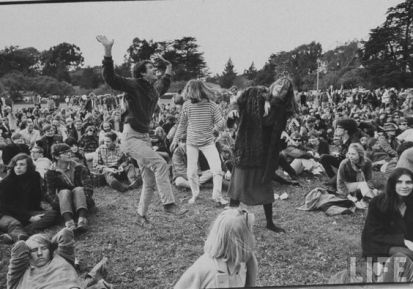
In the summer of 1967, an estimated 100,000 mostly young people made their way to the Haight-Ashbury section of San Francisco to celebrate the themes of the counterculture and “hippieism:” wild dress, bohemian behavior, music, drugs, communal love, peace, and harmony. A Free Clinic was established for free medical treatment, and a Free Store distributed basic necessities without cost. The scene witnessed heavy use of illegal drugs, especially LSD and marijuana.


Hippies in Golden Gate Park, San Francisco, 1967

(sugarhighandlovestoned.blogspot.com)

Bob Weir, the guitarist for the Grateful Dead stated:

“Haight-Ashbury was a ghetto of bohemians who wanted to do anything. … Yes, there was LSD. But Haight Ashbury was not about drugs. It was about exploration, finding new ways of expression, being aware of one’s existence.”

Spurring the Movement with their gyrating guitar riffs, searing voices, and words of revolution and promise were such groups as The Who, the Animals, Jefferson Airplane, the Grateful Dead, The Byrds, The Jimi Hendrix Experience, and Big Brother and the Holding Company with Janis Joplin.

The signature song of the summer was Scott McKenzie’s “San Francisco, Be Sure to Wear Flowers in Your Hair.” Written by John Phillips of The Mamas and the Papas, it hit the top-40 charts in June 1967, reached number 4 on the pop charts in the US and number 1 in the United Kingdom and much of Europe.

If you’re going to San Francisco Be sure to wear some flowers in your hair

If you’re going to San Francisco You’re gonna meet some gentle people there

For those who come to San Francisco Summertime will be a love-in there

In the streets of San Francisco Gentle people with flowers in their hair

All across the nation Such a strange vibration People in motion

There’s a whole generation

With a new explanation

People in motion People in motion

Of course, it was not the Summer of Love everywhere in America. In other cities like Detroit, Michigan, and Newark, New Jersey—15 minutes from my home town—there was rioting, looting, burning, and destruction. Over the entire year there were some 150 cases of civil unrest across the country.

In Detroit, five days of rioting in July left 43 dead, 7200 arrested, and about 2000 buildings destroyed. Fed by underlying anger from unfair treatment by the mostly white police force and from aging and overcrowded housing, the rioting began when the police raided an unlicensed bar in the black community.

Todd Gitlin, noted sociologist and writer, recently stated: If you were in the ghettoes of Newark, Detroit or scores of other cities that summer, you were not wearing flowers in your hair. Forget about utopia: You were staking out, in action, fury and bitterness, whether well- or ill-considered, a claim to citizenship in an America that seemed a million miles from justice and heading the wrong way.

The late summer of 1967 here in New England was an exciting time for sports fans as “The Impossible Dream Team” was headed to its first American League pennant in many years. Led by triple-crown winner and MVP Carl Yastrzemski, the Boston Red Sox went on to win the pennant, only to lose to the St. Louis Cardinals in the World Series.

In looking back on the period now, I am struck by the extreme contrast in experience I had compared to my peers in San Francisco. In the summer of 1967, I was a sophomore cadet at West Point, undergoing rigorous field training, dancing to Light My Fire (Doors), and wondering whether I would see combat in Vietnam, my commitment to my country growing every deeper and unambiguous.

A retired Army officer, Fred Zilian (www.zilianblog.com) is a writer, educator, and monthly columnist.


Posted in Uncategorized | Tagged , , , , , , | Leave a comment

July 10, 1777: Patriot Raid Captures British General Prescott

(This essay, abridged, was originally published as “An Enterprise Against the Enemy,” by the Newport Daily News on July 8, 2017.)

Two hundred forty years ago, a band of American soldiers, led by Lt. Col. William Barton, conducted a daring raid on Aquidneck Island during the British occupation. On the night of July 10-11, 1777, they succeeded in capturing Maj. Gen. Richard Prescott, the hated general who commanded the British-Hessian forces occupying the island since December, 1776.

It is hard for us today to appreciate that this beautiful, fair, and peaceful isle of ours was once the scene of war: occupying forces—some speaking a foreign language, canon, fortifications, muskets, battleships, coercion, censorship, abuse, neighbors and even families split in their political loyalties. But so it was during the British occupation of Newport and Aquidneck Island, December 1776 to October 1779.

The British had decided to seize and occupy the island and Narragansett Bay to obtain a beneficial base of operations for all New England. Also, Newport was known to contain many loyalists, Americans loyal to the British Crown. Sympathy for the Crown was especially strong among the large merchant class, who sought the restoration of good relations between the colonies and Great Britain so that commerce might once again flourish.

The British and their Hessian (German) allies came ashore on December 8, 1776, with about 7,000 soldiers and 1500 civilians. In the face of this overwhelming force, patriot forces retreated from the island. The landing was therefore unopposed. The occupation forces quickly deployed throughout the island. A British regiment landed at Newport and moved into the city. Prominent city officials escorted them to the Colony House and peacefully gave up authority.

By the spring 1777, the British had built fortifications at numerous locations throughout the island, such as in Newport, on Goat Island, and at Fogland Ferry in Portsmouth.

American forces on the mainland launched small raids, shelled British positions, and sniped at and harassed the occupation forces; however, no major offensive was conducted due to the lack of sufficient forces and resources.

The more the occupation forces fortified their positions, the more conditions deteriorated on the island. Seasoned by anti-Semitism in earlier eras in Europe and concerned about disruptions from the imminent warfare, the majority of Newport’s Jewish community fled. The Royal Navy had depressed much of the once thriving commerce in Newport harbor. This had a rippling effect on the economy. Work became hard to find. The candle factories, warehouses, and distilleries all went into decline. Craftsmen and manufacturers sought new lives in Providence, which was safely in patriot hands. The decline in the population was dramatic. Newport’s population plummeted from 9,200 in 1774 to about 4,000 in 1777.

On May 5, 1777, Maj. Gen. Prescott took command of all occupation forces in Rhode Island. At the time, they controlled about one-quarter of the colony and had about 4,300 British and Hessian troops on Aquidneck Island.

Prescott was an arrogant tyrant who treated any colonists of questionable loyalty with contempt, considering them traitors to the British Crown. He yelled at the colonist Thomas Walker: “traitor and a villain you scoundrel, to betray your country,” as he had Walker’s wrist irons tightened.

Prescott treated captured patriots with abuse. Burrington Anthony, a captain in the Portsmouth militia was arrested and placed in the Newport jail. Prescott verbally abused him saying “damn him” and that he “would be hung.” In another incident involving a patriot privateer, Prescott swore at him and struck him several times.

He was also infamous for his treatment of civilians who did not show him proper deference. In passing each other, he would accost and even strike men for not doffing their hats to him. Under his iron-fisted rule, civilians were sent to filthy jails. He also allowed the destruction of unoccupied houses in Newport.

As summer 1777 broke, Lt. Col William Barton, of the 1st Rhode Island State Regiment stationed in Tiverton, sought a way to retaliate for the British capture in December 1776, of Maj. Gen. Charles Lee, second in command of the Continental Army under George Washington. Barton later wrote: “”I used the greatest endeavors to get intelligence of some British officer of the same rank with Major General Lee whom I might surprise and thus effect an exchange of that great man.”

Lt. Col. William Barton

(Wikipedia.com)

Paul Coffin, a civilian who had escaped from Aquidneck Island, gave Barton the information he needed. Barton learned that while Prescott had his headquarters in Newport at the Bannister house, he spent nights at the home of Henry John Overing in Middletown. A few days later, a British deserter confirmed this. Overing, a loyalist, was a successful merchant, distiller, and sugar refiner, and had bought the house and 55-acre farm in 1771. In January 1777, he had taken the loyalty oath to the British Crown.

Barton was familiar with the area because he had been quartered there earlier. However, he needed more precise information for the raid to be successful. This he obtained from a runaway slave named Quako Honeyman and British deserters. Each morning a detachment of eleven soldiers marched to Overing’s house to relieve the detachment of the previous day.

In late June, Col. Joseph Stanton, Barton’s superior, approved his plan. After asking five of his regimental officers and procuring five whale boats, he went to his regiment for volunteers. “Brother soldiers, I am about to undertake an enterprise against the enemy. I wish to have about forty volunteers and those who dare to risk their lives with me on this occasion will advance two paces to the front.” The entire regiment stepped forward. He then hand-picked men to make a total raiding part of 48.

Given the British defensive network on the island and the posting of the ships in Narragansett Bay, Barton decided to launch the raid from Warwick Neck area, not Tiverton or Bristol. He finally shared the details with his men: “The enterprise will be attended with danger and it is probable some of us may pass the shades of death before it is accomplished …. I will not ask you to encounter any hazard but what I shall be exposed to equally with you. I pledge my honor that in every difficulty and danger I will take the lead.”

The raiding party departed Warwick Neck about 9:00 pm, July 10. They navigated to the island without being discovered by the British warships and patrol boats. Once on land they moved eastward along Redwood Creek about one mile to the Overing House, just east of the West Road, and approached and disarmed the single sentinel on duty.

They burst into the house from three different directions. Initially, they could not find Prescott. Some of the men called out for Prescott. Eventually Barton heard a voice from the second floor asking, “What is the matter?” Barton moved to the second floor and entered a bedroom to see a man sitting on the edge of his bed in nightclothes. Barton asked if he was Prescott. Prescott replied, “Yes. Sir.” Barton said, “You are my prisoner.” Prescott replied, “I acknowledge it, sir.” Also captured in the raid was his aide, Lt. William Barrington.

Prescott cooperated and said nothing throughout the return trip. Once the boats touched the shore at Warwick Neck at 3:30 am, Prescott said to Barton, “Sir, you have made a damn’d bold push tonight.” Barton replied, “We have been fortunate.”

George Washington received the news of the capture on July 16. He wrote to Col. Spencer: “The conduct of Colonel Barton … [and his raiding party] cannot be too highly applauded. This is among the finest partisan exploits that has taken place in the course of the war on either side.”

Finally in April 1778, after many months of negotiation, Maj. Gen. Prescott was exchanged for American Maj. Gen. Charles Lee. Historian Christian McBurney in his book, Kidnapping the Enemy, states that the raid was “the most spectacular and successful special operation of the war.”

The Overing House is now owned by the Newport Restoration Foundation and is the residence of Admiral (ret.) James Hogg and Anne Hogg. While the house is not open to the public, the public is welcomed to visit the nearby grounds “Prescott Farm,” on West Main Road, Middletown.

Follow me on Twitter: @FredZilian

A retired Army officer, Fred Zilian is a writer, educator, and monthly columnist for the Newport Daily News.

Sources:

McBurney, Christian M. Kidnapping the Enemy: The Special Operations to Capture Generals Charles Lee & Richard Prescott. Yardley, PA: Westholme, 2014.

__________. The Rhode Island Campaign: The First French and American Operation in the Revolutionary War. Yardley, PA: Westholme, 2011.

Stensrud, Rockwell. Newport: A Lively Experiment, 1639-1969. London: D Giles Limited, 2015.

Posted in Uncategorized | Tagged , , , , , , , , , | 4 Comments

America the Unexceptional

(This essay was originally published as “American Exceptionalism seems to be in retreat,” by the Newport Daily News on June 10, 2017.)

With his recent statement of intent to withdraw the United States from the Paris Accord on climate change, separating us exceptionally from the other 195 states which signed it, President Trump has promoted the project, started in the campaign season, of turning America from an exceptional nation, leading the free world, to an ordinary, unexceptional country, single-mindedly chasing its own, narrowly defined interests.

I cannot remember exactly when I began to think of my country as exceptional. Perhaps it was listening to the World War II stories told by my many aunts and uncles or watching the many TV shows on that war like “Victory at Sea” and “Combat.” Perhaps it was listening to Dion belt out my exact emotions with “Why Must I Be a Teenager in Love.” Perhaps it was experiencing that mystical age of the Kennedy Camelot. Certainly by the time I graduated West Point, all paid for by the American taxpayer, I was fully grateful to the American system which I considered exceptional.

The idea of American Exceptionalism—that America has a special place and role in the world—has its roots deep in the history of Western civilization. Our founding fathers carefully studied ancient democratic Athens and ancient republican Rome as models. The great Athenian statesman, Pericles, said that his city-state’s “distinguishing excellence” was that “in the hour of action we show the greatest courage.” He held high Athens as “the school of Greece.” Though not always succeeding, America—no matter who the president–has sought since World War II to be the “school of the free world.”

Early Christianity provided one of its founding metaphors, drawn from Matthew, Chapter 5, Verse 14: “Ye are the light of the world. A city that is set on a hill cannot be hid.” The early colonial leader John Winthrop of the Massachusetts Bay Colony, as well as President Ronald Reagan, both spoke of America as a “city upon a hill.”

In 1783 George Washington emphasized the unique character and role of our new nation in saying “the Citizens of America …are to be considered as Actors on a most conspicuous Theatre, which seems to be peculiarly designated by Providence for the display of human greatness and felicity.” Thomas Jefferson stated in his letter of 1811 to William Duane: “The last hope of human liberty in this world rests with us.”

Part of Abraham Lincoln’s objection to slavery was anchored in his belief that America was to be a model for all. The warehouse of the largest slave traders in the country, a mere seven blocks from the Capitol, was a terrible embarrassment, he argued. “We were proclaiming ourselves political hypocrites before the world by thus fostering Human Slavery and proclaiming ourselves, at the same time, the sole friends of Human Freedom.”

The idea of American Exceptionalism has never been partisan. The US invasion of Iraq in 2003 was part of President George Bush’s “forward strategy of freedom in the Middle East,” a valiant if misguided attempt to push the bounds of democracy beyond its earlier victories in eastern Europe in the 1980s. President Barack Obama mentioned the concept in his farewell speech in January: “So that’s what we mean when we say America is exceptional—not that our nation has been flawless from the start, but that we have shown the capacity to change and make life better for those who follow.”

At times President Trump has shown his ability to merit the mantle of the American presidency: his plans for mending our infrastructure, his concern for those thrown into unemployment by the faceless forces of globalization, his nudging of allies to carry their fair share of the burden. However, by his proposed ban of Muslim immigrants from selected countries, he has erased the words of Emma Lazarus from the Statute of Liberty. With his erratic tweeting, he has shown disregard for the necessary machinery of democracy and has promoted a democracy of chaos and distraction. By slashing the budget of the Department of State and increasing that of the Department of Defense, and by his Secretary of State Rex Tillerson—in a public speech—placing interests over universal rights, Trump has magnified the idea of might makes right at the expense of the idea of might for right. By his labeling of the media as the “enemy of the people,” he has taken a page—however unwittingly—out of the totalitarian handbook of the 20th century. By not revealing his income tax returns, he has shown contempt for a vigilant, free-thinking citizenry. And by his coarse words and actions, he has promoted the vulgarization of American society.

The torch of freedom is leaving America. Perhaps it is going north to Canada, as The Economist has suggested; perhaps to Japan or Germany, as G. John Ikenberry in Foreign Affairs has suggested.

Thomas Jefferson’s concern of 1811 is apt today: “The eyes of the virtuous, all over the earth, are turned with anxiety on us, as the only depositories of the sacred fire of liberty, and that our falling into anarchy would decide forever the destinies of mankind, and seal the political heresy that man is incapable of self-government.”

The exceptional irony is that this is happening under a president so focused on American greatness.

Follow me on Twitter: @FredZilian

Fred Zilian (zilianblog.com) is a writer, educator, and monthly columnist for the Newport Daily News, RI.


Posted in Uncategorized | Tagged , , , | Leave a comment

Memorial Day: A Time to Honor and Remember

Healthy civilizations remember and honor those who have died serving them. These memorial occasions are also opportune times to reflect on the civilization’s creed—its fundamental values and beliefs.
Almost 2450 years ago, Pericles, the great statesman of ancient Athens, did just this in one of the most famous speeches of Western Civilization. At the end of the first year of the Peloponnesian War (430 BCE), he was called upon to give a funeral oration to honor the fallen. Instead of giving mere praise and consolation, he spoke to the idea of Athens. “Our city is called a democracy because it is governed by the many, not the few. In the realm of private disputes everyone is equal before the law ….” “We alone regard the man who takes no part in politics not as someone who minds his own business but as useless.”

Pericles Funeral Oration, Artist: Philipp Foltz
(wikipedia.org)

Things hadn’t changed all that much in the annual Memorial Day parade in my hometown of Hasbrouck Heights, New Jersey, where I found myself a few years ago. The last one I had attended was the last one I took part in—maybe 1960—as a cub scout in Troop 49.
The parade lineup looked about the same. In the first section were the high school band, mayor and council, board of education, policemen and ladies auxiliary, American Legion, VFW, disabled veterans, and firemen. The second section followed with the service organizations, such as the Elks, Knights of Columbus, and Women’s Club. The third section included the boy scouts and cub scouts, the girl scouts and brownies. Bringing up the rear was that beautiful, big red fire engine.

There were no significant changes in the setting either. Memorial Park, on whose corner I had dutifully posted myself many times as a member of the sixth-grade safety patrol, appeared the same. The memorial itself was unchanged: a large, four-sided piece of grayish-white rock, with metal plates on each side, stationed in the middle of a sea of white pebbles. The plates bore lists of names, names, and more names.

The town’s citizens were out in force as they were in the late 1950s- early 1960s, the heady days of the Cold War. Despite the Soviet launching of Sputnik in 1957, I knew we were still the greatest superpower. From my boyish perspective, we had to be. Despite the loss of Buddy Holly in 1959, rock ‘n roll was going strong with Elvis, Fats Domino, Frankie Avalon, and the Shirelles. As a budding baseball player and avid fan, who collected baseball cards of those perennially strong New York Yankees, I reasoned that the “World Series” was always held in the U. S., never in the Soviet Union.

The ceremony itself seemed to be an echo of those generations ago. I recognized a good number of the town officials and veterans though their faces were now etched with wrinkles and their hair was now hoary, or gone. The schedule of events still consisted of that uniquely American blend of God, country, and commemoration: the opening prayer, the national anthem, and the mayor’s remarks.

Finally, the roll call. As a boy, I never understood why one man recited names and the other monotonously answered with “Absent.” Eventually I came to understand this solemn moment in honoring each of the town’s fallen by name. Democracies make it a practice to place value on the lives of each and every individual, no matter what make-up. One can certainly realize this in visiting the Vietnam Veterans Memorial in Washington, DC, or the 9/11 Memorial in New York City.

The dreary, solemn notes of “Taps” were always followed by the most exciting part of the entire ceremony—the rifle salute. Three volleys. My friends and I would scramble for the shells as they were ejected from the rifle chambers. Finally, came the placing of the wreaths and poppies, and the closing remarks.

Since this took place in the late 1980s, the last three men on the roll call were townsmen who died in the Vietnam War. The last man called was Mike Mackerel. He was one of those, as President Ronald Reagan called them, “boys of Vietnam who fought a terrible and vicious war without enough support from home.” A year or two older than I, I didn’t really know him that well, but I can remember him—thin and scrappy—playing second base for the Kiwanis Club little league team, while I played for the Elks. As I turned to walk home, I spied through the dispersing crowd my high school classmate, Marty. He had served in Vietnam while I had served in West Germany.

In the memorial services around Newport County this weekend, we shall remember and honor our fallen. We should also recognize and appreciate those fighting for us today in many far-off places. Finally, it is an appropriate occasion to remind ourselves of some of the key words of our common creed, such as: country, democracy, service, courage, and sacrifice.

A retired Army officer, Fred Zilian (zilianblog.com) is a writer, educator, and monthly columnist.


Posted in Uncategorized | Tagged , , , , , , | Leave a comment

Is America Going the Way of Norse Greenland?

(This essay was originally published on April 30, 2017, on the History News Network [online] http://historynewsnetwork.org/article/165689)

Civilizations which make bad decisions about the environment they occupy, cannot sustain themselves over the long run. By appointing Scott Pruitt, a known environmental skeptic, as director of the Environmental Protection Agency, and by signing on March 28, the executive order beginning the rollback of the Obama-era initiatives, President Trump has placed the US on such a path.

The Vikings were a warrior, sea-faring people from Scandinavia who in the late 8th century began to project their power first to the British Isles and over the next centuries from as far west as Canada to as far east as western Russia. Their initial raids consisted of only several ships; however, eventually armadas of 30 or more ships plundered the coastal and river towns of western Europe. More than simply violent raiders, they were also very courageous explorers and extensive traders, even if they generally were heavily armed. Ahmad Idn Fadlan, a 10th century Arab soldier and diplomat of Baghdad stated, “Every one of them carries an ax, a sword, and a dagger.”

In 984 a group of these Norse Vikings ventured to Greenland and established two major settlements. In his book, Collapse, Jared Diamond explains how these families from Norway eventually built churches, used iron tools, and herded farm animals. Life on Greenland was harsh, but, as they demonstrated for nearly 500 years, still sustainable. Thereafter, they vanished.

Initially, however, they prospered. They had discovered a virgin landscape suitable for livestock and had the luck of a relatively mild climatic era. They were able to grow adequate hay for their livestock. The sea lanes back to Europe were ice free, facilitating trade for needed goods. Their European kin sought the walrus ivory they were able to supply. There were no quarrelsome natives.

Greenland and Ice Caps

(water.usgs.gov)

However, as time wore on, the favorable conditions changed. The climate became colder, shortening the growing season. The European demand for their ivory declined. Lastly, native Inuit people appeared. These factors were beyond their control; however, they did have control over how they responded to these challenges.

Regarding the Inuit, the Norse chose to view them as inferior people who had little to teach them, calling them “Skraelings” (wretches). The Christian Norse therefore chose to reject their technologies and strategies: their streamline kayaks to harpoon seals; their large boats (umiaqs) and their specialized harpoons to kill whales. They did not learn the special techniques the Inuit used to hunt ringed seals, the most abundant seal in the coastal waters. There is also little evidence of inter-marriage or trade between the Norse and the Inuit. Clearly, the Norse kept them at a distance and chose conflict over cooperation.

Regarding the environment, the Norse made decisions which gave them short term benefits, but which in the long term were unsustainable. By cutting the trees and over-grazing with their livestock, they destroyed the natural vegetation. For fuel and also for the construction of their buildings, they cut and stripped the turf. All these activities caused harmful soil erosion, leading eventually to shortages of lumber, iron, fuel, and arable land.

American civilization, the world’s second largest carbon polluter after China, now has the Trump administration leading it, one that seems intent on fulfilling President Trump’s campaign pledges to place economic growth above a sustainable environment. Appointing Scott Pruitt as EPA director in February was akin to letting the fox into the henhouse. On March 28, Trump signed an executive order beginning the rollback of the Obama-era environmental initiatives and attempting a futile revival of the coal industry. This order directed the EPA to begin the process of rewriting Obama’s Clean Power Plan of closing numerous coal-burning plants and constructing new wind and solar farms. With these actions the United States has now officially become an “environmental skeptic.”

If the world had arrested the markers of harmful climate change, perhaps the situation would not be so ominous. However, this is not the case. As reported by the National Geographic Society, the global surface temperature average in 2016 set another record. It was higher than 2015 which was higher than 2014. Last year’s average was 1.69 degrees Fahrenheit warmer than the 20th century average. The Artic has warmed significantly and its ice cover continues to thin and to shrink. The world’s two largest ice sheets, in Greenland and Antarctica, continue to decline. Since 2002 the Greenland ice sheet has lost an average of 287 billion metric tons of ice each year. Over the past four decades, climate-related disasters have risen. Finally, last year the Great Barrier Reef off Australia experienced its largest recorded coral die-off.

Diamond ends his analysis of the demise of Norse Greenland by focusing on its leaders: the chiefs and clergy. These were the primary decision-makers who owned most of the land and most of the boats, as well as controlling most of the trade with Europe. They chose to devote much of the trade to importing luxury goods to enhance their lives and prestige. They might have made wiser decisions for the settlement’s longer term interests, for example, to import more iron and fewer luxury goods, and to copy the successful technology and techniques of the native Inuit. However, they had the power and privilege to decide otherwise. Diamond concludes: “The last right that they obtained for themselves was the privilege of being the last to starve.”

We should not dismiss the example of the Norse Greenland as irrelevant to our civilization, though it consisted only of several thousand people. The lessons in decision-making of this remote European outpost of the Middle Ages warn us to avoid clinging to formerly beneficial values and ways when time and circumstances have made these harmful in the long run.

Fred Zilian (zilianblog.com) teaches history and environmental politics at Salve Regina University, RI.

Posted in Uncategorized | 3 Comments

The US Enters World War I

(This essay was originally published as “April 6, 1917: The US Goes ‘Over There'”, in the Newport Daily News on April 6, 2017.)

One hundred years ago today, the United States declared war on Germany, joining the war almost three years after its inception.

The war had begun in August 1914, when Austria-Hungary, following the assassination of its heir to the throne, Archduke Franz Ferdinand, declared war on Serbia. Within two weeks the two major alliance systems of Europe were at war. The Triple Alliance consisting of Germany and Austria-Hungary (without Italy) was arrayed against the Triple Entente, consisting of Great Britain, France, and Russia. The former had been joined by the Ottoman Empire and were called the “Central Powers.” The latter, eventually joined by Italy, were called the “Allies.” Many other lesser states, such as Japan, had joined the war, making it a truly global conflict.

From the beginning, the United States, under the leadership of President Woodrow Wilson, was committed to a policy of neutrality. The son of a Protestant minister, Wilson was driven by such high ideals as justice, democracy, and freedom of the seas and favored diplomacy and cooperation over war. He attempted to use the war to change the norms of international relations. Old-style power politics and selfish nationalism would give way to diplomacy and collective security. Good will would triumph over animosity and ill-will.

While personally inclined toward Great Britain, he proclaimed: Americans must remain “impartial in thought as well as action.” Attempting to protect the US’s lucrative commercial ties with the warring states, Wilson demanded that all warring states respect the rights of neutrals.

Within the US, public opinion was mixed. German-Americans were either neutral or, with Irish-Americans, supporters of the Central Powers. The financial and commercial sectors favored the Allies. Trade with them between 1914 and 1916 had blossomed from $800 million to $3 billion. Groups like the suffragettes and the prohibitionists were preoccupied with their own domestic agendas.

In early 1915, Germany, under blockade by the powerful British Navy, turned to a powerful new weapon in its arsenal, the Unterseeboot (submarine). On February 4, 1915, Germany declared the seas around the British Isles a war zone. Allied ships in the area would be sunk without warning.

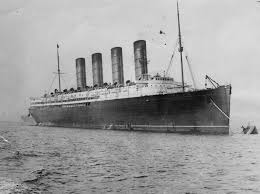
On May 7, 1915, the British passenger liner Lusitania was sunk by German submarine U-20 off the coast of Ireland, killing 1198, including 128 Americans. Survivors totaled 764. The sub’s commander, Kapitanleutnant Walther Schwieger would tell his friend: “The ship was sinking with unbelievable rapidity. There was a terrific panic on her deck. … It was the most terrible sight I have ever seen.”

Lusitania (pbs.org)

Upon learning of the event, Wilson controlled his emotions. He kept to his normal routines, playing golf the next day (Saturday), taking a drive, and going to church on Sunday morning. He told his secretary, Joe Tumulty that he realized his calm response would irritate some people. However, “I dare not act unjustly and cannot indulge my own passionate feelings.” Under pressure from the United States, Germany in September 1915, promised not to attack passenger ships and to allow evacuation of neutral merchant ships.

Two key factors led the US to enter the war: first, the decision by Germany to resume unrestricted submarine warfare and second, the Zimmermann telegram.

In early 1917, Germany decided to make submarine warfare the heart of its naval strategy. German Admiral Henning von Holtzendorf proposed allowing submarine commanders to sink all vessels entering the “war zone” around its enemies. This, he maintained, would end the war in six months. The probable US entry into the war was irrelevant. He boasted: “I guarantee upon my word as a naval officer that no American will set foot on the Continent!”

While the US broke diplomatic relations with Germany on February 3, Wilson stopped short of demanding a declaration of war. Disbelieving the new Germany policy, he said: “Only actual overt acts on their part can make me believe it even now.”

The final event which brought the US to war was a telegram from the German foreign minister, Arthur Zimmermann, to the German ambassador in Mexico. Decoded by British intelligence, it instructed the ambassador to propose to the Mexican president an alliance between Germany and Mexico, to take effect if the US entered the war against Germany. It stated that, in return for Mexico’s support, Germany would help Mexico seize its “lost territory” in Texas, New Mexico, and Arizona. On February 24, 1917, Great Britain presented the fully translated telegram to the US.

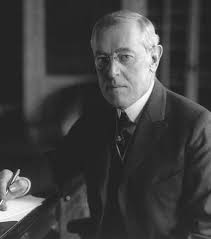
Woodrow Wilson (WW1centennial.org)

After several US ships were sunk in the succeeding weeks, President Wilson addressed the Congress on April 2. Using high, moral language, he said, “The world must be made safe for democracy.” He warned of “many months of fiery trial and sacrifice ahead” and proclaimed that this war was on behalf of all nations. “To such a task we dedicate our lives and our fortunes.”

Congress responded with rousing emotion and applause, and on April 6, passed a joint resolution declaring war on Germany.

A retired Army officer, Fred Zilian (zilianblog.com) is a writer, educator, and monthly columnist.

Posted in Uncategorized | Tagged , , , , , , , , , , , | 8 Comments

West Point at 215, Graduates Defend and Serve the Nation

(This essay was originally published as “West Point Going Strong at 215,” in the Newport Daily News on March 16, 2017.”)

As the U.S. Military Academy at West Point celebrates its 215th anniversary, the ever-uncertain international security environment and the civic needs of our liberal democracy ensure a perpetual role for this reliable, enduring, educational institution.

Congress established the Military Academy on March 16, 1802, originally as a school to supply engineers for the country. Washington’s Continental Army had relied too heavily on foreign-trained engineers such as Thaddeus Kosciuszko of Poland and Baron von Steuben of Prussia. The school, located on a point where the Hudson River turns west, served as the country’s sole engineering school until 1830.

Since its establishment West Point has had many distinguished graduates and has supplied the country with much of its military leadership. A favorite expression at the Academy is that “much of the history we teach was made by people we taught.” During the Civil War West Pointers like Robert E. Lee and Ulysses S. Grant commanded both sides in 54 of the 60 major battles and commanded one side in the other six. The class of 1915, “the class the stars fell on,” produced 59 generals from a class of only 164. Both history and Hollywood have immortalized such graduates as Dwight Eisenhower, Douglas MacArthur, Omar Bradley, and George Patton.

Less than ten months after their graduation, some 140 graduates of the class of 1990, serving under Gen. Norman Schwarzkopf (Class of 1956), helped to secure our victory in the Persian Gulf War (1990-91). Lt. Gen. Fred Franks (Class of 1959), as the VII Corps commander, led the decisive flanking movement against the Iraqi Army in that war. As a major in the late 1960s. Franks taught me plebe English and was my assistant baseball coach sophomore year. During  the Iraq War, 2003-2011, fifty-nine graduates gave their lives.

From the ranks of West Point have come thirteen astronauts and 90 Rhodes scholars, fourth in the latter category among all schools. Mike Pompeo, Class of 1986, is the new CIA chief, and Lt. Gen H. R. McMaster, Class of 1984, is the president’s new national security advisor.

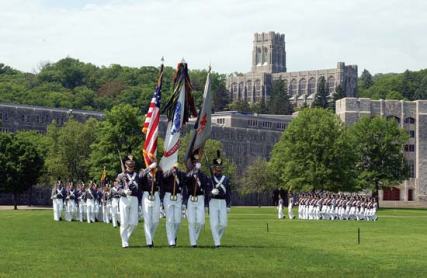
The Military Academy’s mission is to educate, train and inspire its cadets so that each graduate is a commissioned leader of character committed to the values of Duty, Honor, Country and professional growth throughout a career as an officer in the U. S. Army; and a lifetime of selfless service to the nation. It does this by developing cadets in four main areas: intellectual, physical, military, and moral-ethical. The Corps of Cadets is composed of approximately 4,300 of America’s finest young people. Last year’s graduating class consisted of 16% women and 26% minority. From its first class of two cadets, the Academy now graduates approximately 950 cadets each year, providing the active Army with about 20% of its needs for lieutenants. A West Pointer must serve at least five years of active duty and three years in a Reserve Component, reasonable repayment for an education that is estimated to cost the American taxpayer $225,000. per cadet.

Cadets on Parade (US Army photo)

When threats to our security have appeared remote, critics have argued to collapse West Point and its sister academies into one or even to eliminate them: the cost too high; the payoff too low. Such dramatic steps would risk much. West Point has provided the country with leaders of character for 215 years, not only to fight its wars but also to serve the nation selflessly after they leave military service, often in self-directed and quiet ways.

It is said that West Point is the “conscience of the Army.” Its graduates in the civic community also serve as part of the conscience of the nation, fortifying it with the critical values of honor, integrity, and service which the Academy has engrained in them. Its graduates believe in the rich heritage of Athenian democracy, which promoted such a tremendous flourishing of freedom and creativity in that ancient city-state, as we enjoy in America. However, they also recognize the necessity of the Spartan warrior values of vigilance, discipline, honor, and courage to maintain them. In broad, bold letters on the side of an Academy building stand steadfastly the cautionary words of Gen. Dwight D. Eisenhower: “The hand of the aggressor is stayed by strength and strength alone.”

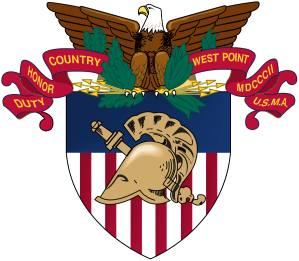
USMA Coat of Arms

West Point serves then as a source of those citizens of character who Plato argued were so essential for a republic. And its core values of DUTY, HONOR, COUNTRY are imperative for a liberal democracy to continue to flourish in this uncertain and increasingly authoritarian world.

Follow me on Twitter: @FredZilian

A retired Army officer, Fred Zilian (zilianblog.com) is a West Point graduate, Class of 1970. He teaches history and politics at Salve Regina University and is writing a novel on Civil War Gen. Ambrose Burnside, Class of 1847.


Posted in Uncategorized | Tagged , , , , , , , , , , | Leave a comment