
With the ending of the French and Indian War in 1763, Great Britain felt fully justified in taxing the American colonies to relieve its debt from the war and in restricting settler movement westward to avoid friction with Native Americans. The war nearly doubled the national debt from a prewar £74 million to a postwar £133 million ($43.6 trillion today).
American colonists resisted, holding that only their colonial assemblies could tax them and that no restrictions should be placed upon their migrations westward. To restrict them was to deny them their inherent rights as loyal British subjects who had done their fair share in the war.
In December 1773, in response to the British tax on tea, scores of colonists in Boston, thinly disguised as Native Americans, forcibly boarded three British East India Company ships and dumped in protest 342 chests of tea into the harbor, some 92,000 pounds. After this, Boston and the colony of Massachusetts became the spearhead of American resistance. Parliament closed the port of Boston, with disastrous effects on the colony’s economy and society. Rather than cave in, colonial leaders like John Hancock and Samuel Adams, organized and resisted, receiving surprising support from the other colonies.
Relations between the Crown and the American colonies continued to deteriorate throughout 1774 and into 1775. In the fall 1774, the First Continental Congress rejected just about every piece of legislation Parliament had passed since 1763. In his speech opening the new Parliament in November 1774, King George III remained steadfast, stating: “You may depend upon my firm and steadfast resolution to withstand every attempt to weaken or impair the supreme authority of this legislature over all the dominions of my crown.”
Undermanned but pressured to take action, General Thomas Gage, commander of the British North American forces, fortified Boston and began to seize munitions in the area. He decided to arrest the two key leaders, Hancock and Adams, in Lexington and to seize munitions in Concord.
On the night of April 18-19, 1775, resistance leader Dr. Joseph Warren gave instructions to Paul Revere to ride from across the Charles River to those two towns to spread the warning. His friends sent the signal to Charles Town, two lamps in the steeple of Old North Church, and other friends rowed him across the river to begin his fateful journey.
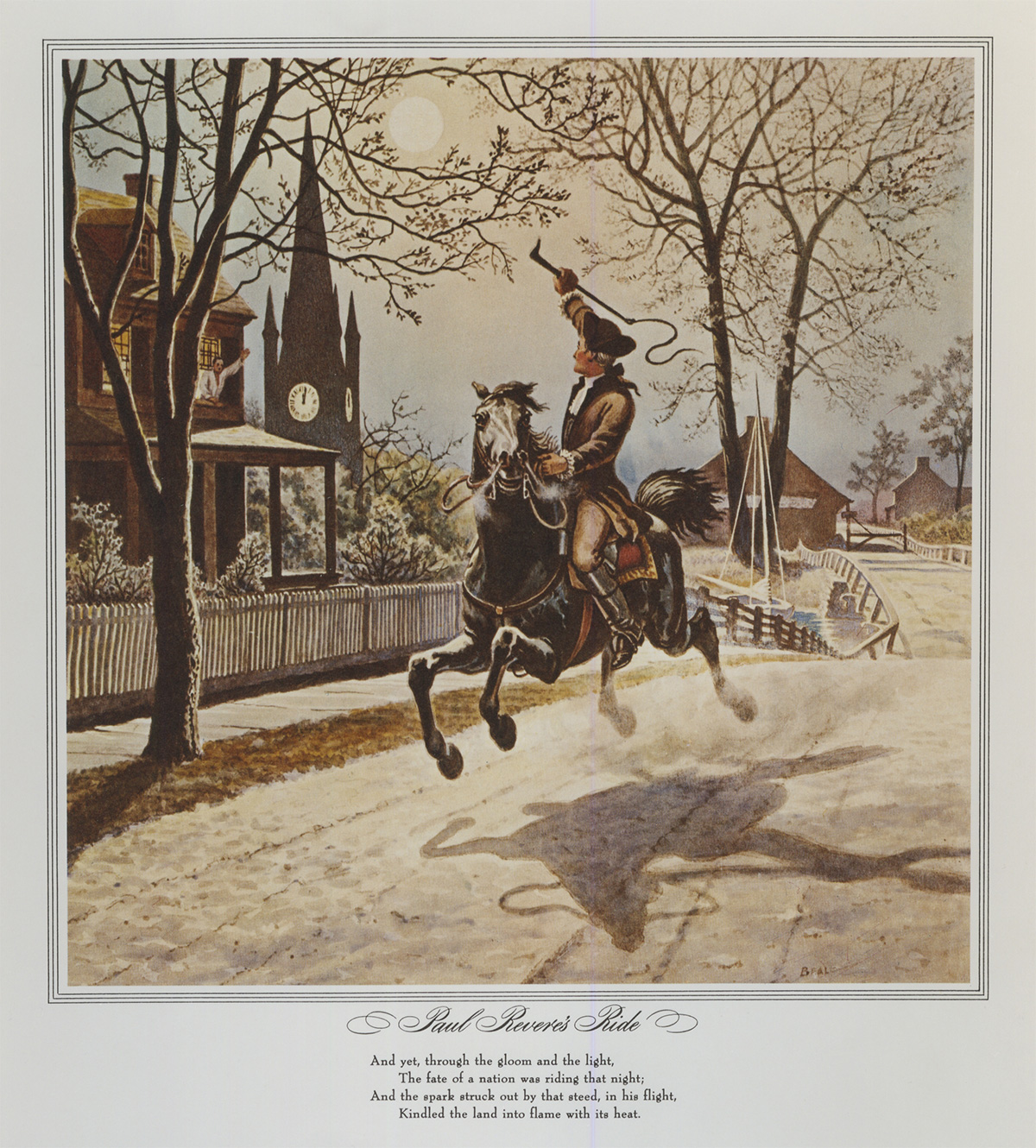
In his poem written 85 years after the event, Longfellow gave several historical inaccuracies. The poem implies that Revere was the only rider. This is not true; there were three initial riders, Revere, William Dawes, and Samuel Prescott, and many others who followed and eventually helped sound the alarm. Second, the poem states that Revere was on the opposite shore waiting for the lantern signal. Revere was still in Boston when the signal was given to alert friends in Charles Town of the British route and of Revere’s imminent arrival. Third, three friends helped to give the signal, not just the one who climbed into the steeple that night, Robert Newman, John Pulling, and Thomas Barnard. Fourth, Revere never reached Concord as the poem states. It was Dr. Samuel Prescott who reached it and spread the alarm there. Finally, Revere’s ride was not smooth and easy. Revere was seized by a British patrol and had some close moments before being released.
In writing the poem in 1860, Longfellow was influenced by the turmoil and division of America at the time. North-South sectional strife by then had reached a fever pitch and in December of that year after the election of Abraham Lincoln, South Carolina became the first state to secede from the Union. Clearly, Longfellow was seeking to offer a unifying story and hero to a country divided.
A retired Army officer and educator, Fred Zilian offers lectures on the American Revolution.


 Zilian Commentary