
(Published in the Newport Daily News on March 14, 2011, as “Democracy is West’s Gift Back to the Arabs”)
As the Arabs for centuries kept alive and eventually passed back to the West the learning of the ancient Greeks, the West has now offered the Arabs the ancient Greek ideals of freedom and democracy, galvanizing and actuating them to overthrow their tyrants.
In the Western tradition, it was the ancient Greeks—especially the Athenians—who raised the ideal of freedom with all its risks to a highest principle. Tired of tyranny, the Athenian people in 508 BCE arose to throw off the yoke of oppression. Under the leadership of Cleisthenes and eventually Pericles, the Athenians established the world’s first democracy.
After the Western Roman Empire declined and fell in the 5th century CE, remarkably and tragically most of the learning of the ancient Greeks was lost to the West. After Muhammad’s death in 632, Arabs–impassioned by Allah’s revelations to Muhammad—launched an expansion which eventually brought them into contact with the wisdom of the ancient Greeks. It was the Arabs—coming across the great works of Ptolemy, Plato, Galen, Hippocrates, Euclid, Archimedes, and especially Aristotle—who kept the lamp of Greek learning alive in those centuries of Western history we have come to consider as dark with brutality, superstition, and intellectual stagnation.
How fitting then that the West has repaid the favor by providing the Arab world with its example of freedom and democracy. Educated and enabled by the gadgets of the technological revolution of the last two decades, the younger Arab generations have been sparked by the self-immolation of one of their own—26-year-old Tunisian Mohamed Bouazizi, denied the freedom to sell fruits and vegetables. Even as US forces invaded Iraq in 2003 carrying the ideal of freedom in their rucksacks, most of us knew if the “Arab Street” was going to rise up and reject the tyranny of Ben Ali in Tunisia, Mubarak in Egypt, and now Qaddafi in Libya, it would have to be self-initiated and not imposed from without by Western forces wielding guns and missiles.
In recent years the question, much-debated in high academic and policy circles, has been whether Islam and democracy are compatible. Some have argued no; others like Daniel Pipes of the Middle East Institute have argued it is not Islam that is incompatible with democracy. Rather it is Islamism or political-militant Islam a la al-Qaeda or the Taliban. “…the Islamist movement which today dominates Muslim intellectual life pulls in precisely the opposite direction from democracy.”
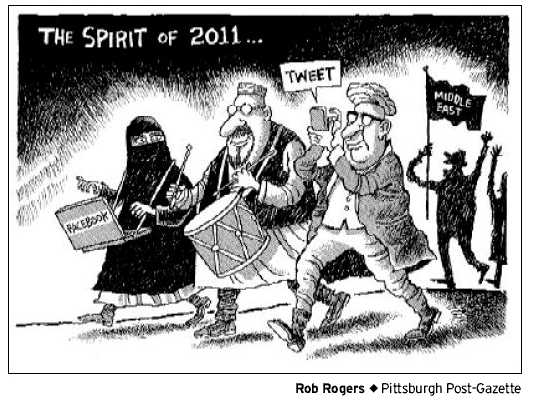
What will emerge in the Arab world in the next decade will be an Arab synthesis of Western democracy and Arab-Islam. With Arab-Islam’s different views of the place of women, the relationship of mosque and state, and the authority of the tribal leader, this democratizing process will be much more of a challenge than the people of Eastern Europe faced after they toppled their Communist regimes in the revolutions of late 1980s and early 90s. The East Germans, for example, were simply incorporated in October 1990 into the existing democracy of the Western Germans.
Arab tradition and culture is much more rooted in the subordination of women, the integration of religion into the life of the state, and deference and docility to the tribal leader. Therefore, the process now begun in the Arab world will be much bloodier, volatile, fitful, and extended. Plato, one of the ancient Greeks that the Arabs helped to keep alive, suggested democracy’s messiness: “Democracy is a charming form of government, full of variety and disorder, and dispensing a sort of equality to equals and unequal alike.” Happily for Western political leaders, they should confront less than they have in the past the dilemma of dealing with ossified autocrats who deny the very rights and freedoms which allowed these leaders to assume power in their own countries.
The ancient Athenians were willing to take the risks which freedom posed. In so taking, they eventually created the political system of direct democracy in which the Athenian citizens actually took turns in running the government of Athens. Three or four times each month all adult, male Athenians assembled to debate and vote on issues as simple as the price of olives and as momentous as a declaration of war. The Arabs (and perhaps the Persians of Iran), who have risen up against their tyrants as the ancient Athenians did, have decided to risk it.
The future complexion of these new regimes is not clear. What is clear is that the long era of acquiescence to the Arab tyrant is over.


 Zilian Commentary
Letter from Abe Lincoln to President Obama, April 12, 2011
( This essay was published in the Newport Daily News, April 16, 2011, as “What Would Lincoln Think of U.S. Today?”)
With the 150th anniversary of the bombardment of Ft. Sumter, on April 12, 1861, launching the Civil War, what might Abe Lincoln say today to our current president?
Dear Mr. President,
Though your allegiance is to the other political party, I cast aside partisanship on such a momentous anniversary. First, let me render my highest praise and heartiest congratulations to you on your election to the highest political office in the land. For a man of your parentage to achieve such a station glorifies both you as well as the constitution and character of our country. With my Emancipation Proclamation of 1863, I am happy to have played a small part in launching the ship of freedom for the Negro race.
Second, I am elated that our beloved country, this great experiment in self-government, continues to thrive 235 years after its birth. My faith in the common people is vindicated. I have always believed that if they retain their virtue and vigilance, no administration, however weak or corrupt, can do too much damage to our government in the space of four years.
I must say that I am not surprised that the United States can claim today to be the leader of the free world. I could anticipate this; in my era I could see the vast potential of our country to expand economically, industrially, and geographically to the shores of the Pacific.
On the other hand, I am surprised by the extent to which the many minorities of our Union have achieved such a notable level of social justice, by the complexities of the international system today, and by the astounding advances in technology which seem to be transforming the lives of Americans so profoundly.
May I offer some humble advice? I must first register my serious concern at the size and role of government, both federal and state, and how it has assumed so many roles in our society, roles in my era filled by other institutions such as family and church, or simply left to individual initiative and responsibility. This to me is the most striking and potentially harmful feature of government in this present era. I have always firmly believed it is the role of government to set the conditions for men to lift themselves. As I said in my July 4, 1861, message to Congress: The war on the Union side was “a struggle for maintaining in the world, that form, and substance of government, whose leading object is to elevate the condition of men …to afford all an unfettered start, and a fair chance, in the race of life.” I fear that these well-intentioned, social welfare programs of today breed too much dependence and dampen individual responsibility and initiative, rather than magnifying them.
Looking beyond our shores, I am heavy with doubt about the multiple military conflicts in which our republic is engaged. In the shadow it casts upon the international stage, let the United States be more the exemplar rather than the crusader. Avoid a malady of ancient Rome, which succumbed to the tendency of seeing threats everywhere. As its borders expanded, it saw malicious threats multiply.
Finally, look first to secure and strengthen the Union. While our country continues to be blessed with many natural, financial, and human resources, these resources must be husbanded. They are not limitless. In waging now more than two wars with the current budgetary problems not only at the federal but state and local levels, we may be driving the country to the breaking point. Let every segment of American society shoulder a share of the burden in solving our fiscal problems. As we claim today to teach others abroad how to be citizens of a state, let us renew our own efforts at home to bind together a house too divided.
Remember the Aesop’s fable about the father who could not keep his sons from quarreling. He gave a bundle of sticks to each son and told each to break it. None could. Then he untied the bundle and gave a stick to each son. Each son broke the single stick easily. While we are unified, no enemy can do us mortal harm.
I am reminded of my words early in my political career: “If destruction be our lot, we must ourselves be its author and finisher. As a nation of freemen we must live through all time, or die by suicide.”
Yours, very sincerely,
A. Lincoln
Fred Zilian is an admirer and impersonator of Abe Lincoln. He is also an educator at Portsmouth Abbey School, Portsmouth, RI.