
(This is the first in a series of essays celebrating the 250th of the American Revolution.)
By early March, 250 years ago, American grievances had grown, and British determination to rule the American colonies had stiffened.
The march of the American colonies toward a Declaration of Independence had begun years before in 1763, when there existed not a trace of desire to break from the mother country. Following Great Britain’s victory in the French and Indian War (1754-1763), American colonists were flush with pride in being loyal British subjects.
And then the problems began. Now a true imperial power with colonies scattered throughout the globe, Great Britain began its attempts to impose restrictions on the westward movement of American colonists (Proclamation of 1763) and to impose taxes on the colonists to pay for the victory. Because of the war, Great Britain’s national debt had nearly doubled from prewar £74 million to postwar 133 mill ($43.6 trillion today).
Between 1764 and 1773, Parliament passed numerous acts which taxed the colonists on a variety of goods: sugar and molasses, paper goods and documents, finished products from Great Britain, and tea. Parliament justified these acts by its inherent authority to tax; the colonists objected, arguing that they could not be taxed without genuine representation in Parliament.
Positions hardened. King George III and Parliament resisted concessions and demanded obedience. More and more American colonists gradually saw independence as the answer to avoid “slavery,” how the British oppressed the Irish, and how many colonists themselves oppressed enslaved Africans.
From 1773 to 1775, ever more dramatic events took place. To resist the tea tax, on December 16, 1773, hundreds of colonists—dressed as Native Americans— boarded three British merchant ships in Boston harbor loaded with tea and hurled 342 chests of it over board. Incensed, Great Britain closed Boston harbor in March 1774, and essentially assumed control of the colony of Massachusetts.
The British assumed that the other colonies would not support the rebels of Boston. They erred. On September 5, 1774, the First Continental Congress met in a show of unity.
On April 19, 1775, the Battles of Lexington and Concord took place with casualties on both sides, especially on the British side during its retreat to Boston. At Concord, for the first time, an American officer gave an order to fire at British regulars. In his “Concord Hymn,” Ralph Waldo Emerson in 1837 called this “the shot heard round the world.”
More blood was spilled on June 17, 1775, during the Battle of Bunker Hill, across the Charles River from Boston, with heavy American and even heavier British casualties.
In January, 1776, Thomas Paine’s pamphlet, Common Sense, went viral. In forceful language with words the common person could understand, he laid out the arguments for independence. The response was electric; 150,000 copies sold in the first three months.
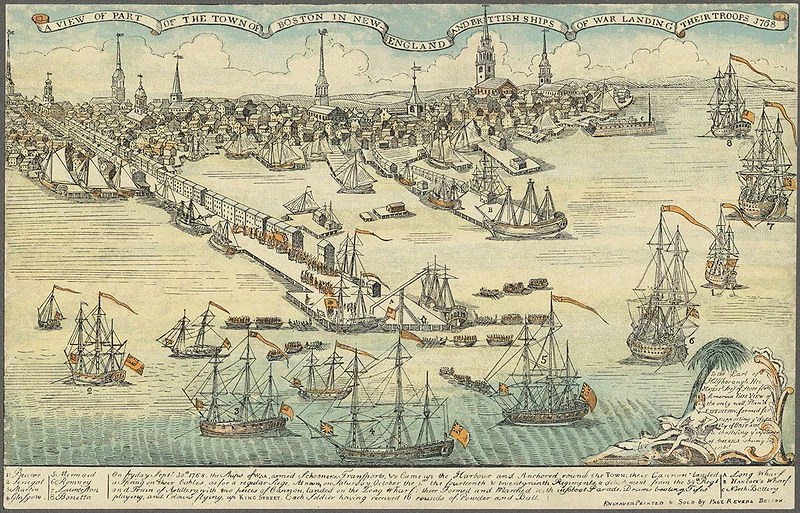
The British Disembarking at Boston’s Long Wharf, 1768
These key events bring us to this week, 250 years ago, when British forces evacuated Boston. Thousands of British soldiers, derided as “lobsterbacks” or “bloody backs” by the colonists, had occupied the city since 1768. The Continental Army, including Rhode Island forces led by Nathanael Greene, had besieged the British forces since April 1775. It had finally succeeded in occupying the high ground on Dorchester Heights, threatening the city and the entire British fleet. On March 17, 1776, the final British forces departed from Boston.
Americans were jubilant; this was a genuine strategic victory.
A retired educator, Fred Zilian is offering a slate of lectures on the American Revolution over the next four months. See: pegasusenrichment.com.


 Zilian Commentary